| Author |
 Replies: 132 / Views: 34,364 Replies: 132 / Views: 34,364 |
|
|
|
Rest in Peace
7742 Posts |
|
|
nitrolures...This is getting too confusing for me, so I will back out of this post before I embarrass myself any more and let you experts come to a final conclusion (But, I will be watching in the background). |
Send note to Staff 
|
|
|
Rest in Peace
Canada
5701 Posts |
|
|
Thank you for correcting me Puzzler; left vertical column is correct. I said vertical row  ...  Sorry for the confusion. |
|
Send note to Staff
|
|
|
|
Rest in Peace
Canada
5701 Posts |
|
|
Valued Member
Canada
450 Posts |
|
|
The book Canada's Postage Stamps of the Small Queen Era, 1870-1897, uses the terminology "vertical row" to refer to what I would normally call a "column". |
|
Send note to Staff
|
|
|
Pillar Of The Community
Canada
2277 Posts |
|
|
Studystamps- Does that book have color illustrations /varieties . Sounds like that would be the small queen bible and may be the one to have. |
|
Send note to Staff
|
|
|
Rest in Peace
Canada
5701 Posts |
|
|
Valued Member
Canada
450 Posts |
|
|
It is full colour (or at least 99.9%).
Here is the table of contents:
Chapter One: The Printers 1
Historical background -- formation of the British American Bank Note Company
-- the printing contract proposals and counter-proposals -- Large and Small Queen characteristics -- printing locations chronology -- the printer's competition
Chapter Two: Preparation of the Series 9
The design -- production steps from master die to finished sheet -- plate layouts
-- imprints -- glossary of terms used to describe plate varieties -- papers -- watermarks
-- inks -- gum -- perforations and background development
Chapter Three: Essays and Proofs 27
The 1868 trade sample sheet -- essays & proofs -- listings and explanation of the different terms -- specimens -- defaced plates -- unofficial "essays"
Chapter Four: Ottawa 1870–1873 37
The 1867 Post Office Act -- expansion of the Dominion -- the first Small Queens: colours, shades perforations, paper, gum, and major re-entries -- the removal to Montreal
Chapter Five: Montreal 1873–1889 49
Developments in the postal service -- the 1875 Post Office Act -- new Small Queen values and one Large Queen -- the General Postal Union -- shades, perforations, paper, gum, and plates -- varieties -- bisects -- back to Ottawa
Chapter Six: Ottawa 1889–1897: The Final Stages 59
The rate changes of 1889 and 1893 -- amendments to registration rules -- new values
-- shades, perforations, paper, gum, plates -- varieties -- imperforates -- specimens
-- bisects -- the finale
Chapter Seven:
The Canada Bank Note Engraving & Printing Company Essays 71
Rationale and history -- competition with the British American Bank Note Co. -- die and plate essays
Chapters Eight to Seventeen include tables of the plates used, and describe the characteristics, perforations in chronological order, paper, number issued, uses, proofs, shades, and known, major varieties.
Chapter Eight: The Half Cent Value of 1882 81
Aspects and main uses of Canada's smallest postage stamp issued to date -- perforation problems peculiar to the value
Chapter Nine: The One Cent Value of 1870 89
Thorough analysis of the first Small Queen designed -- the "Strand of Hair" varieties, etc.
Chapter Ten: The Two Cents Value of 1872 103
In-depth examination of the denomination -- the "latent entries"
Chapter Eleven: The Three Cents Value of 1870 117
Details the first issued Small Queen
Chapter Twelve: The Five Cents Large Queen Value of 1875 131
The emergency issue -- why it was issued
Chapter Thirteen: The Five Cents Value of 1876 137
The "Preferred Rate" stamp
Chapter Fourteen: The Six Cents Value of 1872 147
Possibly the most enigmatic of all the Small Queens - the "A" plate controversy
-- the Five Cents/Six Cents varieties -- the major re-entries, etc.
Chapter Fifteen: The Eight Cents Value of 1893 171
Its dual purpose -- puzzling aspects of the value and its four plates
Chapter Sixteen: The Ten Cents Value of 1874 179
The colourful value!
Chapter Seventeen: The Twenty Cents and Fifty Cents Values of 1893 189
Basis of the design, etc.
Chapter Eighteen: Imperforate Printings 195
Origin -- commentary on each denomination
Chapter Nineteen: Cancellations: A Short Guide 203
Regulations relating to postmarking -- types of postal cancellations
-- fakes and forgeries -- bibliography of relevant works
Appendices 215
A Registration 215
B Rates of Postage 219
C Quantities of Small Queens Issued 22
D Position Dots 224
E Way Letters 225
F Plate-Destruction Records 227
Bibliography 231
Index 233
|
|
Send note to Staff
|
|
|
Rest in Peace
Canada
5701 Posts |
|
|
Valued Member
Canada
80 Posts |
|
|
Rest in Peace
Canada
5701 Posts |
|
|
In this thread, https://goscf.com/t/17809#161734 I speculated that the stamp below was a 37, but I thought the colour was a bit close to vermillion (#41). 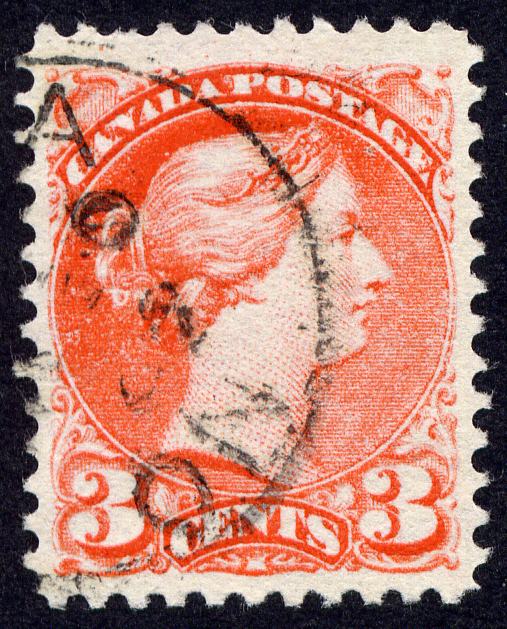 However, I think I found a dot; not at the bottom, but at the top! Perhaps the dot is lower than normal so that a perforation shift would make it appear on the top? I do know that perforations sometimes cut out the dot entirely. Any thoughts? 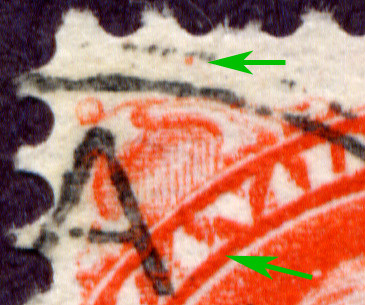 Also notice there appears to be a re-entry at the A and N of Canada? |
|
Send note to Staff
|
|
|
|
Rest in Peace
7742 Posts |
|
|
BeeSee...I thought all the dots were closer to the left edge of the stamp design as this one below...Yours seems to be inward, I wonder if it may be part of a re-entry stamp...??? 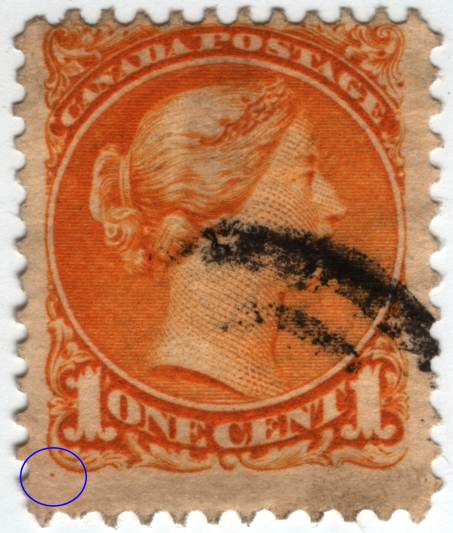 |
|
Send note to Staff
|
|
|
Rest in Peace
Canada
5701 Posts |
|
|
I agree Wert - but the dots do move around; 90 stamps in the sheet have them and I wonder if anyone has seen any extreme positioning of them. |
|
Send note to Staff
|
|
|
|
Rest in Peace
7742 Posts |
|
|
Quote:
I wonder if anyone has seen any extreme positioning of them. That is an interesting question BeeSee. Wonder if anyone else has input to that question...??? |
|
Send note to Staff
|
|
|
Pillar Of The Community
Canada
2277 Posts |
|
|
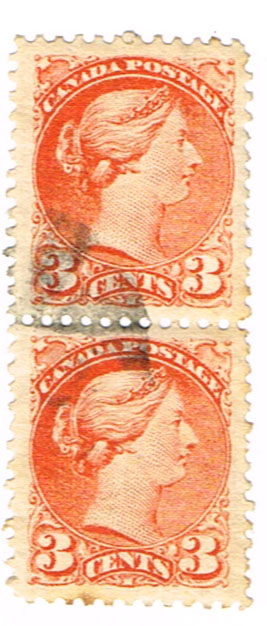
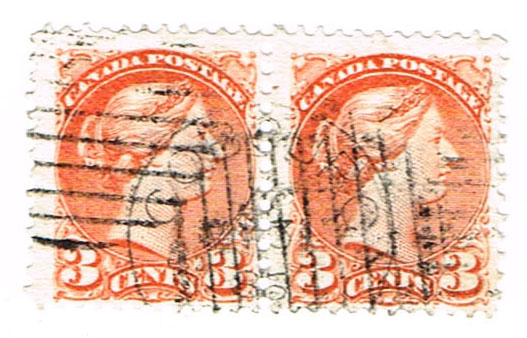
Very possible that misperfing could account for change in dot positionions. As shown with my pair even 2 stamps side by side can be misalligned from the plate itself.
I would definatly say that Bee See's stamp is a true re entry as well. You can check ralphs site and see if its listed and if not he always appreciates submissions . Can't tell looking at other areas if there are other signs of doubbling but that is pretty extreme on the A and N .
I did numerous searches for that book studystamps mentioned and only the greene foundation has it. Interesting note that only 250 were printed and at $150 it may be worth the investment as a true rarity in collecting. Even if it goes into second printing the first will be rare. |
|
Send note to Staff
|
|
|
Pillar Of The Community
Canada
2277 Posts |
|
|
Here are the 6 I posted earlier that arrived today. Scan is 1200dpi Using my computer perf I noticed - from left to right top to bottom. 1-12.4?x12.4?, 2-12.4?x12.1?, 3-12x12, 4-12.25x11.75, 5-12.25x12.4?, 6-12.25x12. That is left side and top perfs. Bee See can you auto cad #1-2-5 ? I fully trust the autoad method more than anything I have including my eyesight. If not no problem but I don't want to peroxide anything I potentially should leave well enough alone. Can tell extreme oxidation on a couple but others seem to be very consistant copperish color.  |
|
Send note to Staff
|
|
|
Replies: 132 / Views: 34,364 |
|




 Posted 02/07/2012 10:10 pm