| Author |
 Replies: 132 / Views: 34,373 Replies: 132 / Views: 34,373 |
|
|
|
Rest in Peace
Canada
5701 Posts |
|
|
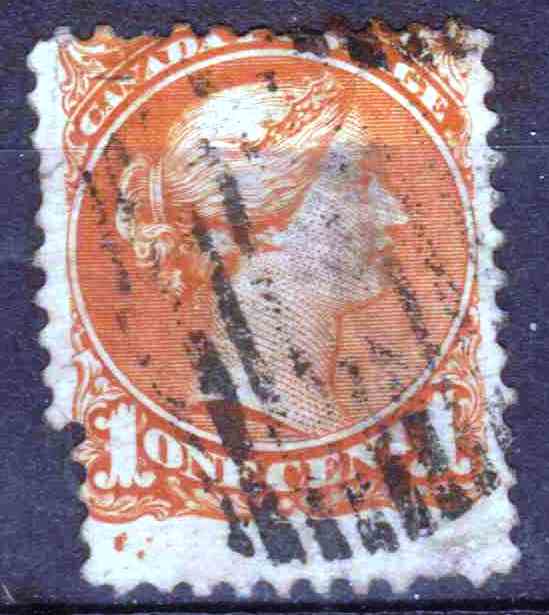
It gets even more complicated! As I said, I had been bringing the stamps into AutoCad and "calibrated" the image by scaling the stamp horizontally and/or vertically to fit and exact known size of the stamp. However, that was based on measuring the width of the outer circle, which is always 17.4 (rounded from 17.35) on my stamps. I assumed the height of all the stamps was the same. Well how wrong I was ! It turns out there are two (or more?) different heights. I scanned the two #41 (2nd ottawa) stamps below side by side in the same image, because when I measured the height with a ruler I could see an obvious difference.  The stamp on the left is 0.4mm taller! The image is from Paint Shop Pro and it has the grid and rulers set to millimetres. I cut and pasted the stamps side by side. Now the question is whether the stamp on the right shrunk in one direction, or is it a different plate or different size for another reason? If it has shrunk, did it shrink before or after the perforations were applied? If it shrunk after perforating, then the perforations shrunk too, and that would mean vertically we could be getting false readings by as much as 1/2 a perforation, since the perforations are about 0.8mm in diameter. My brain is hurting, I think I am getting small queen overload...  |
Send note to Staff 
|
|
| Edited by BeeSee - 02/25/2012 11:39 am |
|
|
Rest in Peace
Canada
5701 Posts |
|
|
Pillar Of The Community
Canada
2277 Posts |
|
|
Hold the fort!! Bee isn't the stamp on the left the one with suspected re-entry? Looks like it in Canada for sure. Possible the re-entry is accounting for the stretch factor? |
|
Send note to Staff
|
|
|
Rest in Peace
Canada
5701 Posts |
|
|
No re-entry, I got an email back from Ralph:
What you have here is a dry print, wherein the stack of dampened paper was allowed to dry out somewhat before printing and the ink was no longer able to properly adhere to the paper, remaining in the engraved lines of the plate, leaving these white areas. These are quite common on the Small Queens, and particularly the 3c value.
...but it could be the cause of the larger size... |
|
Send note to Staff
|
|
| Edited by BeeSee - 02/25/2012 12:09 pm |
|
|
Valued Member
Canada
382 Posts |
|
|
Hi everybody. I think you are reading too much into Small Queens and thereby complicating an already complex issue. There is only one master die for each value and all plates were entered or re-entered from the master. All stamps, therefore, have the same size image.
When I began my study of Small Queens many years ago, I was just as dazzled and confused as the next guy. Having looked at and measured thousands of these stamps, I evolved the chart that is shown on page 55 of the Unitrade catalogue. The chart was originally done as an exercise in demystifying Small Queens for my home stamp club.
I strongly recommend that students of Small Queens simplify their approach to the subject. Get a Kiusalas perf gauge and a Stanley Gibbons "Instanta" gauge (the yellowed one if possible). If you want the best book on the subject, order a copy of the Hillson & Nixon book published by the Greene Foundation - it is expensive, but worth every cent you pay.
GJP |
|
Send note to Staff
|
|
|
Pillar Of The Community
Canada
2277 Posts |
|
|
GJP A very big thank you for your contributions to the catalog as well as the study itself.
The master die for all plates is a helpful pc of information .
As much as we may be batting things back and forth and likely confusing some of the issues alot of this is trying to implement new precise computer programs into the older (yet honored) world of perf gauges. Its been noted the differences and tolerences between the kiusalas old instanta and new instanta gauges yet using the auto CAD program and the calculation of perf holes across 20mm should or could lead to the ultimate in precision . Thats not to say it will be accepted in the near future but will gradually raise questions and if nothing else generate some interesting comparisons.
Thanks again for your contributions to this great hobby/passion/ obsession. |
|
Send note to Staff
|
|
|
Rest in Peace
Canada
5701 Posts |
|
|
Thanks for your post gportch, most interesting!
This brings up two questions:
1) So the stamps do shrink in the drying process?
2) On page 55 in your table, the 1st Ottawa printing is listed as 65 Kiusalas, but is commonly listed by Hillson as perf between 11.85 and 11.89. I can confirm that my 2 copies measure 11.87. Should that not be 66 on the Kiusalas gauge, as 65 is perf 12.1 according to the Gibbons Gauge. Most of my Montreal stamps are around 12.1
|
|
Send note to Staff
|
|
|
|
Valued Member
Canada
379 Posts |
|
|
Very interesting discussion...  I am in the process of measuring 50+ of Small Queens (1c, 3c)and very confused by the color reference, the measures I get and the literature's including tables of reference... For example, what I truly believe to be a 3c vermilion (#41), apparently is not a #41 because I get a measurement over 12 x 12 like 12 1/4 x 12 1/4, 12 x 12 1/4 (using a Lighthouse Stamp Perforation Gauge Model ZS) So far, the only trusty references is based on the serious literature like the "Small Queen Identification Table" on page 55 of the Unitrade 2012 and all other studies involving hours of studies, discussions, research... a lot of handwork, but... ...what I have red so far in this topic, we have, I truly think, a study that is about to shake the columns of the temple. What if the modern way of measuring the perforation (Computer software like AutoCad) demonstrate that all the handwork that was done was wrong enough to oblige a return to the deskwork with modern facilities this time...   |
|
Send note to Staff
|
|
|
Pillar Of The Community
Canada
1416 Posts |
|
|
I wonder if one of the above expert with electroninc perf can do a test and inform us, here on the forum of how does the perf of the various perforastion gauges do vs computer? The way to do it would be to scan a guage, then select a few rows and computer verifies the gauge itself? |
|
Send note to Staff
|
|
|
Rest in Peace
Canada
5701 Posts |
|
|
Pillar Of The Community
Canada
2277 Posts |
|
|
Using the information provided thus far -- we have a single die for however many plated were made from it. This means there is a control as in the image itself should remain constant ( Bee's example having a slightly larger image is still up for concern ) but we can say with a pretty high % of certainty the image size is constant. With that information and the proper software it is mathematically possible to be accurate to 3-4 decimal places. The E gauge I use is a clear instanta gauge that has been scanned and calibrated by many far more knowledgeable than myself- (I forget the guys name who sent me this to continuously than him.) When Bees measurements and images are confirmed by my own calibrated method its hard to argue but I believe the genrally accepted practises within the hobby at least for now rule out a higher more accurate method. Possibly a pandoras box for catalog writters and long time study groups but evidence is hard to refute. The problem is there are examples where the proverbial box was opened along time ago such as unitrade 26a 5c large queen listed as 12x12 with the following notation below "The perf variety on 25(a)must measure at least 12.1 on all sides" Also unitrade 29c " a variety of 29c is known as perf 11.5x12 is really perf 11.8x12 and is scarce" With known varieties that go into 1/10th of a perf and values for these items being in the $1000+ range it only goes to show that a more accurate than manual perf gauge either is or has been used. Since there is a mathematical formula for perfs it is only reasonable that that formula can be taken to a higher decimal place and be more accurate than the human hand and eye.
I don't want to introduce large queens into this topic but I believe I have the 5c variety as well as a 15 c that is over 12x12 on all sides . By eye I never would have believed the 5c variety but with the computer gauge I can zoom to be extremely accurate. I would hate to think if submitted for a cert that someone would rely on a manual perf gauge for that type of measurement. |
|
Send note to Staff
|
|
|
Pillar Of The Community
Canada
1084 Posts |
|
|
Koala: as you check through your queens would you also look to see if you have an Orangeville, Ontario cancel on any of them. Thanking you in advance I remain ....Cynical |
|
Send note to Staff
|
|
|
Pillar Of The Community
Canada
1416 Posts |
|
|
Thanks BeeSee. Fascinating. (I go to the BRCstamp site regularily but I must have missed the sq link before.
Thanks again |
|
Send note to Staff
|
|
|
Rest in Peace
Canada
5701 Posts |
|
|
Gilles, that page was just added a few days ago, and the only link is from here so far. It is just "beta" now. |
|
Send note to Staff
|
|
|
|
Pillar Of The Community
Canada
1416 Posts |
|
|
Replies: 132 / Views: 34,373 |
|




 Posted 02/25/2012 11:37 am