| Author |
 Replies: 66 / Views: 33,807 Replies: 66 / Views: 33,807 |
|
|
|
Pillar Of The Community
Australia
1865 Posts |
|
|
Pillar Of The Community
7838 Posts |
|
|
Here is an image of a stamp depicting Pegasus among the stars, designed by Swiss graphic artist and illustrator Eric Poncy (1903-1983), engraved by Karl Bickel, and issued by Switzerland on September 16, 1957 for use by the International Bureau of the UPU, Scott No. 9O8, SG No. LP8. - nethryk  |
Send note to Staff 
|
|
|
Pillar Of The Community
7838 Posts |
|
|
The ancient city of Ephesus (near modern Selçuk, Izmir Province, Turkey) was famed for the Temple of Artemis (completed around 550 BC), one of the Seven Wonders of the Ancient World. But the Ephesus goddess Artemis, sometimes called Diana, is not quite the same figure as was worshiped in Greece. While the Greek Artemis was the goddess of the hunt, the Ephesus Artemis was a goddess of fertility and was often pictured as draped with eggs or multiple breasts, symbols of fertility, from her shoulders to her waist. Here is an image of an engraved stamp depicting a statue of Artemis of Ephesus, designed by Italian artist Vittorio Grassi (1878-1958), and issued for use in the Italian colony of Libya in 1921, Scott No. 25, SG No. 27, plus an image of an 18th century engraving of a Roman marble copy of a Greek replica of a lost Geometric period xoanon (Archaic wooden cult image) of Artemis of Ephesus, now in the Vatican Museum. - nethryk   |
|
Send note to Staff
|
|
|
Pillar Of The Community
7838 Posts |
|
|
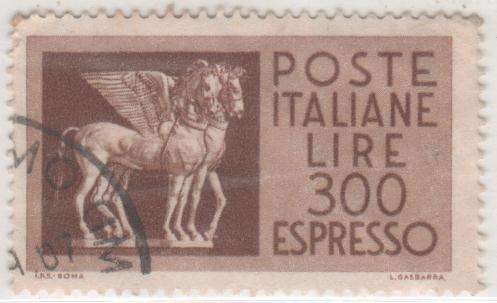
Here is an image of an engraved special delivery stamp which I have tentatively identified as depicting Iris, who in Greek mythology is the winged personification of the rainbow and messenger of the gods, along with the team of four white, fire-breathing, winged horses which pulled the chariot of Helios (the personification of the Sun) across the sky. The horses were named, according to Eumelus of Corinth (a semi-legendary early Greek poet), as follows: "Eous; by him the sky is turned. Aethiops, as if faming [sic], parches the grain. These trace-horses are male. The female are yoke-bearers: Bronte, whom we call Thunder, and Sterope, whom we call Lightning." This stamp was issued by Spain in 1934, Scott No. E14, SG No. E17. - nethryk  |
|
Send note to Staff
|
|
|
Pillar Of The Community
7838 Posts |
|
|
Here is an image of a Europa stamp depicting the Greek god Pan playing his flute, designed by French illustrator Christian Broutin (1933- ), layout by Charles Bridoux, printed by photogravure, and issued by France on June 15, 1968 to commemorate the Fête de la Musique, also known as World Music Day, celebrated annually on June 21, Scott No. 2644, Y&T No. 3166. - nethyrk  |
|
Send note to Staff
|
| Edited by nethryk - 07/10/2012 4:33 pm |
|
|
Pillar Of The Community
7838 Posts |
|
|
In Greek tradition, a sphinx is a mythical creature with the haunches of a lion, the wings of a great bird, and the face of a woman. She is characterized as treacherous and merciless, devouring all those who cannot answer her riddles. Here is an image of a stamp depicting a sphinx, engraved and printed by Perkins, Bacon & Co., and issued by Panama on July 24, 1934 as one of six stamps commemorating the 25th anniversary of the National Institute, Scott No. 270, SG No. 399, plus a detail image of the sphinx. The quoted passage on the stamp, "Only those who build upon ideas build for eternity," written by American essayist, lecturer, and poet Ralph Waldo Emerson (1803-1882), and translated into Spanish, is inscribed on a plaque outside the school, near the two sphinxes guarding the gates. - nethryk   |
|
Send note to Staff
|
| Edited by nethryk - 07/16/2012 10:11 am |
|
|
Pillar Of The Community
7838 Posts |
|
|
In Greek mythology, Anteros was the god of requited love, literally "love returned" or "counter-love" and also the punisher of those who scorn love and the advances of others, or the avenger of unrequited love. According to some traditions, Anteros was the brother of Eros, the Greek god of love. Physically, Anteros is depicted as similar to Eros in every way, but with long hair and plumed butterfly wings. He has been described also as armed with either a golden club or arrows of lead. Here are images of two semi-postal stamps designed by James Berry after an aluminum statue (1893) of Anteros as the "Angel of Christian Charity," sculpted by English sculptor Sir Alfred Gilbert (1854-1934), which surmounts the Shaftesbury Memorial fountain at Piccadilly Circus in London, engraved and printed by Waterlow & Sons, Ltd., and issued by New Zealand on October 1, 1947, Scott Nos. B30 & B31, SG Nos. 690 & 691, plus a photo of Gilbert's statue. - nethryk    |
|
Send note to Staff
|
| Edited by nethryk - 07/31/2012 10:43 am |
|
|
Valued Member
Bahamas
404 Posts |
|
|
Valued Member
Bahamas
404 Posts |
|
|
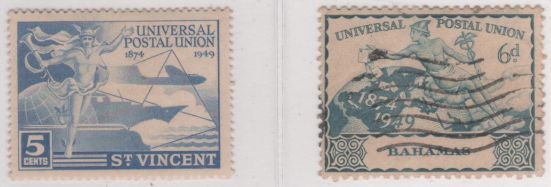
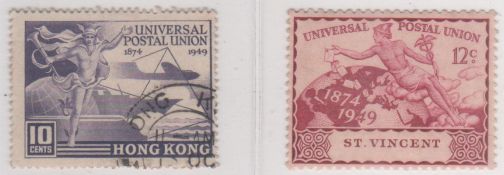
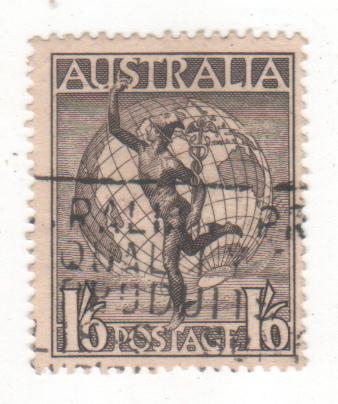
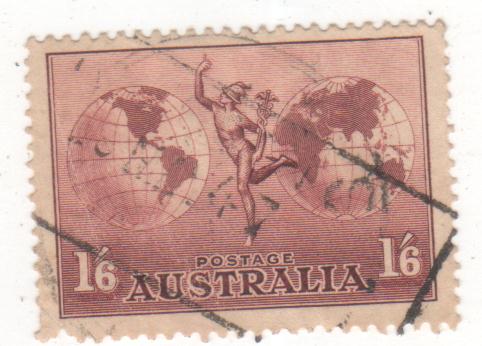
Mercury(MUR-cyoor.ree) Roman name of Hermes "The Wing Messenger". I got mail.  |
|
Send note to Staff
|
|
|
Valued Member
Bahamas
404 Posts |
|
|
Valued Member
Bahamas
404 Posts |
|
|
Valued Member
Bahamas
404 Posts |
|
|
Pillar Of The Community
7838 Posts |
|
|
Here is an image of a semi-postal postage due stamp depicting Icarus, printed by typography, and issued by Brazil on November 15, 1947 to benefit "Aviation Week," Scott No. RAB1. - nethryk  |
|
Send note to Staff
|
| Edited by nethryk - 10/05/2012 08:25 am |
|
|
Pillar Of The Community
Romania
886 Posts |
|
|
Pillar Of The Community
7838 Posts |
|
|
Here is an image of an airmail stamp depicting Pegasus in flight, engraved and printed by Waterlow & Sons, Ltd., and issued by Uruguay on July 25, 1930, Scott No. C33. - nethryk  |
|
Send note to Staff
|
|
|
Replies: 66 / Views: 33,807 |
|



 Posted 02/23/2012 01:13 am