| Author |
 Replies: 145 / Views: 89,310 Replies: 145 / Views: 89,310 |
|
|
|
Pillar Of The Community
Canada
2574 Posts |
|
|
Europa 1981 Folklore Guernsey 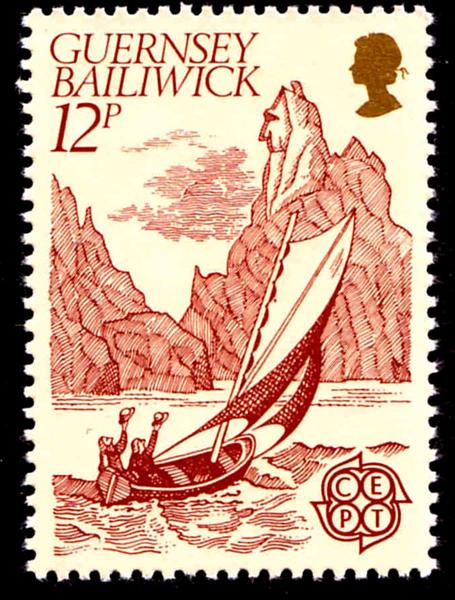 A folk legend that is narrated in Le Petit Bon Homme Andriou in Guersney is about the Archdruid, the last person to convert to Christianity. Druid was not willing to convert to Christianity when all his fellow people had already done so. He, therefore, decided to retire to a secluded cave in the cliff of Jerbourg Point. From this point, as was his regular habit to watch the sea during severe storm, he saw a ship at a distance approaching, heaving heavily towards the rocks of the peninsula to its utter doom. Druid, frightened by this scene, offered prayers to his pagan gods to save the ship and its passengers. As the gale did not abate and the crash became imminent, he prayed to the Christian God with a vow that if the ship was saved he would convert to Christianity and would build a chapel for the Virgin Mary, the Mother of God. As providence would have it, the storm abated and the disaster of ship wrecking against the Jerbourg Peninsula was averted. 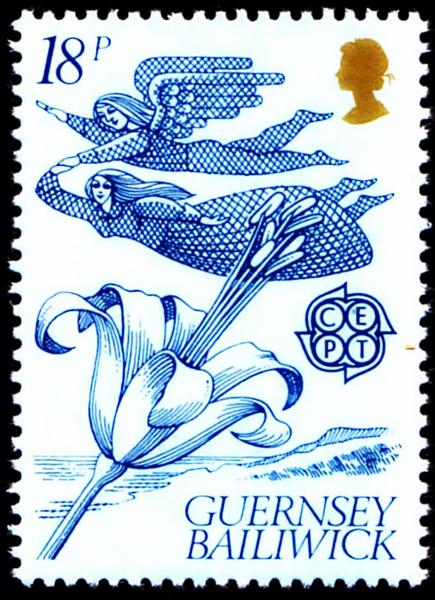 A native of South Africa, there has long been speculation about how Nerine Sarniensis, or the Guernsey lily, came to the island. The most popular explanation – and certainly the most interesting story – is that it stems from the 17th century, when a ship carrying some bulbs and thought to be going from Japan to the Netherlands, was wrecked on our shores and the bulbs flourished in the sand. The overwhelming lack of flowers on beaches would suggest that this is a folk tale, rather than a fact, but it is an entertaining and romantic idea. |
Send note to Staff 
|
| Edited by timbres667 - 09/21/2013 11:58 am |
|
|
Pillar Of The Community
7838 Posts |
|
|
timbres667 - Terrific post! Thanks for sharing. Here are images of the three stamps in a set depicting key scenes from the Japanese folktale "Paradise for the Mice," printed by photogravure, and issued by Japan on April 15, 1975, Scott Nos. 1208-10. - nethryk Old Man feeding Mouse  Old Man following Mouse underground  Mice entertaining Old Man and bringing gifts  |
|
Send note to Staff
|
|
|
Pillar Of The Community
7838 Posts |
|
|
Here are images of the six stamps in a set illustrating Slovak folk tales, designed by Slovak painter and graphic artist L'udovít Fulla (1902-1980), combined engraved and photogravure, and issued by Czechoslovakia on December 16, 1968, Scott Nos. 1594-99. Lots of topical bonuses in this lot! - nethryk "Cinderlad," engraved by Jindra Schmidt.  "The Proud Lady," engraved by Bedrich Housa.  "The Ruling Knight," engraved by Jan Mrácek.  "Good Day, Little Bench," engraved by Ladislav Jirka.  "The Spellbound Castle," engraved by Jindra Schmidt.  "The Miraculous Hunter," engraved by Bedrich Housa.  |
|
Send note to Staff
|
| Edited by nethryk - 10/04/2013 08:37 am |
|
|
Pillar Of The Community
7838 Posts |
|
|
Here are images of the four stamps in a set illustrating scenes from the Faroëse Ballad of Brynhild (from Sigurd's lays, 14th century), designed by Faroëse artist Anker Eli Petersen (1959- ), printed by lithography, and issued by Faroe Islands on February 23, 1998, Scott Nos. 332-35, Facit Nos. 328-31, plus a link to an English translation of the ballad: http://odins-gift.com/pclass/thebal..._dampier.htm- nethryk King Budli and his daughter, Brynhild.  Sigurd and the Wall of Fire.  Sigurd and Brynhild.  Guthren leading the Horse.  |
|
Send note to Staff
|
| Edited by nethryk - 10/14/2013 09:11 am |
|
|
Pillar Of The Community
7838 Posts |
|
|
Here are images of the three stamps in a set depicting Tunisian legends and folktales, designed by Tunisian artist Hatem El Mekki, and issued by Tunisia on August 27, 1984, Scott Nos. 851-53. - nethryk The coquette, the sorceress, and the wicked fairy godmother, Carabosse.  Counting with fingers.  A boy riding a horse.  |
|
Send note to Staff
|
|
|
Pillar Of The Community
7838 Posts |
|
|
Here are images of the eight stamps in a set illustrating scenes from Chinese fairy tales extolling filial piety, printed by lithography on granite paper, and issued by Republic of China (Taiwan) on September 22, 1971, Scott Nos. 1726-33. - nethryk Birds and elephant helping in the field  Son gathering mulberries for his mother  Son gathering firewood  Son, mother and bandits  Son carrying a heavy burden  Son digging bamboo shoots in winter  Man and wife working as slaves  Father, son and carriage  |
|
Send note to Staff
|
|
|
Pillar Of The Community
7838 Posts |
|
|
Here are images of the three stamps in a set illustrating scenes from the 10th-century Japanese folktale Princess Kaguya, or "Tale of the Bamboo Cutter," printed by photogravure, and issued by Japan on July 29, 1974, Scott Nos. 1175-77. - nethryk Discovery of Kaguya-hime in Shining Bamboo  Kaguya-hime as a grown-up beauty  Kaguya-hime and her escorts returning to the Moon  |
|
Send note to Staff
|
| Edited by nethryk - 01/25/2014 11:34 am |
|
|
Pillar Of The Community
7838 Posts |
|
|
According to legend, Tchantchès was a mighty warrior in Charlemagne's army. At the battle of Roncevaux Pass (778), Tchantchès supposedly broke the ribs of three thousand "saracens" (Charlemagne's opponents in this battle have been romanticized into Muslims, but were in reality Basques.) Today Tchantchès is identified with the Belgian city of Liège, and is often represented as a puppet or marionette figure. Here is an image of a semi-postal (charity) stamp depicting Tchantchès wrestling a sword-wielding "saracen," printed by photogravure, and issued by Belgium on June 25, 1944, Scott No. B391. - nethryk  |
|
Send note to Staff
|
| Edited by nethryk - 03/10/2014 11:05 am |
|
|
Pillar Of The Community
7838 Posts |
|
|
Valued Member
452 Posts |
|
|
Pillar Of The Community
7838 Posts |
|
|
Here are images of the two stamps in a Europa set depicting Polish tales and legends, designed by Polish graphic artist Mieczys#322;aw Wasilewski (1942- ), printed by lithography, and issued by Poland on May 5, 1997, Scott Nos. 3338 & 3339. Note: In Slavic mythology, a rusalka (plural: rusalki) is a female ghost, water nymph, succubus, or mermaid-like demon that dwells in waterways. In the middle of the night, rusalki come out of the water and dance in the meadows. Handsome men passing by are enchanted by rusalki songs and dancing, and are then led away by the rusalki to the river bottom and to their deaths. - nethryk   |
|
Send note to Staff
|
|
|
Pillar Of The Community
United Kingdom
1187 Posts |
|
|
Isn't Monaco criticised for producing stamps for collectors rather than postal use, but what beautiful artwork and design on those stamps.
Terry |
|
Send note to Staff
|
|
|
Pillar Of The Community
7838 Posts |
|
|
Terence Collins - I'm glad you also like the Monaco stamps posted above. Their designer, French artist Pierrette Lambert (1928- ), is one of the best in the business, in my opinion. Here are images of the eight stamps in a set illustrating some of Aesop's Fables, printed by lithography, and issued by Greece on March 5, 1987, Scott Nos. 1581-88. - nethryk The Fox and the Grapes  The North Wind and the Sun  The Stag and the Lion  Zeus and the Snake  The Crow and the Fox  The Woodcutter and Hermes  The Ass in the Lion's Skin  The Tortoise and the Hare  |
|
Send note to Staff
|
| Edited by nethryk - 06/05/2014 09:04 am |
|
|
Pillar Of The Community
7838 Posts |
|
|
The Pied Piper of Hamelin (German: Rattenfänger von Hameln, "Rat-Catcher of Hamelin") is the subject of a legend concerning the departure or death of a great number of children from the town of Hamelin (Hameln), Lower Saxony, Germany, in the Middle Ages. The piper is a rat-catcher hired by the town to lure rats away with his magic pipe, but when the citizenry refuses to pay for this service, he retaliates by turning his power that he put in his instrument on their children, leading them away as he had the rats. Here is an image of a stamp depicting the Pied Piper leading the children away, designed by German artist Günter Jacki (1936- ), printed by lithography, and issued by Germany on May 22, 1978, Scott No. 1273, Michel No. 972. - nethryk  |
|
Send note to Staff
|
|
|
Pillar Of The Community
7838 Posts |
|
|
In a tradition dating from the 16th century, the town of Cassel, a commune in the arrondissement of Dunkirk, commemorates legendary giants in an annual procession. One of the town's two giants is Reuze-Papa ("Father Giant"), who is depicted as a bearded man wearing a Roman-style breastplate and helm. Here is an image of a stamp depicting Reuze-Papa, the Dunkirk lightship Le Sandettié, and the Church of Saint-Éloi, designed and engraved by André Lavergne, and issued by France on May 29, 1998 to publicize the 71st Congress of the Federation of French Philatelic Associations, held in Dunkirk, Scott No. 2662, Y&T No. 3164, plus a photo of the current 6.25 m (20.5 ft) tall effigy of Reuze-Papa, created in 1827. - nethryk   |
|
Send note to Staff
|
|
|
Replies: 145 / Views: 89,310 |
|



 Posted 09/21/2013 11:50 am


