| Author |
 Replies: 145 / Views: 89,315 Replies: 145 / Views: 89,315 |
|
|
|
Pillar Of The Community
7838 Posts |
|
|
Die Bremer Stadtmusikanten ("The Town Musicians of Bremen") is a German folktale recorded by the Brothers Grimm. In the story a donkey, a dog, a cat, and a rooster leave their farm homes and travel together, eventually foiling a robbery and living happily ever after in an abandoned cottage. Here is an image of a stamp depicting a scene from the folktale in which the animals scare the robbers away by standing on each other and making a din, designed by German artist Elisabeth von Janota-Bzowski (1912-2012), printed by lithography, and issued by Germany on January 13, 1982, Scott No. 1368, Michel No. 1120, plus a photo of a bronze statue by German sculptor Gerhard Marcks (1889-1981) depicting the Bremen Town Musicians erected in 1953 in Bremen, Germany. Note that the donkey's front hooves have become shiny, as touching them is said to make wishes come true.  - nethryk   |
Send note to Staff 
|
| Edited by nethryk - 08/06/2014 11:59 am |
|
|
Pillar Of The Community
7838 Posts |
|
|
Here are images of the four stamps in a set depicting steps in the Abakwetha, the traditional Xhosa manhood initiation ceremony, designed by A.H. Barrett, printed by lithography, and issued by Transkei (South Africa) on January 30, 1979, Scott Nos. 52-55. Chi Cha Youth  Abakwetha in Seclusion  Umtshilo Dance  Leaving the Sutu  |
|
Send note to Staff
|
|
|
Pillar Of The Community
7838 Posts |
|
|
In the folklore of northern France and Belgium, giants are larger-than-life figures representing fictional or real persons. In traditions dating back to medieval times, these giants are brought out onto the streets for annual festivals. Here is an image of a stamp depicting two of these Giants of the North and festival celebrants, designed and engraved by Jean Delpech, and issued by France on February 16, 1980, Scott No. 1695, Y&T No. 2076, plus an image of a photo of the same giants in Douai, Nord-Pas-de-Calais, France. The names of these two giants and the dates of their emergence are: Gayant (1530) and Marie Cagenon (1531). - nethryk   |
|
Send note to Staff
|
| Edited by nethryk - 09/23/2014 07:45 am |
|
|
Pillar Of The Community
Singapore
1054 Posts |
|
|
Singapore 2014 The Attack of the Swordfish or How Bukit Merah came to be. Once upon a time, the local fisher folk were beset by a school of fierce swordfish and people were killed. The villagers seek the help of their ruler, who was helpless, until a bright boy suggested using the trunks of banana trees to build a barricade upon which the swordfish launched themselves and were trapped. The villagers feted the boy, and the ruler became fearful of such unusual intelligence. The ruler ordered the boy to be executed. The boy was killed atop a hill, he bled profusely and his blood stained the hill. Today this place is called Bukit Merah, or Redhill, and this is a real place in Singapore.  |
|
Send note to Staff
|
| Edited by tantsbsac - 10/03/2014 9:42 pm |
|
|
Pillar Of The Community
Singapore
1054 Posts |
|
|
Singapore 2014 Sang Nila Utama or How Singapore got her name. Prince Sang Nila Utama was hunting on the east coast of Sumatra when he sighted the white sands of the distant island of Tumasek. He decided to cross the sea to explore the island. Midway to the island he met with a heavy storm, to save his boat he ordered his men to throw everything overboard; finally he had to even throw his heavy crown into the sea, whereby the storm immediately subsided. Upon reaching the shore of Tumasek, he sighted a regal animal he had never seen before; his advisor told him the animal could be a singa (lion in Sanskrit). The prince was sufficiently impressed by his sighting and decided to settle on the island, renaming it Singapura or Lion City.  |
|
Send note to Staff
|
| Edited by tantsbsac - 10/03/2014 10:09 pm |
|
|
Pillar Of The Community
7838 Posts |
|
|
In Inuit mythology, Sedna is the vengeful goddess of the sea and marine animals. She is often represented as having a fish tail, much like a mermaid. Here is an image of a stamp depicting a soapstone sculpture of Sedna carved by Inuit artist Kiawak Ashoona (1933- ), printed by lithography, and issued by Canada on September 25, 1980, Scott No. 866. - nethryk  |
|
Send note to Staff
|
|
|
Pillar Of The Community
7838 Posts |
|
|
The legend of Die schwarze Frau von Hardegg ("The Dark Woman of Hardegg Castle"), designed by Austrian graphic artist Adolf "Adi" Tuma (1956- ), combined engraved by Werner Pfeiler and photogravure, and issued by Austria on February 19, 1999, Scott No. 1775. The story behind the stamp (in German): http://www.sagen.at/texte/sagen/oes...rzefrau.html- nethryk  |
|
Send note to Staff
|
|
|
Pillar Of The Community
7838 Posts |
|
|
In Maori mythology, Pania of the Reef was a beautiful maiden who lived in the sea. In secret, Pania married Karitoki, the son of a Maori chief, but she explained to him that as a creature of the ocean, she could not survive if she did not return to the sea each morning. When Karitoki treacherously placed a morsel of cooked food into Pania's mouth as she slept in an attempt to force her to stay with him on land, she fled back to the sea and he never saw her again. When people now look deep into the water over the reef, some say they can see Pania with arms outstretched, as if reaching for her former lover. Here is an image of a stamp designed after a statue of Pania of the Reef, printed by photogravure (Harrison & Sons, Ltd.), and issued by New Zealand on November 3, 1958 as one of three stamps in a set commemorating the Hawkes Bay Centennial, Scott No. 323, plus a photo of the 1.5 meter bronze statue, which was unveiled on June 10, 1954 at the Marine Parade, Napier. - nethryk   |
|
Send note to Staff
|
|
|
Pillar Of The Community
7838 Posts |
|
|
Here are images of the two stamps in a fairy tales set, designed by Brazilian artist Jô Oliviera (1944- ), printed by lithography, and issued by Brazil on November 21, 1986 to publicize the LUBRAPEX 86 Philatelic Exhibition, Scott Nos. 2087 & 2088. - nethryk "The Romance of the Mysterious Peacock"  "The History of the the Empress of Porcina"  |
|
Send note to Staff
|
|
|
Pillar Of The Community
7838 Posts |
|
|
Here is an image of a stamp depicting Monkey King from Chinese folklore, printed by lithography, and issued by Nevis on February 16, 2004, Scott No. 1375. - nethryk  |
|
Send note to Staff
|
|
|
Pillar Of The Community
Germany
3028 Posts |
|
|
Pillar Of The Community
Germany
3028 Posts |
|
|
Pillar Of The Community
7838 Posts |
|
|
Here are images of the two stamps in a set commemorating Czech national festivals and holidays, designed by Czech artist Josef Liesler (1912-2005), combined engraved by Josef Hercik and lithography, and issued by Czech Republic on May 5, 1998 as EUROPA stamps, Scott Nos. 3046 & 3047. - nethryk The Ride of the Kings  Wearing masks for Carnival  |
|
Send note to Staff
|
|
|
Valued Member
13 Posts |
|
|
The Heavenly Maiden was a very popular design for several Ryukyu stamps from 1951 through 1961. The legend says a heavenly maiden came down to earth to bathe in a river. A farmer named Okuma saw her and hid her celestial robe from her. When she couldn't find her robe to return to heaven she began crying. Okuma appeared and consoled her then invited her back to his home. She lived with him and they had a son and daughter. Years later the daughter found the robe and gave it to her mother and the heavenly maiden returned to the heavens. The maiden would occasionally fly low to console her grieving children. King Satto is believed to be the son of the Heavenly Maiden. 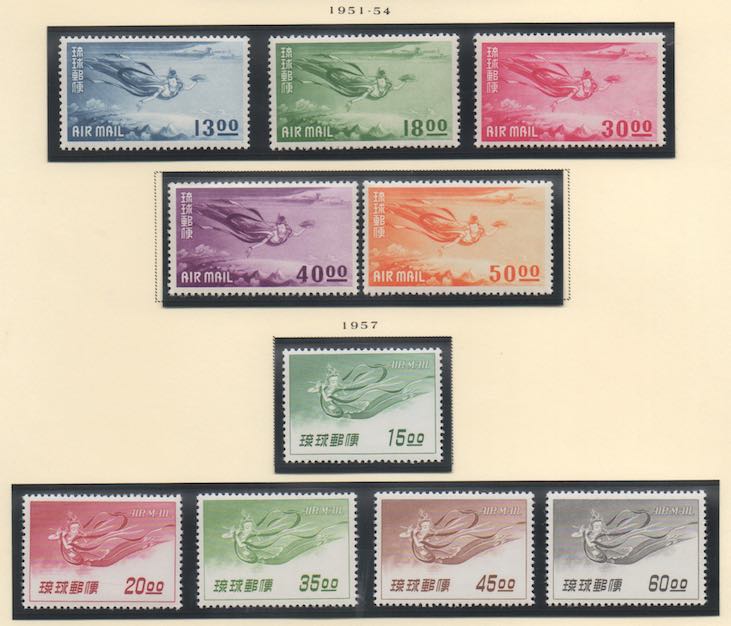 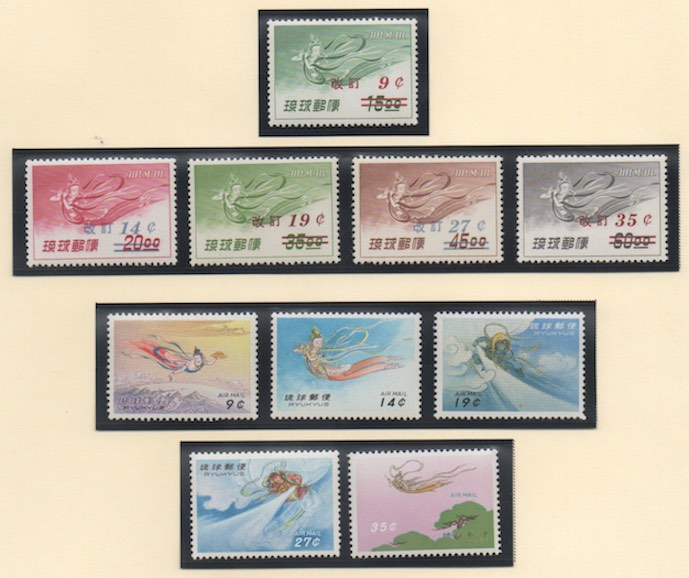 The second image also depicts the God of Wind on the 19c and 27c stamps. |
|
Send note to Staff
|
| Edited by BjRollison - 03/16/2015 2:54 pm |
|
|
Pillar Of The Community
Czech Republic
623 Posts |
|
|
Replies: 145 / Views: 89,315 |
|




 Posted 08/06/2014 09:10 am