In Japanese folklore, a shachihoko is a mythological animal with the head of a tiger and the body of a carp. It was believed that this animal could cause the rain to fall, and as such, temples and castles were often adorned with roof ornaments (shibi) crafted in the form of a shachihoko, in order to protect them from fire. Here is an image of a stamp depicting Nagoya Castle and a shachihoko, printed by photogravure, and issued by Japan (Aichi Prefecture) on August 1, 1989, Scott No. Z9, plus an image of a photo of a shochihoko float used in a Karatsu Kunchi festival.
Here is an image of a stamp honoring the Brothers Grimm (Jacob, 1785-1863, and Wilhelm, 1786-1859), German academics, linguists, cultural researchers, lexicographers and authors who together specialized in collecting and publishing folklore during the 19th century, designed by French artist Pierrette Lambert (1928- ), engraved by Eugène Lacaque (1914-2005), and issued by Monaco on November 7, 1985, Scott No. 1497.
Here are images of the two stamps in a set illustrating scenes from Icelandic folktales, respectively: Luftur the Sorcerer, and the Sea Witch in the Deeps, designed by Þröstur Magnússon, printed by photogravure on granite paper, and issued by Iceland on May 4, 1981 as Europa stamps, Scott Nos. 541 & 542, Facit Nos. 602 & 603.
Schleicherlaufen Festival, designed by Auguste Böcskör, combined engraved by Maria Magdalena Laurent and photogravure, and issued by Austria on January 21, 2000, Scott No. 1805, plus a YouTube link to a video of the 2010 edition of the festival. Bonuses: Flag, dragon, bear.
Here is an image of a stamp depicting the Devil and Billy Goat from the legend of the "Devil's Bridge," designed after original artwork by Swiss painter Heinrich Danioth (1896-1953), combined engraved and lithography, and issued by Switzerland on May 13, 1997 as a EUROPA stamp, Scott No. 998, plus a photo of this illustration at the famous Teufelsbrücke ("Devil's Bridge") over Schöllenen Gorge, which provides access to the St. Gotthard Pass.
Here is an image of a stamp designed after a detail from a painting depicting 19th century carnival revelers by Spanish artist Francisco Hohenleiter y Castro (1889-1968), printed by photogravure, and issued by Spain on February 5, 1986, to publicize the Carnaval de Cádiz, Scott No. 2470, plus an image of Francisco Hohenleiter's original work of art, and a YouTube link to a documentary using newsreels to trace the history of this extravagant community festival, which is celebrated annually for more than two weeks!
Here are images of the two stamps in a set commemorating Spanish regional carnivals, printed by photogravure, and issued by Spain in 1984: Santa Cruz de Tenerife (issued on March 5); and Las Fallas, Valencia, (issued on March 16), Scott Nos. 2363 & 2364.
The Yaqona Ceremony is a solemn traditional Fijian welcoming ceremony featuring the ritual presentation of kava to honored guests. Here is an image of a stamp depicting the presentation phase of a Yaqona ceremony, engraved and printed by Bradbury, Wilkinson & Co., Ltd., and issued for use in Fiji on April 1, 1963, Scott No. 170, plus a relevant photo, and a YouTube link to a Universal-International News newsreel about Queen Elizabeth II's 1963 Royal Tour of Fiji during which she participated in a Yaqona Ceremony.
"Tineke van Heule" is a Belgian folk song about a fictional milkmaid named Eule, lyrics by René De Clercq (1877-1932), and put to music by Emiel Hullebroeck (1878-1965). Here is an image of a stamp depicting Eule, designed by Oscar Hector Bonnevalle (1920-1993), printed by photogravure, and issued by Belgium on September 19, 1983 to commemorate the annual Tineke van Heule Festival, Scott No. 1152, plus a photo of a statue of Eule. Bonuses: Cow, coat of arms (Heule).
Here is an image of a stamp depicting scenes from the adventures of Till Eulenspiegel, a trickster figure originating in Middle Low German folklore, designed by Holger Börnsen, printed by lithography, and issued by Germany on January 13, 1977, Scott No. 1230, Michel No. 922.
Here is an image of a stamp depicting torch bearers at the Falles de Sant Joan ("The Bonfires of Saint John"), a traditional Midsummer festival celebrated annually in Andorra and around the world on the evening of 23 June, St. John's Eve, designed by Pere Canturri (1935-2015), printed by lithography, and issued by Andorra (French Administration) on June 23, 2003, Scott No. 571, plus a YouTube link to an amateur video of the 2015 Falles de Sant Joan, Andorra La Vella.
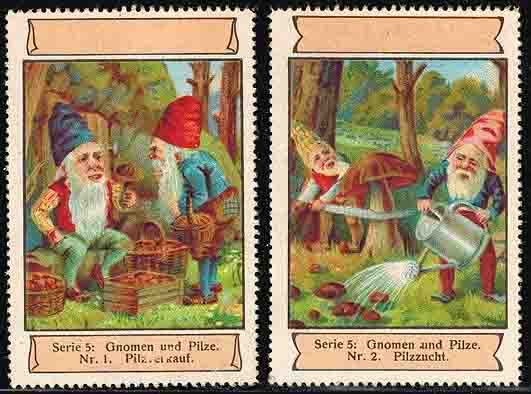
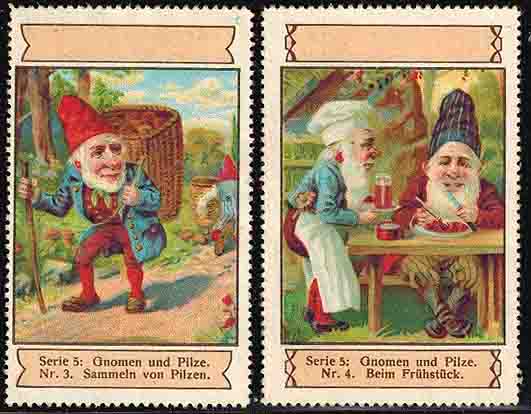
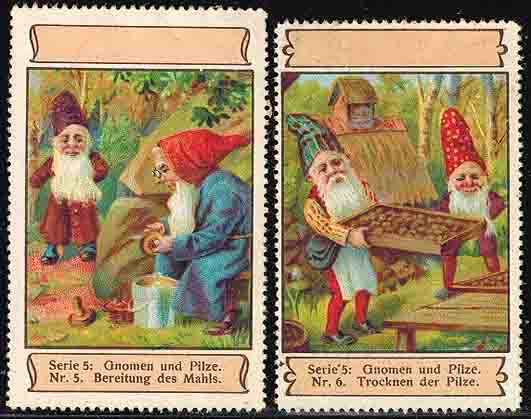
Gnomes and their mushroom industry are depicted on this series of large, old (circa 1900) German labels. According to Wikipedia, "A gnome is a diminutive spirit in Renaissance magic and alchemy, first introduced by Paracelsus in the 16th century...It is typically said to be a humanoid that lives underground." Size of each label is approximately 72mm x 48mm.
Disclaimer: While a tremendous amount of effort goes into ensuring the accuracy of the information contained in this site, Stamp Community assumes no liability for errors. Copyright 2005 - 2026 Stamp Community Family - All rights reserved worldwide. Use of any images or content on this website without prior written permission of Stamp Community or the original lender is strictly prohibited. Privacy Policy / Terms of UseAdvertise Here





 Posted 03/14/2016 09:02 am