Why you should never burn Postal material.........
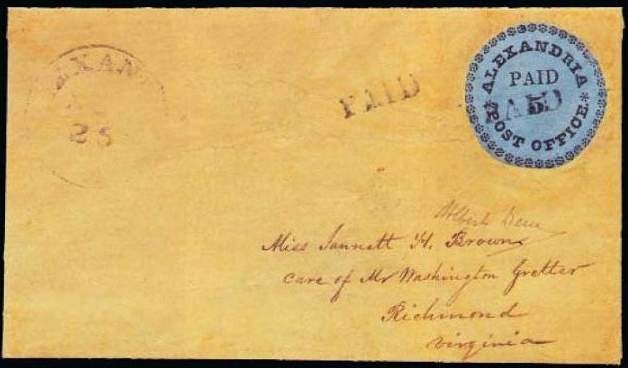
If Jannet had followed her Beau's advice, the US would be deprived of a valuable piece of history, with a lovely ending.
http://www.washingtonpost.com/wp-dy...2402731.htmlThe Envelope / Cover that was re-united with its contents
The Blue Boy
By Theresa Vargas
Washington Post Staff Writer
Thursday, May 25, 2006
In the stamp collecting world, often the tiny square on the outside of an envelope is all
that matters. It is the commodity that is coveted and traded and sold. But for some,
there is the draw of the story behind the stamp -- where it came from, the time it
represents, the printing mistake that alters it just a bit from others like it.
And so it was with the Alexandria Blue Boy -- a stamp that carried a love letter in
1847 between a couple that for many reasons should not have been.
They were second cousins. He was Presbyterian; she was Episcopalian. Relatives were
watching.
One of the rarest stamps in the world, the Blue Boy sold for $1 million in 1981 and is
estimated to be worth many times that now. Still, many wondered why this stamp --
an Alexandria postmaster provisional printed on blue paper before U.S. government
stamps were commonplace -- survived when all others like it were lost or destroyed. If
the envelope had been saved for sentimental reasons, did the letter also exist? If so,
what did it say?
"Did these two people ever get married?" said Gordon C. Morison, executive director
of the Washington 2006 World Philatelic Exhibition, a stamp show on a scale seen in
the United States only once every 10 years.
Last fall, as Morison and others prepared for the exhibition, he wondered out loud
about the Alexandria Blue Boy to May Day Taylor, a fellow philatelist who had
volunteered to help with the show.
"We wondered where the letter was or if it even existed anymore," he said. "I did not
ever expect we'd find the letter. Frankly, that stuff is not saved."
But on that September day Taylor began her search -- one that sometimes consumed
40 hours in a week and regularly took her from her Friendship Heights home to
Alexandria. She started by going through the Alexandria phone book, then sat for
hours in libraries researching dates, genealogies and the history of the postal service.
From the envelope, she had a name: Miss Jannett H. Brown. And she had a general
address: Richmond, Va. What she re-created from there was a time and a place long
gone.
The post office that issued the stamp is now an antique store and the days of
horse-drawn carriages are distant, but Taylor said she could stand at one end of Prince
Street, on the cobblestones that remain, and see the story unfold through her research.
She found that Jannett Hooff Brown lived at 517 Prince St., a few blocks from her
second cousin James Wallace Hooff, who was at 1016 Prince St. They were 23 and 24
years old. In between them lived Daniel Bryan, who was both the postmaster and a
poet, although his verses were considered long-winded and grandiose. He is believed
to have created the Blue Boy, which consists of a circle of 40 rosettes around the
words "Alexandria Post Office." And contrary to previous reports, the Blue Boy stamp
was not used in 1846, but rather in 1847, even after the U.S. government had issued
its own.
"It's that putting together of all the pieces that makes for a beautiful picture, a snapshot
of what it was like in a different day and time," Taylor said.
The break in Taylor's research came when she discovered that Hooff and Brown had
indeed married and that their descendants lived in Alexandria. She visited one day
around Christmastime, hoping to get as many relatives together as possible to discuss
the task at hand: finding the letter.
Waiting for her was an old scrapbook pulled from the basement.
On the first page was a picture of the Blue Boy on the envelope. Then, she saw grainy
photographs of Brown and Hooff, black-and-white prints turned brown over time.
And finally, on the next page, folded in a yellowed envelope with a note identifying it,
was the letter.
In the careful, elaborate penmanship of another era, the letter began with the place and
time. Alexandria, Va. Nov 24th 1847. It was sent to Richmond, where Brown was
visiting relatives. Mostly it tells of family happenings.
There is no marriage proposal.
"Reading the letter evokes different emotions for different people," Taylor said.
"There are some people who read the letter and say it's a wonder they ever had
children. . . . If you are expecting a marriage proposal and something gushy and hearts
and flowers, it's probably going to be a disappointment."
Instead, there is restraint in Hooff's words, an air of distance that only occasionally
allows his emotions to peek through.
"The reasons you give for not writing often, are good, for your cousin Wash. will be
certain to say something, if you give him all your letters, to put in the office," Hooff
writes. "But whenever you think you can write me a line without exciting the attention
of your coz. Wash, do so, for it gives me a great deal of pleasure to receive a letter
from you, even if it is only a short one."
And: "Bye the bye, I believe Aunt Julia has an idea of my writing you; for two or three
days after my first letter to you, she wrote Mother," Hooff writes, adding that his
mother and sisters later referred to Aunt Julia as a "prophet" in front of him. "And
Mother laughingly remarked 'That if there was any love going on Aunt Julia was sure
to find it out,' and while making that remark, I think, looked at me, but I continued
reading, as if what she said did not apply to me in the least." It is signed: "Yours with
the greatest affection, W"
Six years later -- after Aunt Julia left Richmond for Albany, N.Y. -- the two were
married. Eventually they had three children.
Their oldest daughter, Mary Fawcett, who found the envelope in a sewing box, sold it
in 1907 to a stamp collector. Now, almost a century later, the letter and stamp -- on
loan from an anonymous owner who lives in Switzerland -- will be reunited at the
Philatelic Exhibition beginning Saturday at the D.C. Convention Center.
Morison said that even with more than $200 million worth of philatelic items on
display, the Blue Boy story will be the star.
"Many wanted to know how the movie ended," he said.
It ended as it began, with a letter that should have been destroyed.
"Burn as Usual," Hooff had written on the bottom.





 Posted 07/05/2012 10:30 pm


