| Author |
 Replies: 422 / Views: 107,340 Replies: 422 / Views: 107,340 |
|
|
|
Valued Member

Australia
206 Posts |
|
|
Slowly, though, some more unusual species of primates are appearing on stamps. Unfortunately, like all the great apes (which still make up the bulk of representations), the reason is that these species, too, are becoming endagered, such as:  which shows the highly endangered black crested macaque, which occurs only in one small although protected area of the island of Sulawesi, in Indonesia. Indonesia itself includes the species in its 2019 set of flora and fauna:  |
Send note to Staff 
|
|
|
Pillar Of The Community
7838 Posts |
|
|
cobie - So many nice contributions to the thread. Thanks! Barbary macaque ( Macaca sylvanus), printed by photogravure, and issued by Algeria on September 17, 1981, Scott No. 673, plus a photo. -nethryk 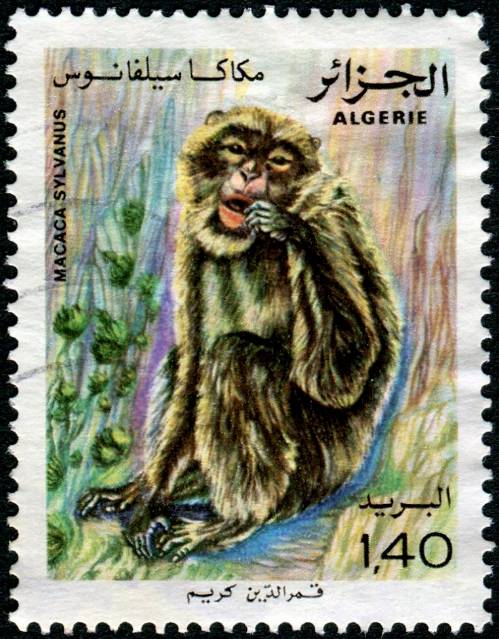  |
|
Send note to Staff
|
|
|
Valued Member
Australia
206 Posts |
|
|
Thanks Nethryk! The Barbary ape (not an ape, but so called because of its lack of tail) lives in the mountains of Morocco, where it is becoming increasingly rare. Rather than an ape, it is a macaque species whose nearest family members live in Pakistan and India, the rhesus monkey; all other macaques live in Asia too so how did Macaca sylvanus get to Morocco? Moreover, the Barbary monkey also occurs in Europe, on the rock of Gibraltar. It is not known how they might have got there but a 2000 Gibraltar stamp from a Millennium issue about Gibraltar's history seems to suggest they may have come with the spread of Islam across the straits, in 711:  However, monkeys are considered unclean by Islam - others have suggested they may have come a pets with Phenician or Carthaginian ships. The species was known in antiquity but I am not aware it bing mentioned as living in Spain. An unlikely tale suggests a tunnel below the Mediterranean... Be that as it may, tradition has it that as long as there are monkeys on the rock, it will stay part of the UK. In WWII, numbers dropped and Churchill himself is claimed to have ordered fresh imports from Africa (if you can get it, Paul Gallico (author of "The Snow Goose")wrote an amusing tale about this - the book is called "Scruffy"). Anyway, the apes have thrived on the rock and since tourist will feed them, despite being asked not to, can be quite a nuisance. But Gibraltar is proud of its "apes", and the species features on a number of their stamps, including their own issue of 6 in 2011:  |
|
Send note to Staff
|
|
|
Pillar Of The Community
United States
7239 Posts |
|
|
On March 25, 1975 the DDR issued a set of 8 "Zoo Animals" stamps. The 10 pf. stamp (Michel #2031) depicts a Sumatran orangutan (Pongo pygmaeus).  |
|
Send note to Staff
|
|
|
Valued Member
Australia
206 Posts |
|
|
Thanks bookbndrbob! Just of the presses is a commemorative sheet from Jersey, honouring Gerld Durrell, who is of course famous as a writer, a conservationist, and founder of the wonderful Jersey Wildlife Trust. The sheet consists of 2 sets of 10 stamps, each with a lable, many of which show the endangered species Durrell is involved with:  There are lemurs and gorillas, and chimpanzees, as well as other animals. This issue follows another one that I am not sure has been here yet:  with starting at the top shows the emperor tamarin, white-handed gibbon, red-ruffed lemur, crested macaque (or Sulawesi black ape, see my recent post showing the Indonesia issue),black tamarin, and red-fronted lemur - all endangered or critically endangered. A fitting tribute to Durrell. |
|
Send note to Staff
|
|
|
Pillar Of The Community
United States
7239 Posts |
|
|
This stamp, from the Belgian Congo's 1959 "Animals" set of 12, depicts a galago. From Wikipedia, "Galagos, also know as bush babies, or nagapies (meaning 'littlle night monkeys' in Afrikaans) are small, nocturnal primates native to continental Africa, and make up the family Galagidae."  |
|
Send note to Staff
|
|
|
Valued Member
Australia
206 Posts |
|
|
Thanks bkbndrbob! I'll try to find some more bushbabies but in the meantime, here are some 2017 issues from Madagascar, one is a heart-shaped stamp.   |
|
Send note to Staff
|
|
|
Pillar Of The Community
United States
7239 Posts |
|
|
The subject of the one shilling value of Gibraltar's October 1960 definitive series is a Barbery ape. It is Scott #156. From Wikipedia, "The Barbery macaque (Macaca sylvanus) also known as Barbery ape or magot, is a species of macaque unique for its distribution outside Asia. Found in the Atlas Mountains of Algeria and Morocco along with a small population of uncertain origin in Gibraltar, the Barbery macaque is one of the best known Old World monkey species."  |
|
Send note to Staff
|
|
|
Valued Member
Australia
206 Posts |
|
|
Thanks for another barbary monkey! Here are two recent issues from Djibouti. They are claimed to be official but are just another set of usually attractive stamp sets churned out by poor countries, every year another set of Elvis or Princess Diana, and of animals or endangered species. The animal sets can form a large number, as each animal group from insects to apes gets its own set. Here are this year's "Les primates" - no striking unusual species but at least some of the stamps are round ...   However, on the four stamp MS, what seems to me to be a rhesus monkey (Macaca mulatta) is labelled Macaca sinica. This is the scientific name of the toque macaque of Sri Lanka, and the animal on the stamp does not show that species' pudding basin hairdo. |
|
Send note to Staff
|
|
|
Bedrock Of The Community
United States
29035 Posts |
|
|
Colombia Departments of Colombia - Risaralda December 14, 2015 Set of 12, one stamp depicts Red Howler Monkey Alouatta seniculus found in the western Amazon Basin.  |
|
Send note to Staff
|
|
|
Bedrock Of The Community
United States
29035 Posts |
|
|
Malaysia Primates of Malaysia December 16, 2003 The stamp set depicts Red Leaf Monkey ( Presbytis rubicunda), found on the island of Borneo and the nearby smaller Karimata.  |
|
Send note to Staff
|
|
|
Bedrock Of The Community
United States
29035 Posts |
|
|
Paraguay Paraguayan Mammals August 19, 2013 Set of five, one stamp depicts tufted capuchin, a New World primate from South America.  |
|
Send note to Staff
|
|
|
Bedrock Of The Community
United States
29035 Posts |
|
|
Brazil Nature Protection October 5, 2007 Set of six, one stamp depicts Chimpanzee ( Pan troglodytes).  |
|
Send note to Staff
|
|
|
Valued Member
Australia
206 Posts |
|
|
Thanks Kuol for keeping the thread going - I have been away travelling for a few months as well as managing to break my arm which curtailed my activities for a bit! There are, as usual, quite a few new issues from African countries that are attractive although not necessarily bona fide products. So let me make my come back here with an offical issue from Palau for the Singapex Exhibition, featuring long-tailed macaques (or crab- eating macaque, or fascicularus monkey). This species is an introduced one and now firmly established there, as it is on some other islands like Mauritius, thought to have been introduced by seamen who ahd them as pets (and may have discovered they are rather annoying pets, to put is mildly - parrots, cats and dogs at least cannot climb so well, have no stealing hands, and return a degree of affection).   |
|
Send note to Staff
|
|
|
Pillar Of The Community
Germany
3028 Posts |
|
|
Hi, friends of apes! Hungary issued an interesting pane of twelve stamps depicting the faces of young animals (but only half of each face) that can bee seen in the zoo of Budapest. One of the them shows the face of Moira, a young orangutan. The tabs give you the name and birthday of each youngster and illustrates where the species comes from. 2014  |
|
Send note to Staff
|
|
|
Replies: 422 / Views: 107,340 |
|



 Posted 07/19/2019 10:54 pm


