
As a resource to those new to stamp collecting and those who are trying to evaluate
inherited collections, I present this pictorial catalog of philatelic faults.
A fault on a stamp is something that will cause it to lose any monetary value. It is recommended to avoid purchasing stamps with faults.
Unless a stamp would otherwise by extremely valuable, a faulty version of that stamp has no philatelic or monetary value.
I am grouping faults into various categories related to how the fault occurred. I will add small glossary of philatelic terms later on.
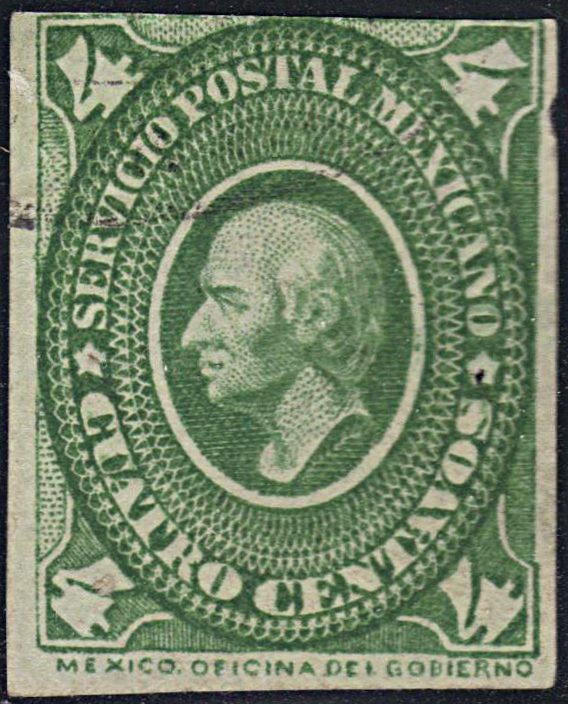
Category 1 - Stamp Perf FaultsThese are faults in the perforated edges of the stamp.Perforations cut off - Either as a means to separating stamps more quickly, or as in the case of the image below, to make a stamp appear as if it were originally not issued with perforations.
The latter is done when imperforate versions of stamps are more valuable than those issued with perforations, as in the case of this 1884 Hidalgo 4 centavos stamp issued in Mexico.
Knowing the stamp can help. In this instance stamps from this series were issued with generous margins. Narrow margins on imperforate stamps that are normally issued with generous margins should be an immediate clue that something is wrong with the stamp.
In cases such as this, stamp catalogs will only give values for such stamps as a pair, or in bigger blocks which demonstrably confirm that they were issued imperforate.
 Perforations torn off -
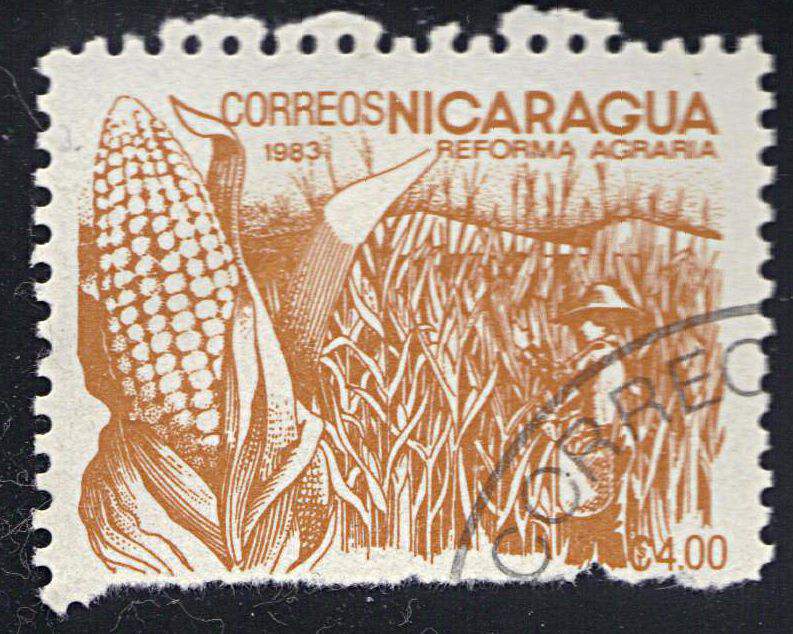
 This happens with stamps are separated and the stamps did not separate at the perforation.
This is more likely to happen when there are fewer perforations or when the paper the stamps are printed on is of poor quality.
This 1983 Agrarian Reform 4 Cordoba stamp issued in Nicaragua is a prime example. The bottom perforations were almost completely torn off when it was separated from the sheet. At the top of the stamp are chunks removed the the stamp above it.
 Short Perfs or Pulled Perfs-
 Referred to as Pulled Perfs this fault is the least dramatic, and has less of an impact on the value of stamps than the other faults mentioned thus far.
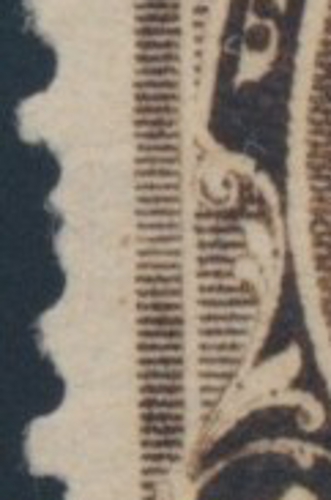
A short perf, also referred to as a blunted perf, is when one of the "teeth" on the edge of the stamp that was created as a result of separating that stamp from the sheet is reduced. A pulled perf is when the tooth is missing entirely.
Here is an example of a pulled perf on a classic United States postage stamp. The perforation tooth below the missing one is a blunted or short perf.
 Stamp Separation Gouges -
 Gouges in the margin of a stamp are usually caused when stamps are separated roughly.
Here is a Canal Zone 13 cent stamp issued in 1979 with a gouge. While the stamp may have been quite useful for postal use, it is otherwise worthless.
Some stamp dealers may refer to this as a pulled perf, but the damage is much more substantial if you compare this picture with the one above.
 Rounded Corner -
 A rounded corner is damage on a stamp where the perforation teeth from the corner of the stamp did not separate with the rest of the stamp. Stamps issued on low-quality paper are more likely to experience this fault.
The lower-left corner of the stamp is rounded on this 1988 The People Seeking Healing stamp issued in Mexico.
 Category 2 - Physical and Chemical DamageThins -
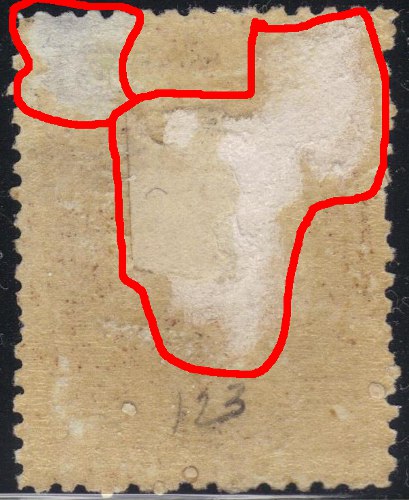
 A stamp with a thin is a stamp which has had a part of the paper of the stamp removed, most often as the result of someone trying too hard to remove a hinge. Thins can be small or quite large. Sometimes thins can be very shallow and difficult to see.
To evaluate whether or not a stamp has a thin, when it is not readily apparent, place it in a watermark tray and wet it with watermark fluid. Any thins will become immediately obvious.
Here is the reverse of a stamp with small and large thins due to improper removal of a stamp hinge.
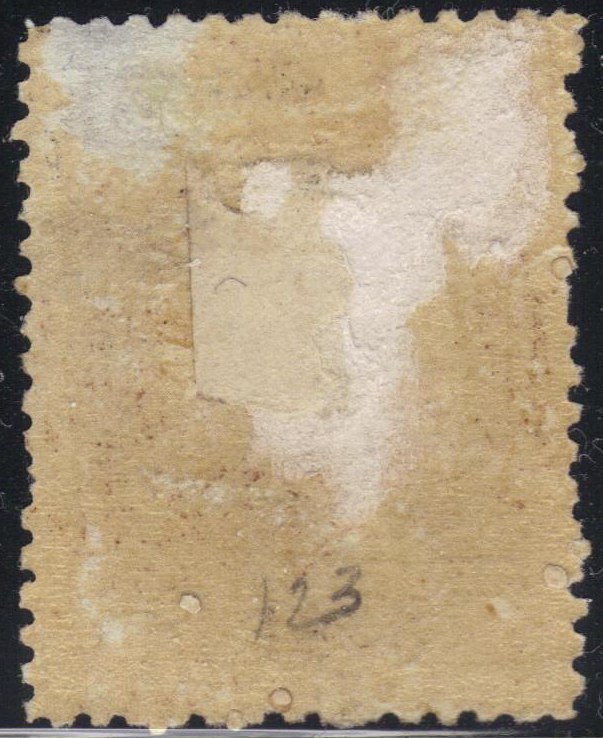
Here is the same image, with the thins circled.
 Creases -
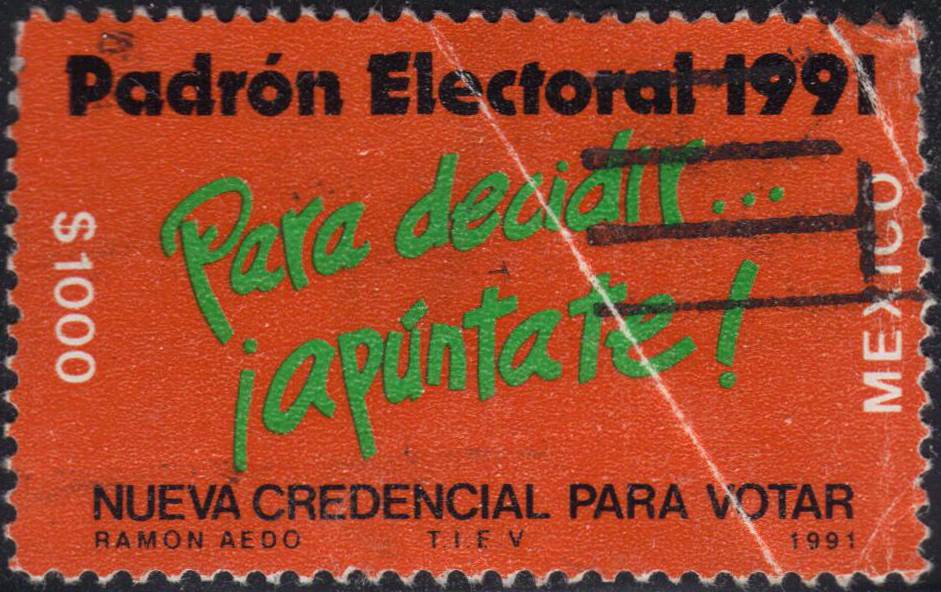
 A crease is when a stamp has been folded. Even if the stamp has been treated so as to lie flat again, signs of the crease are usually still visible, especially on the reverse. Stamps can be tested for creases with watermark fluid. Sometimes, the ink used to print the stamp will react to a crease.
Here is a 1991 New Voter Registration 1000 pesos stamp issued in Mexico with two creases visible as white lines.
 Torn Stamps -
 Either as a result of an attempt to separate stamps in a rough manner, or by later mishandling, stamps can be torn. Unless very small and on very valuable stamps, tears will render the stamp as worthless.
Here is a 1948 George Washington Carver 3 cent stamp issued in the United States. It has a large tear on the right side. It also has a crease in the upper-left corner where the perfs are folded over onto the stamp. There is surface thin on the front of the stamp on the right-hand number tablet. On the left side of the stamp, the lower half of the perfs have been removed with scissors.

Category 3 - Restored Stamps
Category 4 - Damage Caused by the Inexperienced Collector and Post Office
Category 5 - Cover Faults





 Posted 07/29/2012 07:03 am


