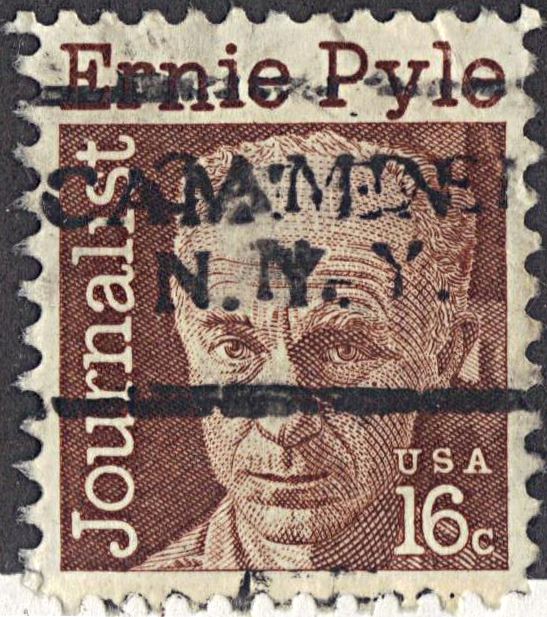
Sc#1398 1970.
Mr Ernest T Pyle.
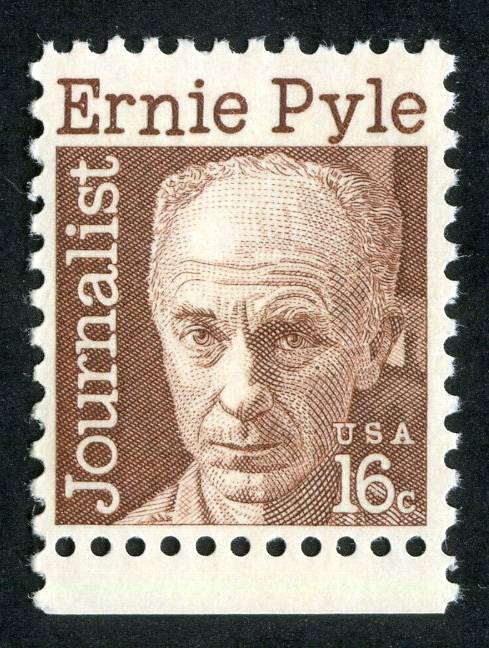
This stamp features the famous war correspondent, Ernie Taylor Pyle.
It represented double letter-rate in the then, new schedule of charges.
The U.S. Postal Service issued a 16-cent stamp honouring Ernie Pyle, the Scripps-Howard
newsman who brought the common man's war into millions of homes.
Pyle covered World War II as no other war had ever been covered, for he was more
concerned with the privations of privates than with the communiques of generals. His
despatches were warm with human interest. He had a premonition of his death, and he was
killed by Japanese gunfire on the Island of Ie on April 18, 1945.
The vertical stamp, which will be printed in brown on the Cottrell press, was designed by
Robert Geiss-mann, of New York City. The portrait is based on a photograph made by
Alfred Eisenstaedt, which appeared in Life magazine on October 2, 1944.
Ernest Taylor Pyle, winner of the Pulitzer Prize for Journalism in 1943, was born near Dana,
Indiana, on August 3, 1900.
He left college shortly before graduation for a job as a cub reporter on the La Porte (Indiana)
Herald, to begin a career that would take him to jobs in Washington, D.C. and New York and
later as a roving reporter throughout the United States and South America.
Pyle covered the bombing of London, prior to U.S. entry into the war, and when that
occurred he was on hand for the invasions of North Africa, Italy, France and to the end —
the invasion of Okinawa. It has been said that he captured the GI in words with the same
sympathy as Bill Mauldin did in cartoons.
He was a small, wiry, diffident, red-headed man, who once said "I suffer agony in
anticipation of meeting people for fear they won't like me. Millions learned to love him, and
GIs cried when they learned of his death.
The obituary editorial in the New York Tunes echoed those millions with these words: "He
was the chronicler of the human side of the war. In writing without inhibitions of his own
fear and misery and weariness, he spoke for the average soldier everywhere. His columns
were treasured by both the soldier and his family here at home, because they were what each
would like to have written had they possessed Ernie's gift of words. And it was a great gift."
Acknowledgement: Mr. Richard C. Dahlem 1971





 Posted 08/29/2012 01:02 am