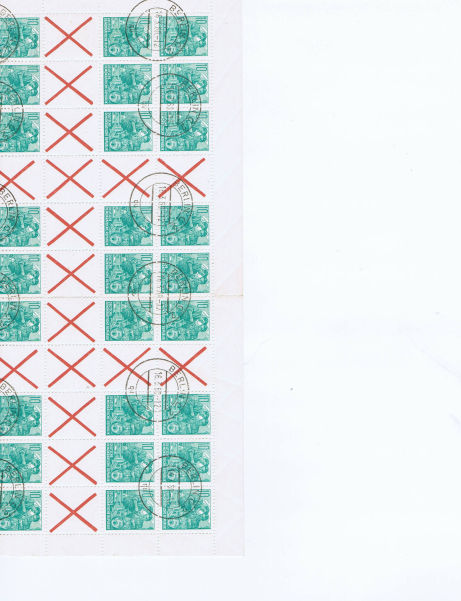
Art,
I'm not a DDR expert, but I think I can clear up your confusion a little... or make it a lot worse!
But first, a little German Stamps 101...
German stamps of the period were commonly distributed for sale in three major forms:
1. Full sheets
2. Booklets
3. Rolls
In a Michel listing, this is noted by the use of (B), (MH), and (R) notations.
(B) -- Bogen (full sheet)
(MH) -- Markenheftchen (booklet)
(R) -- Rollenmarken (roll)
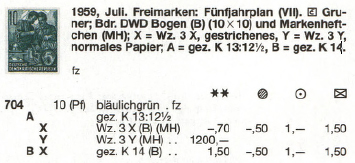
So, if this is, in fact, a Sc 477 (MiNr 704), it was available in full sheets and booklets, but not rolls.
The booklets (Markenheftchen, or MH) consisted of a varying number of booklet panes (Heftchenblätter, or H-Bl.). The booklet panes were not printed in pane-sized sheets. They were printed in much larger sheets (Markenheftchenbogen, literally "booklet sheets", or MHB) then cut down to size. For this issue, there were 6 stamps to the pane, printed 6 panes to the sheet.
Not all MHB were cut into their respective panes, however -- because of the collectors' market, they were also available for purchase uncut.
So, the end result is that there are two types of full sheets for many German stamps -- the full sheet (Bogen) printed for direct sale to the customer, and the uncut booklet sheet (MHB). That's likely why the Scott listing doesn't match what you're seeing.
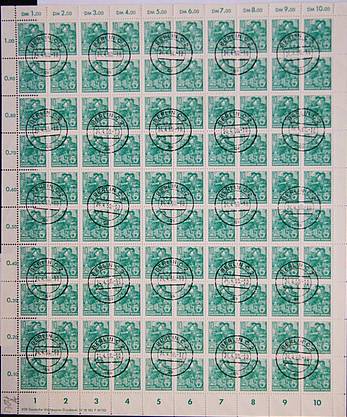
The full sheets were 10x10, with no labels.
The MHB was 11x8, with 54 stamps and 34 labels.
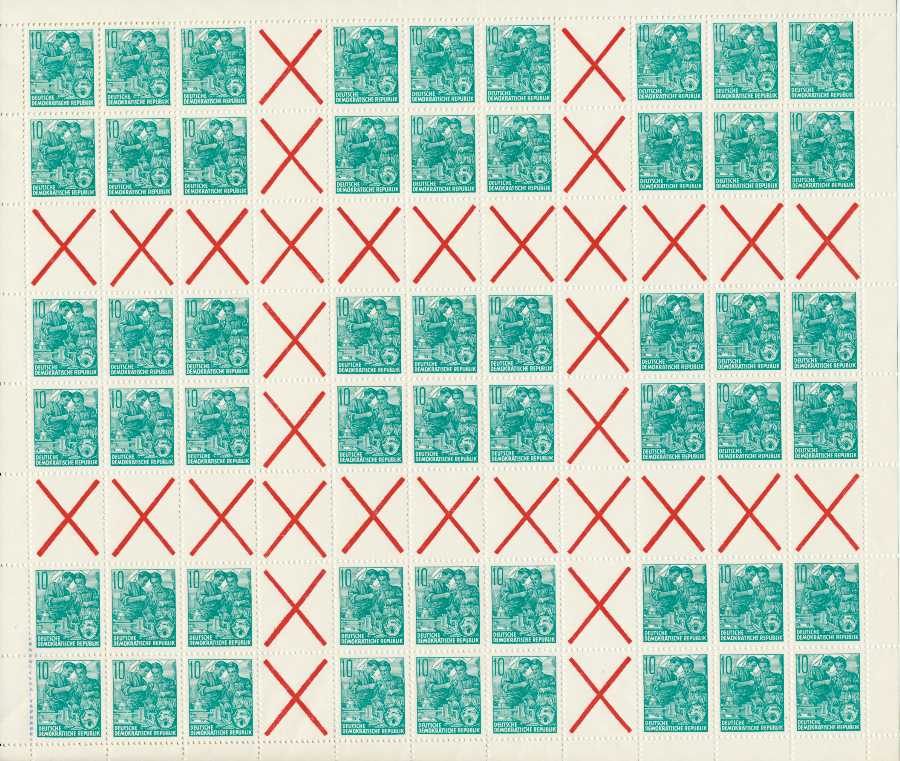
The reference in Scott to a 60/40 sheet is only for a special printing of a single issue, Sc 478a (MiNr 580 B), for the 2d German Stamp Exhibition in Berlin. The remaining stamps of this set were printed according to the normal pattern of 54/34.
Does that clear it up?
And just in case you weren't aware of them, here are two excellent references for the Five Year Plan --
Jay Carrigan's Guide and
Wikipedia's Fünfjahrplan.





 Posted 09/28/2012 7:45 pm