| Author |
 Replies: 12 / Views: 3,540 Replies: 12 / Views: 3,540 |
|
|
Valued Member
130 Posts |
|
|
I'm can't find this one in my book. Any help? 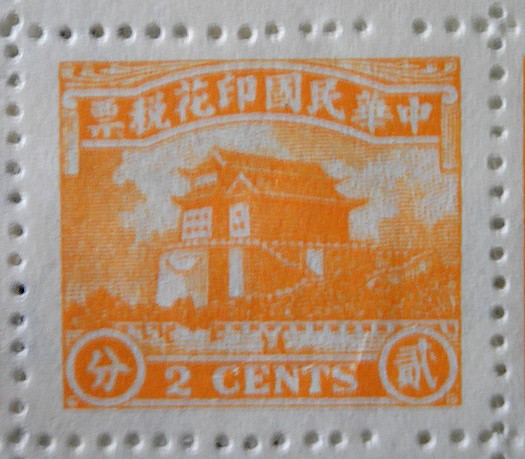 |
|
Send note to Staff
|
| Edited by ffejy - 10/01/2012 10:52 am |
|
|
|
|
Pillar Of The Community
Australia
3547 Posts |
|
|
It's a revenue stamp, not a postal issue, so you won't find it in the regular catalogues. These are the characters for 'stamp duty':  |
Send note to Staff 
|
|
|
Pillar Of The Community
United Kingdom
631 Posts |
|
|
Tonymacg
I have a few early Japanese that I assume are revenues of some sort, on 1 yen, 1 sen and 10 sen values - does the "EP" type character mean the same there? Thanks in advance... |
|
Send note to Staff
|
|
|
Pillar Of The Community
United States
1497 Posts |
|
|
Valued Member
130 Posts |
|
|
Never heard of sewing machine perfs. I hope it makes it more collectible seeing as how I have an entire sheet of 100. |
|
Send note to Staff
|
|
|
Pillar Of The Community
United States
6756 Posts |
|
|
Sorry, not sewing machine perfs. Sewing machine perfs are usually very small and not well-formed. You can see on your revenue stamp, the top and bottom perforations are identical (in spacing, breaks, bends...). |
|
Send note to Staff
|
|
|
Pillar Of The Community
Australia
3547 Posts |
|
|
DavidR, I don't collect China or Japan, so you shouldn't take my comments as gospel. However, that character (it means 'print' in both languages) is most likely to indicate revenue use. It's hard to see how it would appear on a normal postage stamp, unless the subject of the stamp was printing. |
|
Send note to Staff
|
|
|
Pillar Of The Community
Australia
3547 Posts |
|
|
And here is an excellent example of sewing machine perforations, on this sheet of the 1927 4 Anna stamp of Barwani 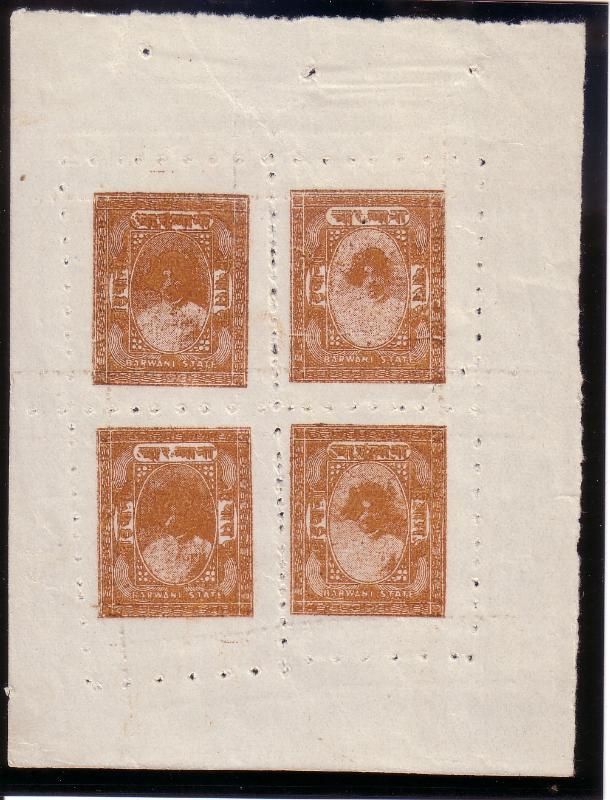 (SG 23c; I don't know if Scott distinguish this particular printing) Note the pin-perf appearance, with holes through the paper, but no paper actually punched out, the slightly irregular gauge (depending on how the paper was fed through the machine) and the irregular corners, where the machinist was simply able to turn the sheet around. The experiment wasn't a raging success, at Barwani anyway. They perforated two quite small printings this way, before giving it up as a bad go, and reverting to a proper perforating device:  (SG 23b - by far the most common of the 1927 4 Annas stamps) |
|
Send note to Staff
|
|
|
Pillar Of The Community
United States
1497 Posts |
|
|
Great examples. Definitely a difference in the quality of the holes.
Robert |
|
Send note to Staff
|
|
|
Pillar Of The Community
United States
7106 Posts |
|
|
For the 1927 4 anna, Scott gives the main number, Sc#17, to the perf 7, thin wove paper, dull orange.
Then, in lieu of sub-entries, there is a note that #17 was also printed in light brown in thick paper, pin-perf 6, and in orange brown on thick paper, rough perf 7. |
|
Send note to Staff
|
|
|
Bedrock Of The Community
Australia
38679 Posts |
|
|
It would be helpful, if you would consider changing your thread title to something like..China Revenues Liu-Ho Pagoda. It assists students to locate information when searching. Liu-Ho Pagoda Exist: Engraved King-Hwa prints lithography Da-Tung prints Lithography Various surcharges 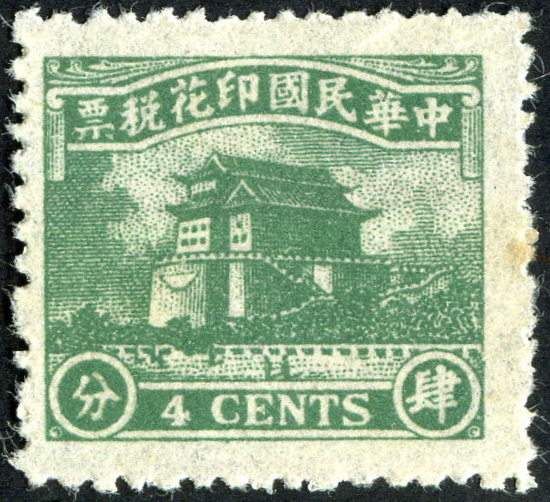 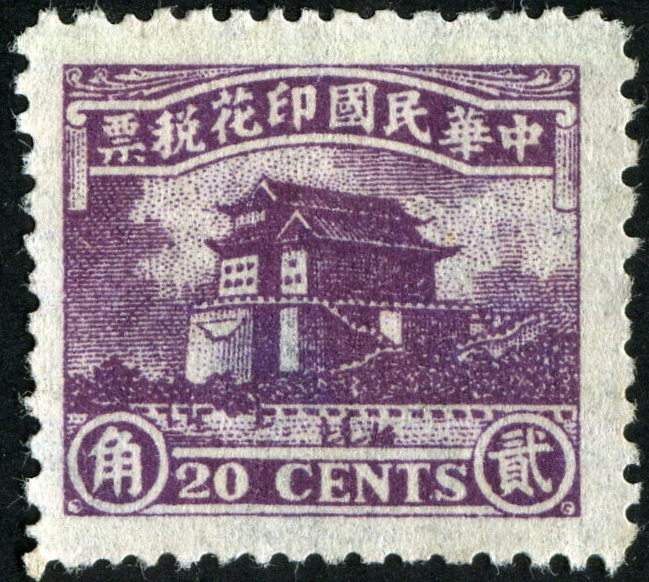 |
|
Send note to Staff
|
|
|
Valued Member
130 Posts |
|
|
Bedrock Of The Community
Australia
38679 Posts |
|
|
 well done you on the thread rename. Anyone wanting supplementary info that googles the Pagoda gets a really in depth link. |
|
Send note to Staff
|
|
| |
Replies: 12 / Views: 3,540 |
|



 Posted 09/29/2012 7:35 pm


