| Author |
 Replies: 12 / Views: 2,106 Replies: 12 / Views: 2,106 |
|
|
Valued Member
United States
296 Posts |
|
|
Here is a peculiar item; It is an 1870-83 Victoria ( Australian) 'Stamp Duty' issue which I believe is either AR18 or AR45, which appears before the Australian issues. The Watermark is the V and Crown. What the Perfs are is a little fuzzy. I measure something less than 13. Scott's states 13, with exceptions of 12 or 12 ½. As the backside image shows, the lower left hand side perfs seem to get closer together towards the corner. Whether the stamp is new or used is also unclear. You will note a (purple?) horizontal line across the front of the stamp. It does not bleed through the back. My questions: Is this an AR18 or AR45 (does the wm relevant to AR18 also apply to AR45?) Is the horizontal line across the front a cancellation? If not, what is it? If it is not a cancellation, can it be removed? Scott's refers to 'pink'; I would think this applies to the font (exists in both of the listings, but the font of the subject is white, not pink.) Also, both listings include the perf 12 and 12 1/2, but list no prices. What can be concluded from that? Finally, how does a 'Revenue Cancel' manifest itself? 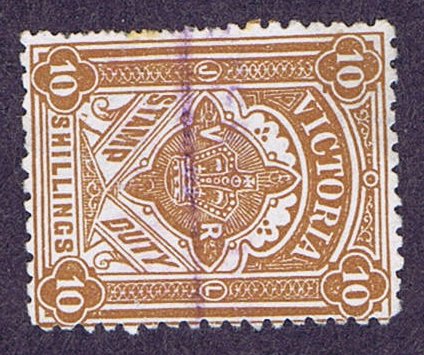 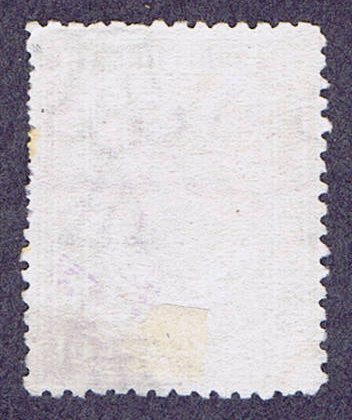 Sorry about the orientation. It's a software issue. |
|
Send note to Staff
|
| Edited by Art Strohmeier - 10/11/2012 5:19 pm |
|
|
|
|
Pillar Of The Community
Australia
3547 Posts |
|
|
This looks like a revenue cancellation. The primary use of such values was for stamp duty, not postage. |
Send note to Staff 
|
|
|
Pillar Of The Community
United States
5894 Posts |
|
|
I concur with Tony. This horizontal line is a revenue cancellation. Those are pulled perforation nibs on the lower left hand side of the stamp. |
|
Send note to Staff
|
|
|
Valued Member
United States
296 Posts |
|
|
Tonymacq and Snauggie;
Thanks for your input; Seems like I learn something new every day.
Now, is it an AR18? or AR45? Does the wm apply to both? or just the AR18? and what does the 'pink' refer to?
|
|
Send note to Staff
|
|
|
Pillar Of The Community
Australia
3547 Posts |
|
|
Sorry, I can't do Scott numbers - I only have Gibbons. However, that watermark looks very like Gibbons Type 85, which apparently was introduced in 1899. As stamps inscribed STAMP DUTY were for stamp duty use only from 1 July 1901, and that type watermark is only listed sideways on the 10/- in green, I'd suspect you have a later printing made purely for stamp duty purposes, and therefore not in the (stamp) catalogues. |
|
Send note to Staff
|
|
|
Pillar Of The Community
United States
7105 Posts |
|
|
In terms of other possible revenue options, the only candidate I see in Forbin for this stamp is Victoria #11, listed under the 1880 series.
Forbin says the design was reused, but either the 10-shilling is green, or, in the case of 1909, the listings top out at five shillings in that series.
On one hand, Forbin's information is almost 100 years old so it always subject to updating with more-recent information; on the other hand, more people were paying more attention to revenues back then...
As for Scott, the Classic does not list a different watermark for the two listings; however, the listings would seem to show that AR18 is lithographed and AR45 is typographed. Both of them would be on pinkish paper. Both of them have a fairly generous pricing listed for a revenue cancel, all things considered.
If anyone has a different interpretation of Scott's listings, please chime in. |
|
Send note to Staff
|
|
|
Valued Member
United States
296 Posts |
|
|
Tonymacq and cjd:
Thanks to both of you for your input.
Re the stamp duty stamps not appearing in Scott's, clearly it is there in the Scott's 'AR' series, which is exclusive to 'Stamp Duty'. The last entry in Scott's AR series' is the 1897-90 series. Both the AR18 and AR45 were issued in the period of 1879-96, which may be consistant with cjd's comment re Forbin.
cjd: Does the wm referenced prior to the AR 13 entry also apply to the AR31 and subsequent? I've never been clear on that one. Also, would not the wm be applied to the paper, regardless of which printing process is used? |
|
Send note to Staff
|
|
|
Pillar Of The Community
United States
7105 Posts |
|
|
Quote:
Re the stamp duty stamps not appearing in Scott's Art, I think Tony was getting at the notion that the major catalogues say they generally list fiscals when they were known to be authorized for postal use, and he was speculating that your watermark might mean that yours was issued after the period of postal use had ended. The 1909 series from Forbin, for instance, is not listed in either Scott or SG, as they were only ever eligible for revenue usages. As for watermarks, Scott's listing pretty clearly implies that the watermark does not change between printing methods for this series. Otherwise, Scott would've (should've) inserted a new watermark i.d. or 'unwatermarked' in among the listings. I wish Scott would affirmatively repeat some of the information at the start of each new set, rather than having the reader assume that it carries over unchanged from the previous listings. Or at least I think I wish that they did...perhaps it would end up being more clutter than I'd like. You are correct that the paper is "born" with the watermark, irrespective of what is later printed onto it. No reason why the litho and typo issues couldn't be on the same paper...in this case they apparently were on the same paper. |
|
Send note to Staff
|
|
|
Pillar Of The Community
Australia
3547 Posts |
|
|
Yes, as I understand it, some at least of the Queen Victoria type revenues were being reprinted well into Edward VII's and even George V's reign. There is the possibility that this stamp is from one of those later printings.
Another consideration: I don't know if Scott mentions it, but Gibbons states that the watermarks on all the postal era 10/- stamps were sideways. The watermark in the scan appears to be upright, and not on the pink papers used during the postal period.
Taken all in all, I'd say this was a late, revenue printing. |
|
Send note to Staff
|
|
|
Valued Member
United States
296 Posts |
|
|
You say "the stamp was issued after the period of postal use had ended. The 1909 series from Forbin, for instance, is not listed in either Scott or SG, as they were only ever eligible for revenue usages."
so no proof there
and
"Forbin says the design was reused, but either the 10-shilling is green, or, in the case of 1909, the listings top out at five shillings in that series."
No proof there.
Is there any issues of Australian Revenue stamps that would settle this?
Is there any documentation from Scott's that confirm the wm in a sideways position? Probably not, and may not prove anything anyway. I would think, unless there's a 'Specialized issue' somewhere. On the other hand, we do know that the wm in the subject is consistent with the example in Scotts. So unless something convinces me otherwise, I'm leaning towards going with AR18 or AR45.
BTW, if I take a look at the backside with a microscope, will that show any characteristics peculiar to typo or litho?
|
|
Send note to Staff
|
| Edited by Art Strohmeier - 10/12/2012 10:53 pm |
|
|
Pillar Of The Community
Australia
3547 Posts |
|
|
You would need to check in the appropriate Barefoot catalogue of Commonwealth revenues to be absolutely certain about this.
However, from what I can see of the watermark, it's a Gibbons Type 85, which was introduced in 1899, and was only used (sideways) for one postal issue of the 10/-, which was printed in green.
The cancellation being clearly fiscal, I'd say this was from a printing later than those listed in Forbin. |
|
Send note to Staff
|
|
|
Valued Member
United States
296 Posts |
|
|
If it was a Gibbons type 85, was only used once, for a green print, it wasn't the subject, which isn't green, and which has a wm which isn't sideways. What am I missing? |
|
Send note to Staff
|
|
|
Pillar Of The Community
United States
7105 Posts |
|
|
I don't know how long the underlying stamp design continued to be used, but there are revenue usages consisting of overprints on this stamp design that were issued before and after World War II.
Now, might they have had so many of them on hand that they were still overprinting them fifty years later? I suppose it is possible... seems more likely that they were still printing this stamp well into the 20th century. None of those newer printings would be listed in the postage stamp catalogues, since they were no longer valid for postage. |
|
Send note to Staff
|
|
| |
Replies: 12 / Views: 2,106 |
|




 Posted 10/11/2012 5:16 pm


