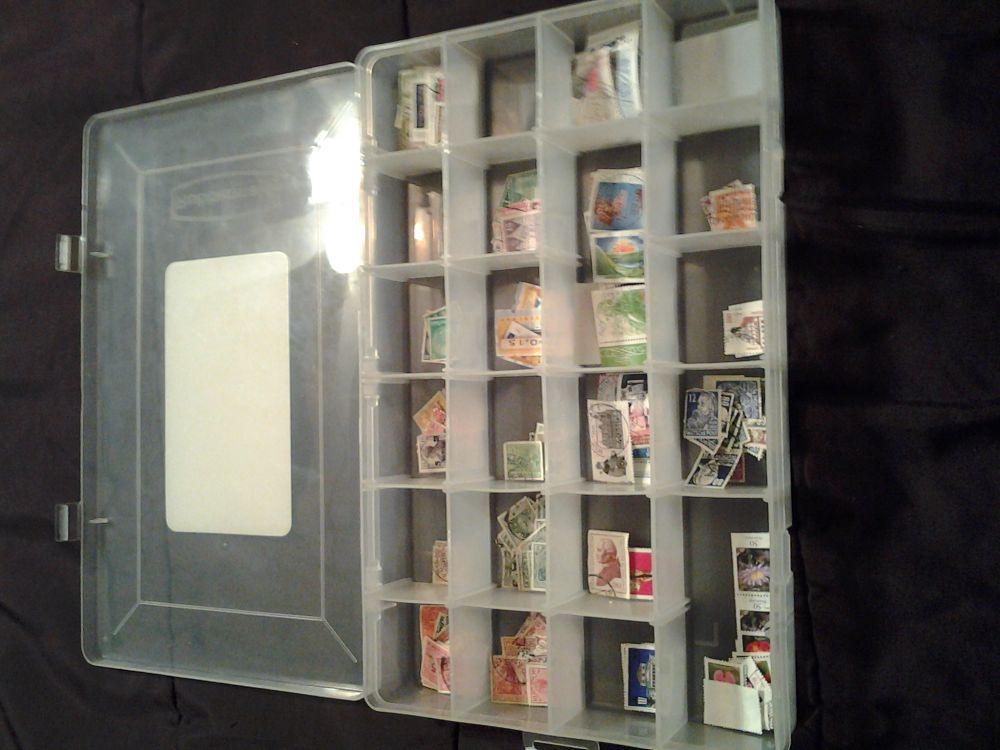
If you've not already acquired them, here's some thoughts on stuff you need: If I'm telling you what you already know, I apologize.
Stamp tongs. Get two or three pair; One pair always disappears, usually temporarily. Glassine envelopes (I like no. 3's)
A Magnifying Glass (I suggest go full bore with a combo light and magnifying glass that attaches to your work desk.)
A supply of pencils, an eraser, and ball point pens.
Cut up some Postage Stamp size strips of manila paper (something light in color), for id'ing your individual issues.
Several 3-ring binders.
A shoe-box size professional card container with index cards and an adjustable slider for temporarily holding your completed issues prior to final storage.
Identification: How to ID a stamp.
Simple, right? Look it up in the catalog. There are some attributes in a stamp that make it easi(er) to identify. The date, for example. With the date you can zero in to the appropriate section of a catalog. The year of issue, if it exists, is typically found at the bottom of the stamp, in small letters. They don't exist, for earlier years, and for some countries, not at all. Not all stamps are printed for a series, In that case, take a look at the overall aspects of the illustration for the series. Note the font, the characteristics of the design, what the border looks like, any attributes related not to the specific illustration, but the detail design. Note the denomination and how the characters are formatted.
Look for other dates that might be a clue, such as date of an event, or anniversary or whatever.
Zero in by range of the denomination, considering that Stamp prices rise with inflation. The names of the countries sometimes change over time. To zero in on the section of the catalog to start, consider the age of the stamp; whether it looks really old, really new, somewhere in between and in which direction.
Compare the verbage and the denomination on the stamp with the catalog entries. Is the denomination on the stamp outside the range of the issues you're looking at in the catalog? Can you find a match between the verbage on the stamp and the catalog?
Eventually you'll probably expand into foreign countries. You continually review the following:
The Front pages of (any volume of) Scott's Catalog, including the Common Design Types,
In the back pages, the Illustrated Identifier and the Index. There are other indexes as well, including a referenced in SCO material you'll come across. You should make a list of them for later reference.
Country might be simple, might not. You might recognize the country from the identifier Some are easy, some not so easy and some, like the cryllic (Russian, Finland, Latvia, etc.,) are quite difficult. With time, you'll get used to them.
When you submit stamps for ID'ing, you might want to print a copy of the thread for later reference.
When you compose your message, you might want to do it in word, and save it, in case the thread disappears during a computer interruption. Nothing is more frustrating than to get partially through and losing your input.
P.S. Don't worry about whether to collect new or used, or restrict yourself to a specific country. Let your searches and your pocketbook decide that when the time comes. You can't tell the value by whether a stamp is new or used.
Close Window
|





 Posted 10/26/2012 05:48 am