Tom (nr-notrare) has inspired me to do something I've been meaning to do for a long time. This is the first in what will be a series of mini-articles on unusual places that issue, or have been depicted on, stamps.
Heligoland (Helgoland in German):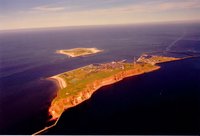 Geography:
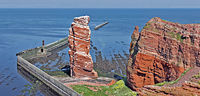
 Heligoland is a small (< .5 square mile) island about 50 miles off the German coast. At one time it was a single entity, but an earthquake tore it apart in 1720. Heligoland now consists of two islets, Dunen-Insel (the Dune), smaller and uninhabited, and Rock Island (Hauptinsel) with a population of some 1650 full time residents. The island is a popular tourist destination supporting up to 20,000 daily visitors during the summer.
 History:
 The island appears to have been inhabited since prehistoric times and has been claimed by a number of small city states. In 1714 it was captured by the Danish and remained in their hands until 1807. Heligoland was seized by the British during the Napoleonic Wars. Britain traded the island to Germany in exchange for certain property rights in Africa. The most significant of these was that Queen Victoria insisted that her grandson, Kaiser Wilhelm II of Germany be given a mountain an Africa. Britain had two, but Germany had none. As a result, the border was relocated so that Mt. Kilimanjaro would be in German East Africa – now Tanzania.
Heligoland has been an important base for numerous armies and navies throughout history. It was a major naval base for Germany in WWI and the Battle of Heligoland Bight was fought nearby. In the Nazi era and through WWII it was reactivated and rebuilt. After the war, the British used the islets as a bombing range. In 1947, the Royal Navy detonated 6,800 tons of explosives there, the largest single non-nuclear detonation in history.
Culture: In 1952 the islands were returned to Germany and were demilitarized and restored to their current beauty. German is the official language. It is a part of the European Union, but is exempted from the normal EU Value Added Taxes. As a result, it has become a popular tourist destination famous for its relatively inexpensive cigarettes, alcoholic beverages and perfumes.
There is only one motorized vehicle on Rock Island, a police car, and even bicycles are banned. The fishing industry, tourism and the previously mentioned retail industry provide the bulk of the local economy.
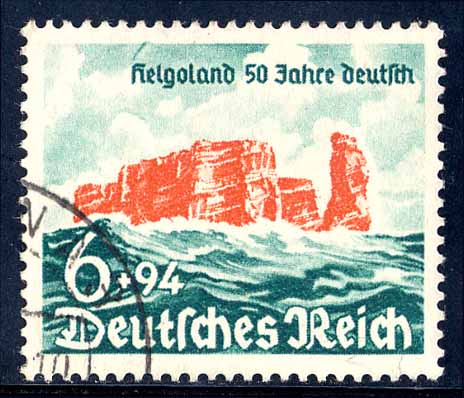
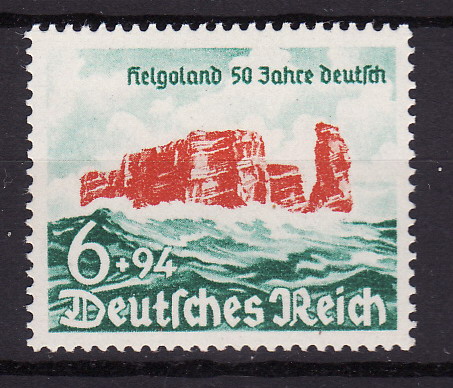
Stamps: Germany B176 - Issued on Heligoland's 50th anniversary as a part of Germany. One of the two illustrations is a plate flaw - can you tell which one?
 Sources:
 For more information on Heligoland and it's stamps go to this excellent collector's site:
http://www.fritzwagner.com/helgolan...s_intro.html





 Posted 10/28/2008 6:32 pm


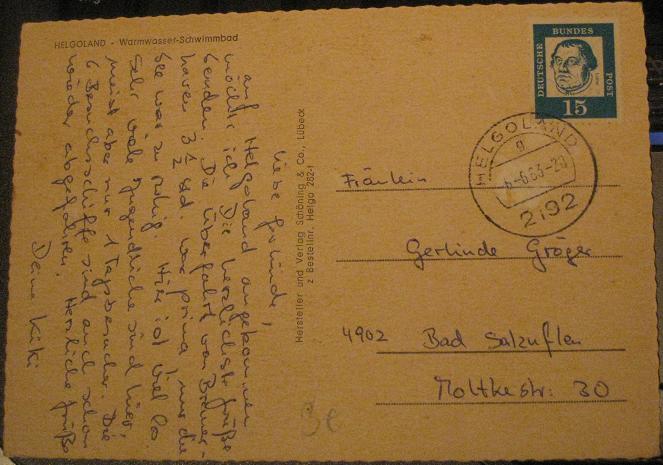 helgolandpostcard1.JPG
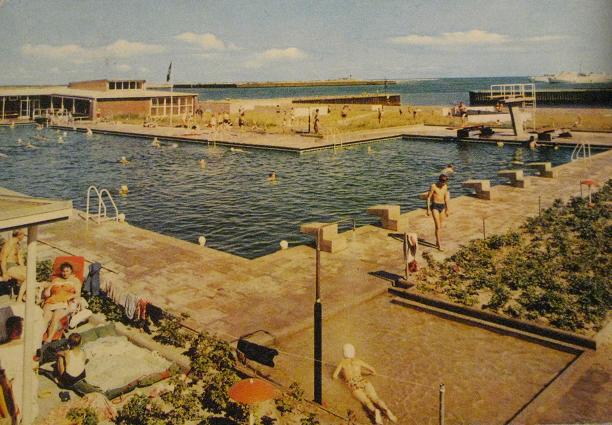 helgolandpostcard2.JPG
