| Author |
 Replies: 24 / Views: 6,824 Replies: 24 / Views: 6,824 |
|
Pillar Of The Community
USA
2877 Posts |
|
|
Picked out a few match revenue stamps today from an APS sales circuit. 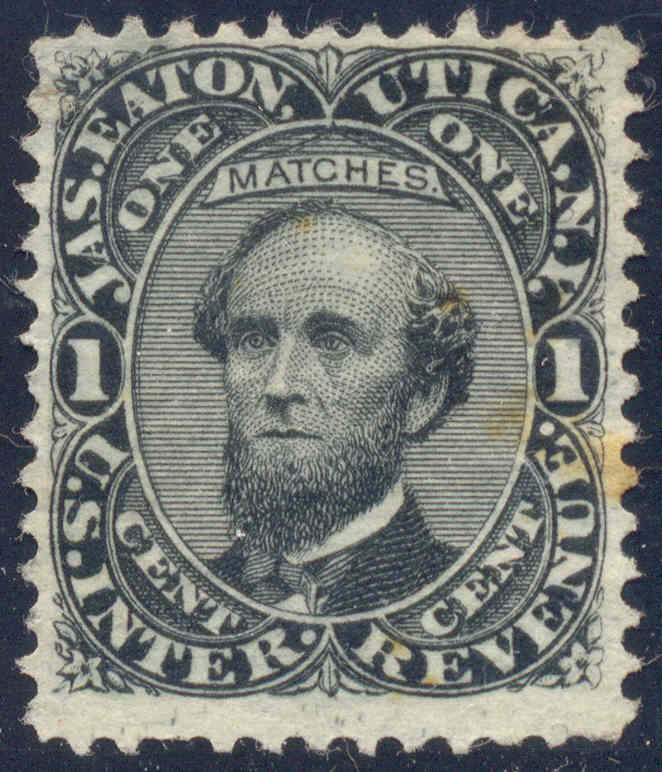 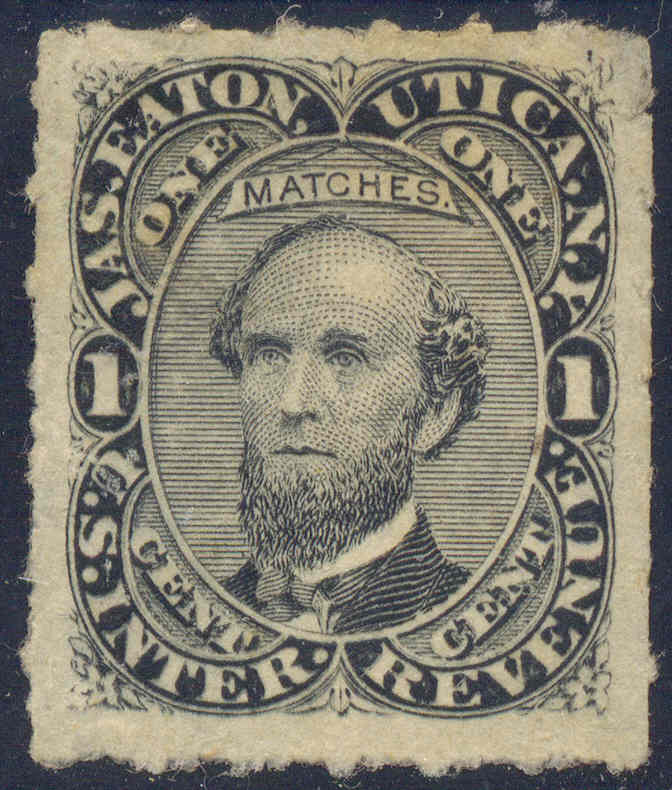 1 cent black Jason Eaton Matches, Utica, New York (who lives there?) perforated (#RO73a) and rouletted (#RO74d). |
|
Send note to Staff
|
|
|
|
|
Pillar Of The Community
USA
2504 Posts |
|
|
Guess that would be a pair of matching matchmakers.
Utica? Didn't Rockinrobin say she was born there? |
Send note to Staff 
|
|
| Edited by modern_who - 10/29/2008 10:14 pm |
|
|
Pillar Of The Community
USA
3315 Posts |
|
|
OK, so I Google JEM and get about a million hits on some rugby or soccer player.
So who or what is a match revenue stamp? |
|
Send note to Staff
|
|
|
Pillar Of The Community
USA
2877 Posts |
|
|
Taxes were levied on matches to help finance the Civil War.
Stamps were printed to show payment of the tax, and these stamps were affixed to a carton of matches.
The taxes remained in effect long after the war ended,
and after a while the government let companies design their own tax stamps.
The tax stamps which were printed for use by a single company are called "private die" revenue stamps.
These two stamps were printed by the US government for the Jason Eaton Match Company of Utica, NY
to use on its match cartons. |
|
Send note to Staff
|
|
|
Pillar Of The Community
USA
2877 Posts |
|
|
Here are two more match stamps from the same circuit book. 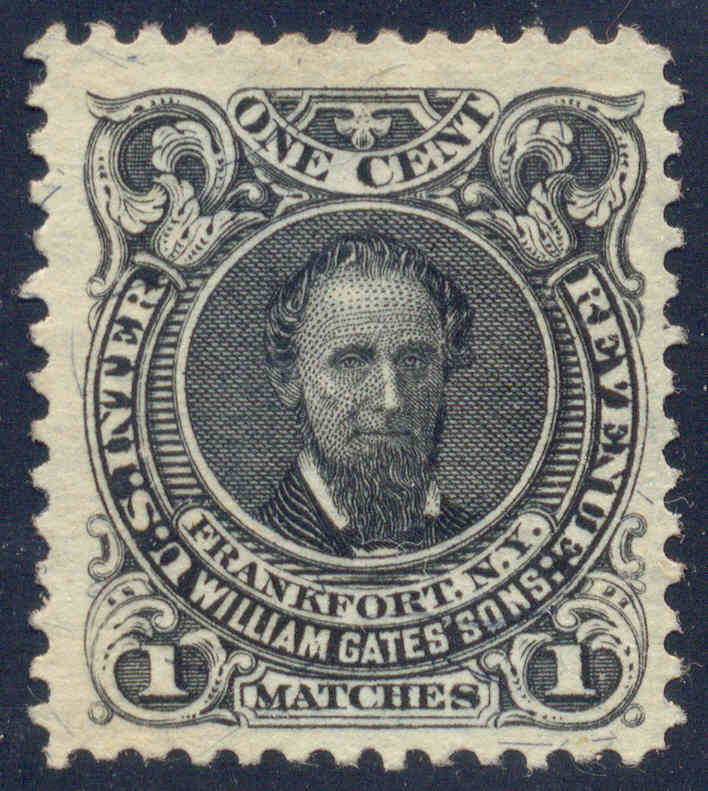 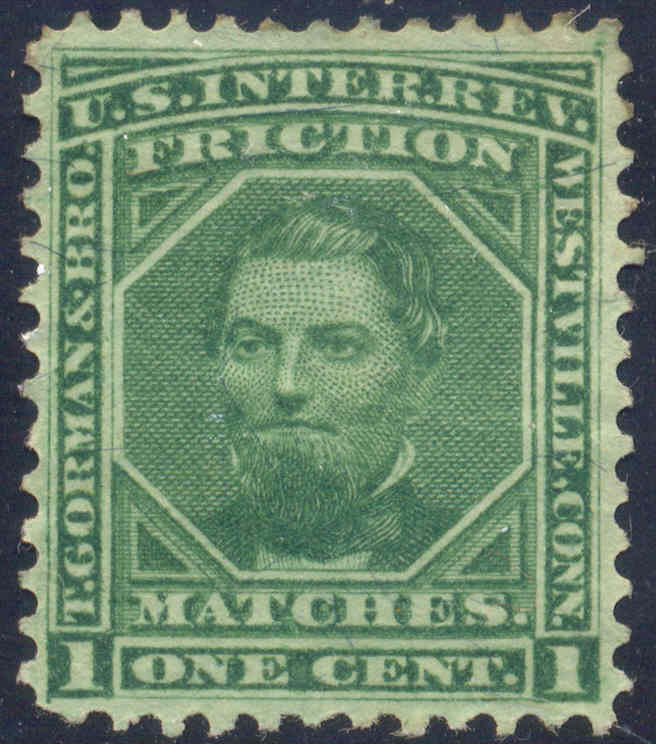 1c black William Gates' Sons Match Co., Frankfort NY (left, Scott #RO92b) and 1c green T. Gorman and Brother Friction Matches, Westville, CT (right, Scott #RO98b) |
|
Send note to Staff
|
|
|
Pillar Of The Community
USA
1749 Posts |
|
|
Wow,I love the detail in those stamps!!
They just don't make 'em like that anymore!
Thanks so much, Tom, for sharing those beautiful works of art!
Gussyboy1 |
|
Send note to Staff
|
Nobody gets in to see the Wizard. Not nobody. Not No How!" |
|
|
Pillar Of The Community
USA
2504 Posts |
|
|
Interesting that you should now post
one from Frankfurt NY, Tom. Makes me
wonder what's with this area and matches
or were they made everywhere?
Frankfurt NY boarders Utica on the
east but is in another county. There
is still a fireworks factory there, way
out in the boonies. At least there
was about 15 years ago when I drove
out to it and talked with the owner. |
|
Send note to Staff
|
|
|
|
Pillar Of The Community
USA
3315 Posts |
|
|
Thanks for the info Tom! They are beautiful issues. I guess the next logical question is "Where did matches come from?"
Let's ask Mr. Google.
In 1827, John Walker, English chemist and apothecary, discovered that if he coated the end of a stick with certain chemicals and let them dry, he could start a fire by striking the stick anywhere. These were the first friction matches. The chemicals he used were antimony sulfide, potassium chlorate, gum, and starch. Walker did not patent his "Congreves" as he called the matches. His first sale of the matches was on April 7, 1827, to a Mr. Hixon, a solicitor in the town. Walker made little money from his invention.
One Samuel Jones saw Walker's "Congreves" and decided to market them, calling his matches "Lucifers" "Lucifers" became popular especially among smokers, but they had a bad burning odor.
In 1830, the French chemist, Charles Sauria, created a match made with white phosphorous. Sauria's matches had no odor, but they made people sick with a ailment dubbed "phossy jaw". White phosphorous is poisonous.
In 1855, safety matches were patented by Johan Edvard Lundstrom of Sweden. Lundstrom put red phosphorus on the sandpaper outside the box and the other ingredients on the match head, solving the problem of "phossy jaw" and creating a match that could only be safely lit off the prepared, special striking, surface.
In 1889, Joshua Pusey invented the matchbook, he called his matchbook matches "Flexibles". Pusey's patent was unsuccessfully challenged by the Diamond Match Company who had invented a similar matchbook (their striker was on the outside, Pusey's was on the inside). His patent was later purchased by the Diamond Match Company in 1896 for $4,000 and a job offer.
In 1910, the Diamond Match Company patented the first nonpoisonous match in the U.S., which used a safe chemical called sesquisulfide of phophorous.
|
|
Send note to Staff
|
|
|
Pillar Of The Community
USA
1881 Posts |
|
|
Hi T........
Very nice revenues.....always enjoy seeing material from your collection, you have some great items.
|
|
Send note to Staff
|
|
|
Pillar Of The Community
United States
1566 Posts |
|
|
So many stamps to collect. I wasn't the least bit interested in revenues until I found my first one. Now I can't find enough of them. |
|
Send note to Staff
|
|
|
Pillar Of The Community
USA
867 Posts |
|
|
Valued Member
387 Posts |
|
|
The Revenues and all BOBs ( back of the book) seem to becoming more desirable. One used to be able to pick up collections a lot cheaper than today.  Hey Swabbie, what is your next kilolot buy ?? Jim |
|
Send note to Staff
|
|
|
Pillar Of The Community

Canada
3963 Posts |
|
|
Great revenue stamps Tom  Thank you for sharing them and their stories. Dianne  |
|
Send note to Staff
|
Don't grumble that the roses have thorns, be thankful that the thorns have roses |
|
|
Pillar Of The Community
USA
2877 Posts |
|
|
Pillar Of The Community
USA
2877 Posts |
|
|
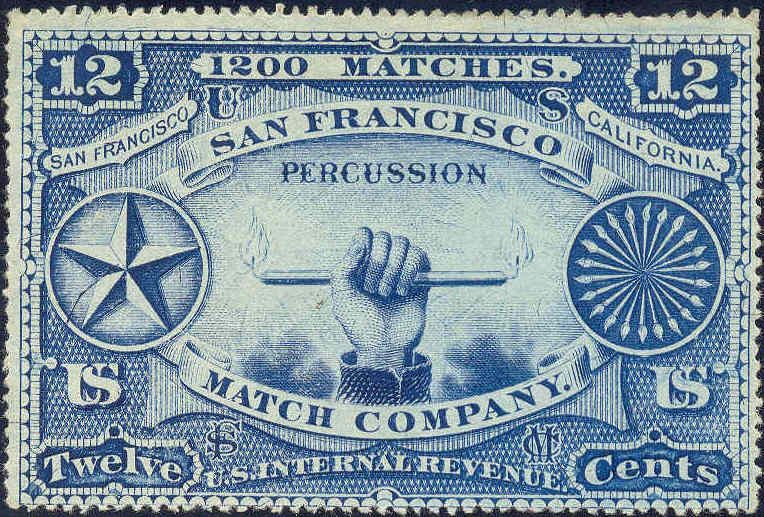 Scott #RO165b San Francisco Match Company. I drove down to Framingham tonight to pick it up at the FedEx office (1 hr each way). It was worth it! |
|
Send note to Staff
|
|
|
Valued Member
Australia
312 Posts |
|
|
Quote:
Walker made little money from his invention. But he made plenty from his Scotch! Very nice Revenue stamps, T. I'm trying to resist getting into US Revenues, restricting my BOB to airmail and special deliveries, but posts like this make it hard. Victorian (Aust.) Revenues are a different kettle of fish, as they were valid for postage use from 1884 to 1901, so can be collected as postage stamps. Not an easy area to collect though. Balf |
|
Send note to Staff
|
|
|
Replies: 24 / Views: 6,824 |
|




 Posted 10/29/2008 9:50 pm


