| Author |
 Replies: 14 / Views: 2,977 Replies: 14 / Views: 2,977 |
|
|
Valued Member
United States
13 Posts |
|
|
|
|
Pillar Of The Community
Australia
2156 Posts |
|
|
Oooh that's a lot of stamps!
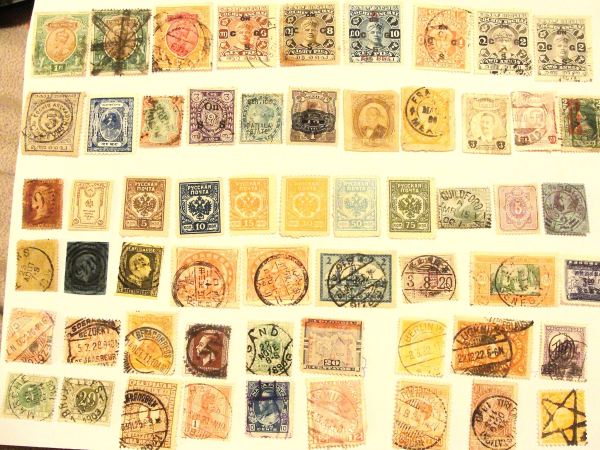
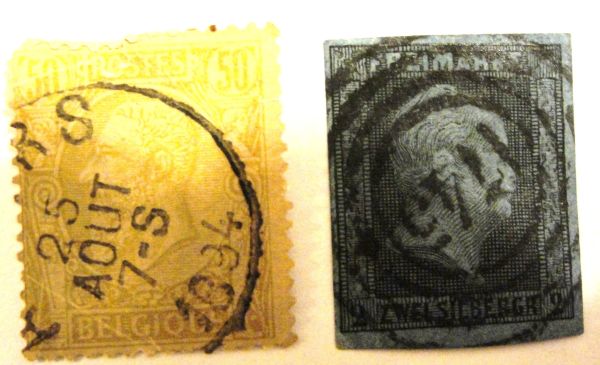
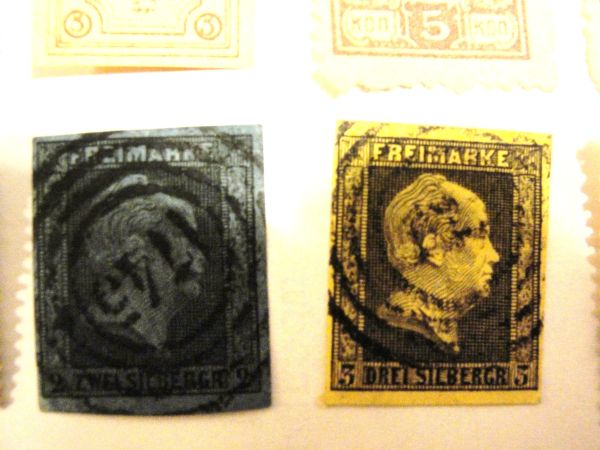
The two Prussian stamps (the ones in which the king is facing right) have numeral cancels. Depending on the number, these can be worth some money. The one that's legible in this scan reads '1745.' This was the number for Dortmund Bahnhof (Dortmund Railway Station). It's not rare, but it's still a nice find. |
Send note to Staff 
|
| Edited by jimjamtwo - 01/24/2013 12:53 am |
|
|
Valued Member
United States
183 Posts |
|
|
Valued Member
United States
254 Posts |
|
|
Valued Member
United States
13 Posts |
|
|
Sorry, I did actually shorten the list but I know its still a bit long. Thanks everyone for the info. i'll look into it. |
|
Send note to Staff
|
|
|
Pillar Of The Community
United States
898 Posts |
|
|
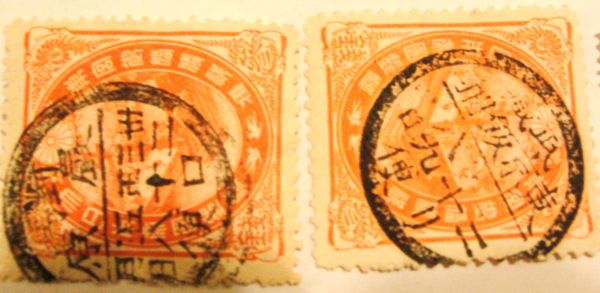
In the master photo, the stamps on the 4th row down, positions 4, 5 & 7 are from Japan.
The two stamps in position 4 & 5 are actually the same stamp. (The one in position 4 needs to be rotated 90° clockwise, and the one in position 5 needs to be rotated 90° counter-clockwise, in order to be oriented the way they were designed, with the chrysanthemum at the top.) It's Scott #109, and the used version catalogs for $2.50 in the 2013 catalog.
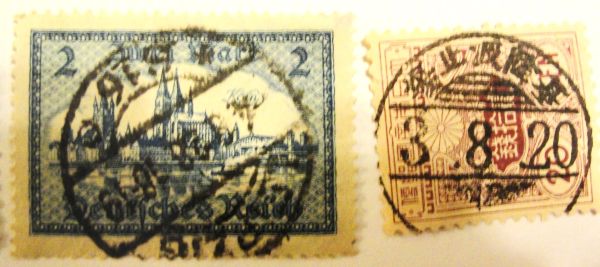
The stamp in position 7 is hard to identify from the pictures without checking for a watermark. Without a watermark, it's Scott #123 ($1.25 used). With a watermark, it's Scott #139 ($0.60 used). (It also goes with the chrysanthemum at the top, so rotated 90° clockwise.)
But, those stamps have nice strikes (cancels) on them, and might be worth a bit more because of that. In fact, I was going to comment that most of the used stamps you've shown have nice cancels -- many of them "socked on the nose", as it's called. It looks like the original collector selected them with that in mind.
Hope that's a little bit helpful.
I think you'll have a lot of fun with this lot!
-- Dave |
|
Send note to Staff
|
|
|
Valued Member
United States
13 Posts |
|
|
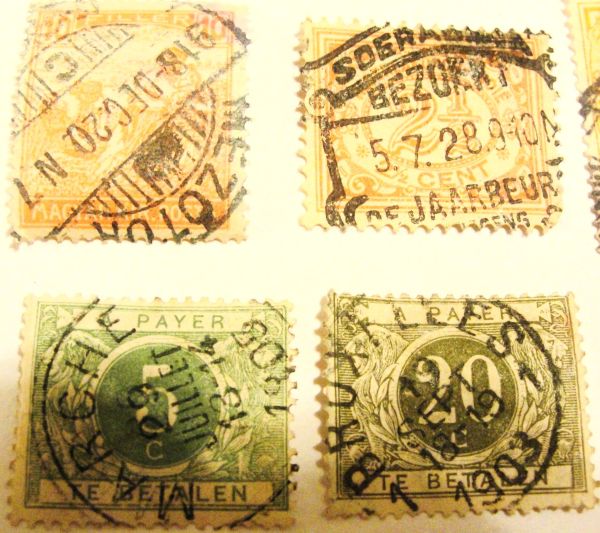
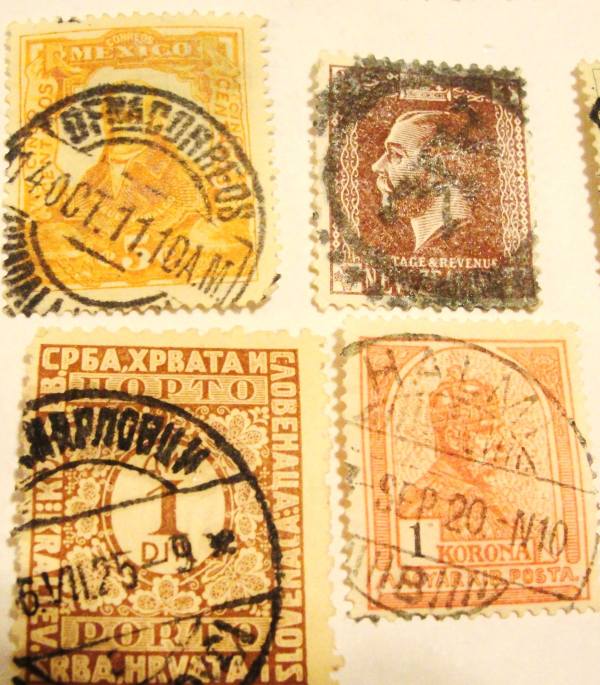
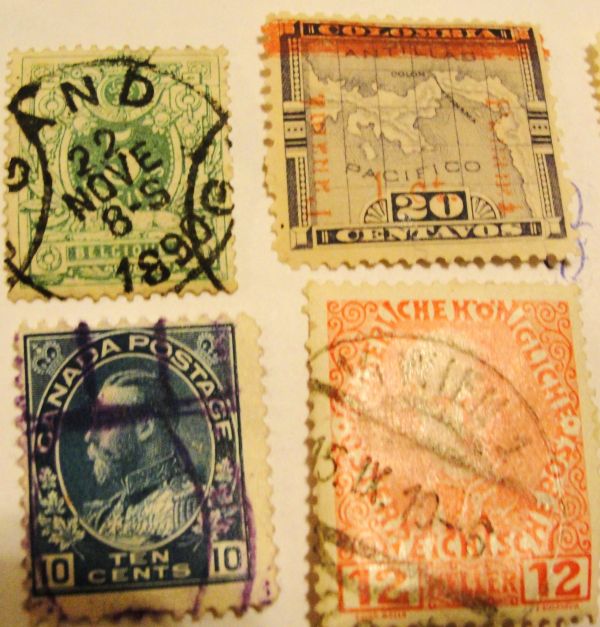
Thanks for the info. This is a very small group of what he was aquired and yes,i have noticed that most of the cancels looked really nice and im sure it wasn't by accident. That was one of the questions that I had. Do some cancels actually increase the value of a stamp over an unused issue? |
|
Send note to Staff
|
|
|
Pillar Of The Community
Canada
2277 Posts |
|
|
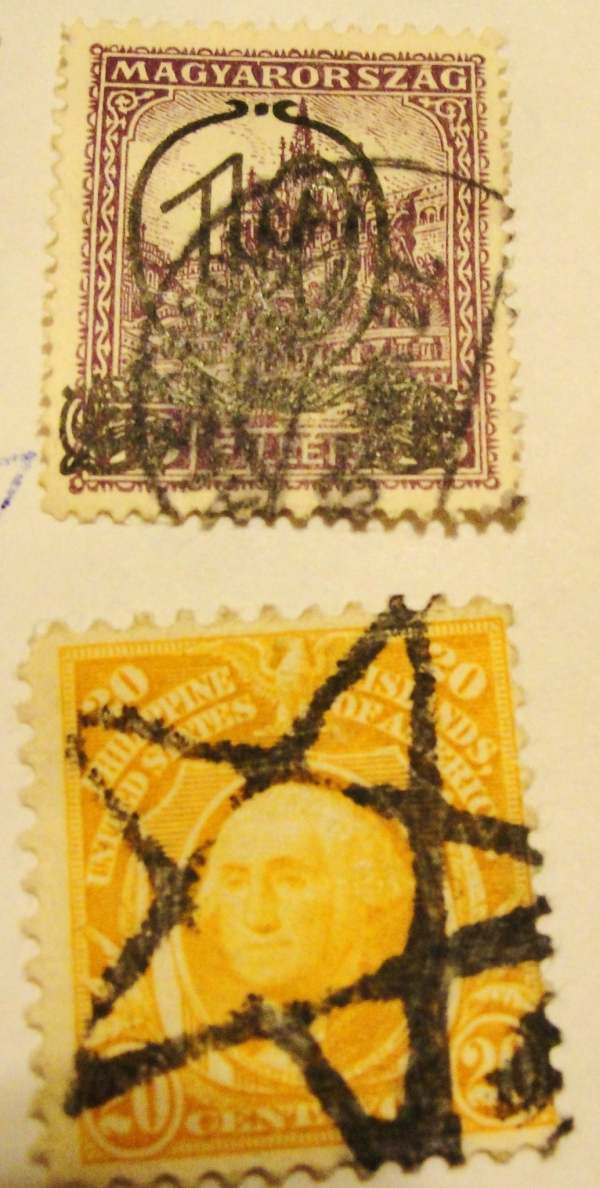
The cancel can be mightier than the stamp in some cases. Some cancels are exceptionally rare as a postal location may have been temporary or a specific canceling device may have been only used a few times. Can make a 20cent stamp worth hundreds in the right situation. However studying cancels can be more of a challenge than stamps themselves. You have a nice assorted grouping there and if I can suggest to start with a small group of maybe 10 at a time. If you are going to be a collector it is best to stop in at your local library and get a copy (5-6 books) of scotts catalogs which will help you greatly. Anything that has no country name and just says postage/ revenue is great Britain as they are the only country that does not require a name. Cochin, travencore are India states, Magyar is for Hungary, Deutches reich is Germany, Norge is Norway, Helvetia is switzerland, Eire is Ireland, sverige is Sweden, Noyta CCCp is Russsia but some issues with Noyta can be finland and others. Thats just a rough start. |
|
Send note to Staff
|
|
|
Pillar Of The Community
United States
8956 Posts |
|
|
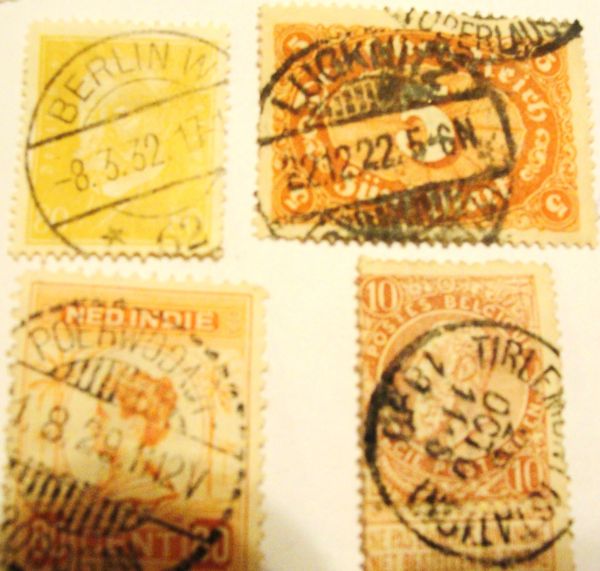
Row 5, stamp 2 is the Netherlands.
Row 6, stamp 7 is Dutch East Indies.
A nice bunch os stamps, and the cancels do make it interesting.
But if I may make a helpful suggestion; please try to put up fewer stamps per picture - makes it less confusing.
Peter |
|
Send note to Staff
|
|
|
Valued Member
United States
13 Posts |
|
|
Thanks for the info and believe me, any helpful suggestions are greatly appreciated. |
|
Send note to Staff
|
|
|
Pillar Of The Community
Australia
3547 Posts |
|
|
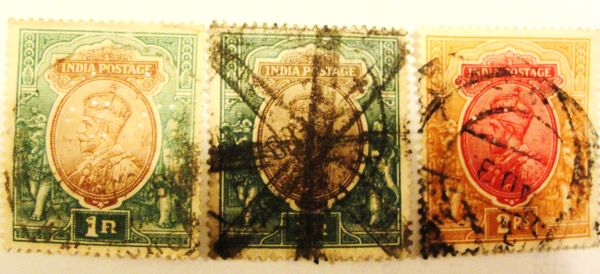
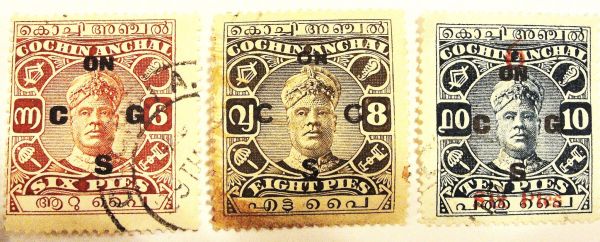
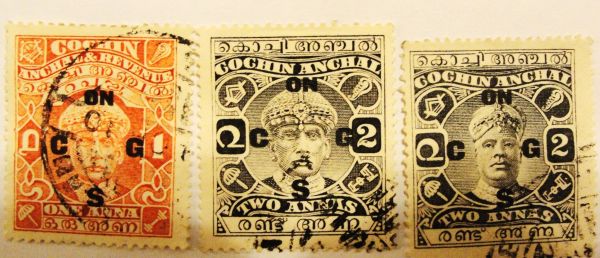
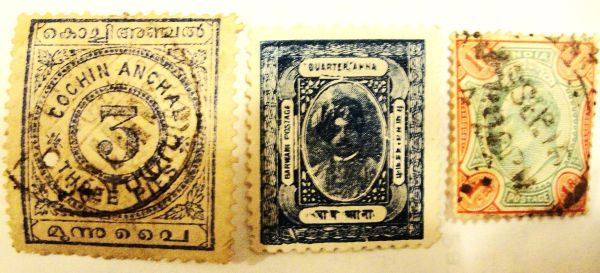
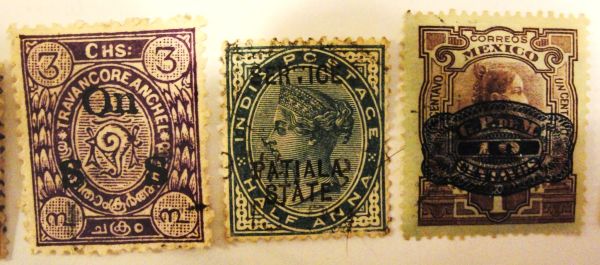
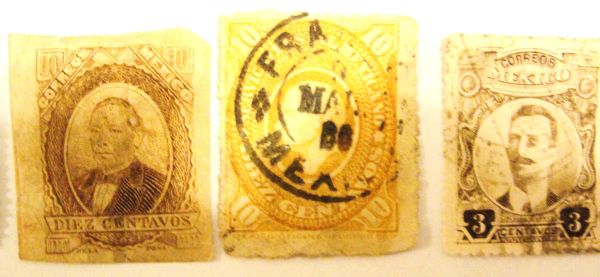
In the blown-up photos, Row 1 are India; Rows 2 and 3 are Cochin State (India); Row 4 Cochin, Barwani State (India), and India; Row 5 Travancore State (India) and Patiala State (India)
None of the cancels on these have any interest, and all minimal catalogue value, I'm afraid. |
|
Send note to Staff
|
|
|
Valued Member
United States
13 Posts |
|
|
Thank you for the info.I think that im just as interested in the cancels as I am the stamps. Are there any catalogs that deal strictly with cancels? |
|
Send note to Staff
|
|
|
Pillar Of The Community
Romania
886 Posts |
|
|
Quote:
Are there any catalogs that deal strictly with cancels? For Hungary (Magyar) there is Gudlin`s `Classic Postmarks Of Hungary`, for pre-stamp era Ber/Makkai/Suranyi: `Handbook of the Hungarian Pre Stamp Mail`. First is widely used for valuation (just check ebay, you`ll find many listings like this: http://www.ebay.com/itm/HUNGARY-186...em43b7430b08 but I`d only recommend if you have a substantial Hungarian collection. It`s listed on ebay right now: 110$. For Austria there is Edwin Muller`s catalogue. But in better stamp catalogues you can find some information on postmarks too. Michel`s Deutschland Spezial contains some infos about postmarks, I`ve now checked Prussia. Here`s what I`ve found about numeral cancels: Four ring postmarks, used bw. 15.11.1850- 31.3.1859. Numbers ranging 1 - 1987. Initially in alphabetical order, from 1=Aachen to 1725= Zützer, later when new postoffices opened, numbers added. |
|
Send note to Staff
|
|
|
Valued Member
United States
13 Posts |
|
|
Pillar Of The Community
United Kingdom
544 Posts |
|
|
Since you say you are quite new to stamp collecting, I will try to shed a little light on the Cancellations question for you. If I seem to be indulging in the pedagoguy of grand-matronly egg sucking, feel free to skip this:
Essentially there are two ways you can look at cancellations – with the eyes of a stamp collector and the eyes of a postal historian.
The stamp collector, by and large, (and almost always, if he/she is a thematic collector) doesn't much like cancellations which are large and readable, because they distract the attention away from the stamp and its design. Hence as a very rough rule used stamps are worth less than mint, and heavily cancelled stamps are worth less than very lightly cancelled ones. There are two main exceptions to this.
Exception 1 – Some stamps are issued mainly to sell mint to collectors and are very little used in the postal service of the issuing country. In these cases used stamps, especially ones covered with a large readable cancel so that it is clear they are original and not faked up, are worth more. Especially in the case of early issues of very small countries, where few people could read and write, they can be quite valuable.
Exception 2 – Some people (for reasons I have never understood, but hey ho....) like to collect stamps cancelled on the first day of issue. Be clear, since WW2 these are usually easily available on full covers, and noone would be very interested in an incomplete first day cancel on an off-cover stamp. But before that, and especially before WW1, these are scarcer and might well be worth a premium. However please don't start going over every early stamp you have and checking with a catalogue to see if it's First Day. It won't be; and when you've been disappointed 200 times you'll give up stamp collecting.
The postal historian on the other hand doesn't care too much about what the stamp underneath is. He is interested in the cancel. Admittedly he'd rather have it on a cover, but just on a stamp can sometimes be good enough.
First he may be looking for something interesting in the information it yields; e.g. proving a hitherto unknown earliest use of a stamp, or again some stamps were used in areas far away from where they were issued (India in Aden, GB in Venezuela). But as with the First Days, you have to kiss an awful lot of frog stamps before one changes into this kind of princess.
Much more realistic, at least at the start, is to build up a collection of different cancels. Some of these may turn out to be quite scarce. Do not get excited. Scarce stamps usually mean valuable stamps. Scarce, even downright rare types of cancel, whilst they will make a premium if sold to a specialist, don't attract big money. Why? Because we (and if you join us – you) postal historians are regarded by much of the stamp collecting fraternity as complete nutters. Most stamp collectors don't collect cancels so the demand for them is very low; and the prices reflect this. This is further exacerbated by the fact that (to answer your original question) there is no Universal cancel catalogue. Some countries have a specialist catalogue; most don't, though their specialist societies will probably have published articles on postmarks. In most cases those articles will concentrate on the early period. That means there is plenty of scope for a new collector, who has just been persuaded by a wise old man, to start a collection which may eventually allow him to write such an article himself.
Good luck, and initially it's fine just to collect what you want; but I can't say strongly enough that if you want to try the cancel collecting road, pick a single country quite quickly and specialise. |
|
Send note to Staff
|
|
| |
Replies: 14 / Views: 2,977 |
|




 Posted 01/23/2013 11:50 pm