| Author |
 Replies: 54 / Views: 12,173 Replies: 54 / Views: 12,173 |
|
|
|
Pillar Of The Community
United States
6668 Posts |
|
|
Valued Member
United States
43 Posts |
|
|
I too collect French stamps as part of a general Worldwide collection. It is my 4th biggest collection, after the US, Hungary and Czechoslovakia. |
Send note to Staff 
|
|
|
Pillar Of The Community
United States
5894 Posts |
|
|
I collect the classical style Fremch stamps actively (to about 1956 when they stop being attractive). |
|
Send note to Staff
|
|
|
Valued Member
France
12 Posts |
|
|
I collect france and general colonies. For information, I saw theses stamps on the first page, 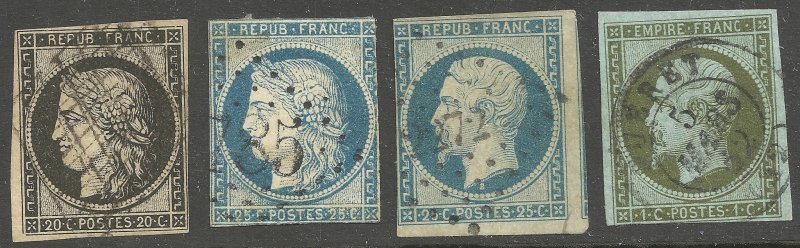 the second stamp is a mutilated one issued in the 1870s, not the one issued before. You can see it because the cancel is a losange GC issued later and you can see some perfs on the right. Regards, |
|
Send note to Staff
|
|
|
Valued Member
United Kingdom
7 Posts |
|
|
Interesting thread, and I agree with what everyone has said about the artistic merit and superb engraving quality of the French stamps. One thing you do encounter, however, particularly in the 1930s to 1950s stamps which comprise most of my French material, is a routine degree of gum toning which in some other countries might be considered a detraction. (I am talking here about an even 'tan' as opposed to foxing or rusting). I've read about this elsewhere but never looked into why it happens. Is it due to the French Postal authorities at that time using an acidic paper? |
|
Send note to Staff
|
|
|
New Member
Argentina
3 Posts |
|
|
Hi!. My name is Sergio. Im from Argentina.
I collect stamps since I was 10 years old.
Now im trying to start with France.
I need to know the differences between normal gum and tropical gum... fro explample Yvt 1230
Regards
Sergio |
|
Send note to Staff
|
|
|
Pillar Of The Community
United Kingdom
8635 Posts |
|
|
"Tropical gum" means a browning of the gum, or the stamp as a whole. It's usually associated with humid climates. Collectors who lived in humid climates would often soak off the gum to prevent the rest of the stamp from being damaged.
Yvert 1230 is the 5c arms of Lille, issued c1960. |
|
Send note to Staff
|
|
|
Pillar Of The Community
United States
1565 Posts |
|
|
Sergio: welcome to the Forum. I'm sure you will find much useful information here. |
|
Send note to Staff
|
|
|
New Member
Argentina
3 Posts |
|
|
Thanks for the welcome GeoffHa and Climber Steve.
Thanks GeoffHa, In Argentina we use the same description as you, but I think in france stamps means other thing. For us, Tropicalized gum is when the gum went brown because of weather. So the price get lower. In Yvert catalog, Stamps with tropical gum aremore expensive than teh common stamp, so I think these are two different kinds of gums. Have a look at Yvert 1233b (gomme torpicale). Someone told me that in this type of stamps teh gum is practilly invisible, not a shinny gum.
Please sorry my english!
Regards
Sergio |
|
Send note to Staff
|
|
|
Pillar Of The Community
United States
7105 Posts |
|
|
I haven't seen this because my Yvert stops at 1940, but here is a (poor) translation from Wikipedia: Quote:
This is a variety of gum affixed behind French postage stamps destined for certain markets.
The gum stamps is intended to stick on their support (envelope ...). The tropical gum withstands the humid heat of tropical overseas departments (Réunion, Guyana, Guadeloupe, Martinique) and has been used for batches of certain French stamps specifically intended for these departments. These stamps could then be stored without risk of sticking unexpectedly.
According to the Yvert and Tellier catalog, it was in the late 1970s and early 1980s that stamps were produced with this type of rubber. At the look, it is more dull than the normal gums of this period.
We can cite :
A special series of 80 centimes and 1 franc Marianne de Béquet 1976
A special series of 1 franc + 20 centimes Stamp day 1978
A special series of the 1 franc Cinquantenaire of the stadium Roland Garros 1978
A special series of 40, 60, 90 centimes and 3 francs 50 centimes, 4 francs and 5 francs type Sabine 1981 |
|
Send note to Staff
|
|
|
Pillar Of The Community
United Kingdom
8635 Posts |
|
|
Sergio
Hello. Can't find a 1233b in my 2015 Yvert, but Maury (2016) lists a 1233 Type I - i, gomme tropicale, which I presume is the kind described in Cjd's link. I shall have to take a look. It's a shame that France didn't devise this for its earlier colonial stamps!
Geoff |
|
Send note to Staff
|
|
|
Pillar Of The Community
USA
9748 Posts |
|
|
Wow, a blast from the past..glad to see the thread is still active ! |
|
Send note to Staff
|
APS 070059 Life Member International Society of Guatemala Collectors I.S.G.C. #853 |
|
|
Valued Member
United Kingdom
33 Posts |
|
|
I'm another enthusiast for French stamps. One thing that prticularly interests me is the Marianne stamps. She appears again and again - and the latest - Marianne engagee is really good. My favourites - the Dulac, the Cheffer, the Briat, the Luquet. And she keeps on turning up with other topics, like Europe or the anti-AIDS campaign.
I've a theory that the sower was the first - before she got the job in millinery modelling. |
|
Send note to Staff
|
|
|
Pillar Of The Community
United States
1121 Posts |
|
|
I really do love the stamps of France, although I don't have a particularly impressive collection of them. The Maury catalog has really opened my eyes with regards to types and variations. Here are my pages for the lined Sower issue, including most of the Maury listed types. This is why I rarely ever get rid of anything as a "duplicate". All the various types here were found hidden in my "duplicates", including the 15c Type VI. 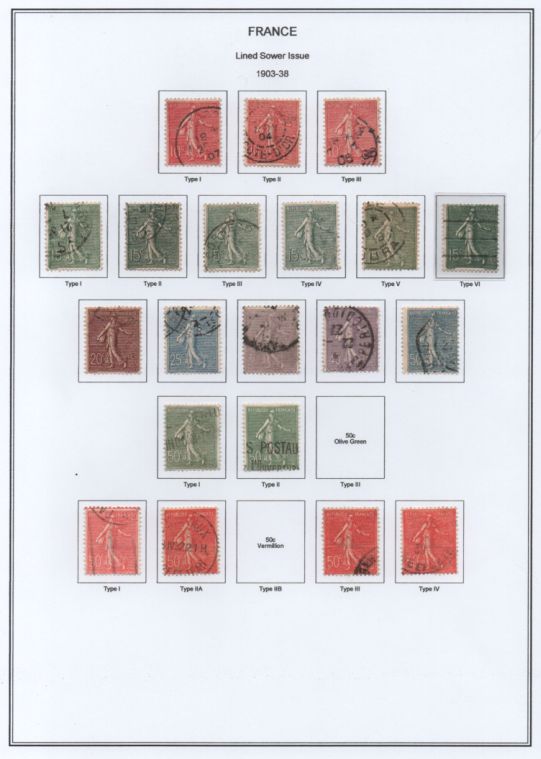 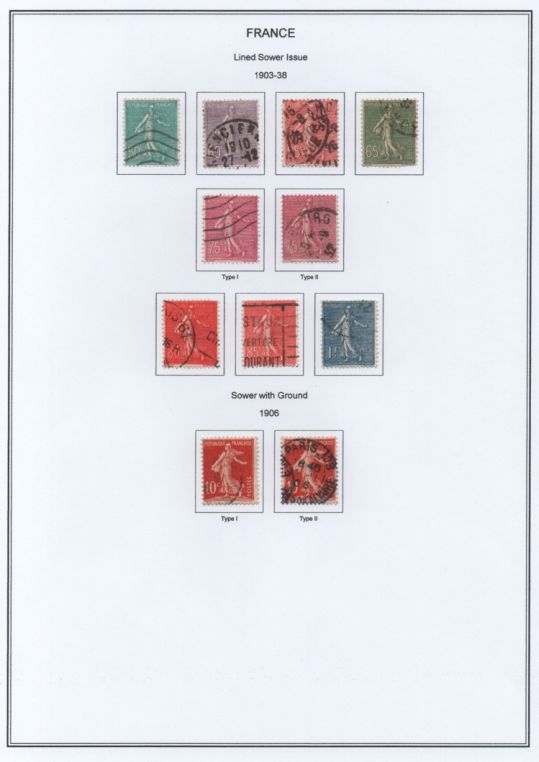 And here is one of my favorites, from the art series.  |
|
Send note to Staff
|
|
|
Pillar Of The Community
United Kingdom
8635 Posts |
|
|
Replies: 54 / Views: 12,173 |
|




 Posted 08/14/2013 1:15 pm