| Author |
 Replies: 9 / Views: 1,710 Replies: 9 / Views: 1,710 |
|
|
Pillar Of The Community
Canada
6525 Posts |
|
|
I have three of these booklets of QEII transports, two with DEX gum and one with PVA 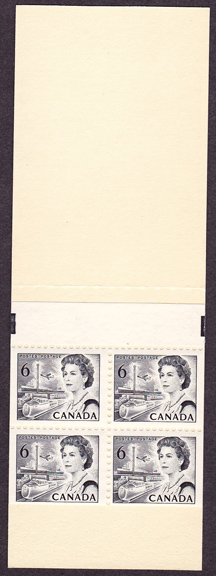 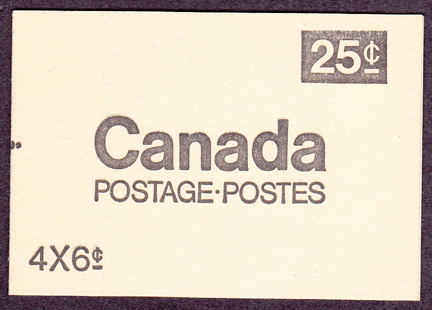 Innocent enough I suppose until you look at the price on the cover. Since when does 4 x 6¢ = 25¢? Goes to show you can't count on Canada Post. Though I don't think it subtracts from the item itself. Perhaps it hides a multiple of sins? The addition of the bilingual cover certainly helps....oh, somebody stop me! |
|
Send note to Staff
|
|
|
|
|
Pillar Of The Community
Canada
652 Posts |
|
|
they were anticipating the phasing out of the penny and used the rounding up system. |
Send note to Staff 
|
|
|
Pillar Of The Community
2361 Posts |
|
|
In the U.S., you now pay a substantial premium over face value for stamped envelopes and cards. No freebies anymore. As it is, they only charged 1c for that little book, surely well below cost, even then. |
|
Send note to Staff
|
|
|
Valued Member
392 Posts |
|
|
The Canada Post Office received a lot of criticism at the time. The same mistake was not made when the 7c booklet was produced:  The Opal booklet had 20 cents worth of stamps and sold for 25 cents. |
|
Send note to Staff
|
|
|
Pillar Of The Community
United States
6756 Posts |
|
|
I'm not familiar with Canadian booklets.
But with only a couple of exceptions, up to the 1940s almost all the early US booklets were sold at 1c over face value. Sort of a packaging charge. This practice was continued for a handful of booklets as late as the 1960 7c airmail booklet, which sold for 85c instead of the 84c face value.
The early regular issue US self-adhesives (10c Christmas weather vane doesn't count) were also sold at above face value. For example, the 25c self-adhesive eagle had a face value of $4.50 for the pane, but was sold for $5. The three 29c self-adhesive eagle/shield panes and coil strips each had a face value of $4.93, but initially sold for $5. That policy was changed after a few months (don't remember how long), and they began selling for FV of $4.93. After that, all US self-adhesives sold at face value. |
|
Send note to Staff
|
| Edited by khj - 05/02/2013 12:08 am |
|
|
Pillar Of The Community
Canada
4648 Posts |
|
|
They were the good ole days jamesw.
I remember that every time I had 10 quarters in my pocket, I would go to the post office vending machine and buy a complete set every time. The designs would come out different for each quarter inserted.
I still have some of those booklets too.
Chimo
Bujutsu
|
|
Send note to Staff
|
|
|
Pillar Of The Community
Canada
1401 Posts |
|
|
All vending machines selling stamps in Canada were set for 25 cent coins.
The extra cent charged was because the machine could not accept nickels, dimes, or pennies. |
|
Send note to Staff
|
|
|
Pillar Of The Community
Canada
6525 Posts |
|
|
Well that makes sense. Though I like to think Canadianphilatelist was right suggesting how forward thinking Canada Post to anticipate the demise of the penny. Here's another one that added up correctly. 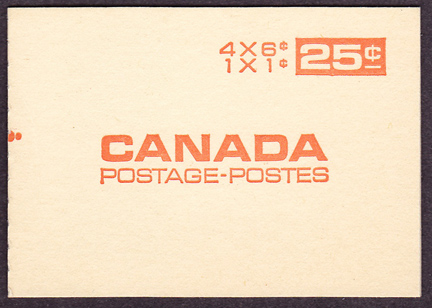 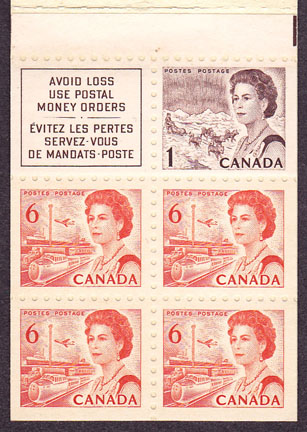 |
|
Send note to Staff
|
|
|
Valued Member
392 Posts |
|
|
The back of the 6c black booklet was not shown initially in this discussion. The Post Office did provide an explanation :  But that extra penny really bothered some people. Seems silly to me but as a result we have seen interesting se-tenant combinations over the years. |
|
Send note to Staff
|
| Edited by lorddenning - 05/03/2013 12:59 am |
|
|
Pillar Of The Community
Canada
6525 Posts |
|
|
true lorddenning, the books do say that on the back, but the setennant book shown above predates the 4x6¢ book by 2 years. So does that mean, because of printing and service costs they removed the one cent stamp? |
|
Send note to Staff
|
|
| |
Replies: 9 / Views: 1,710 |
|




 Posted 05/01/2013 10:21 pm


