| Author |
 Replies: 13 / Views: 3,045 Replies: 13 / Views: 3,045 |
|
|
Pillar Of The Community
1545 Posts |
|
|
In 1868, John Walter Scott issued his first multi-paged postage stamp catalog, "A Descriptive Catalogue of American and Foreign Postage Stamps, Issued from 1840 to Date." 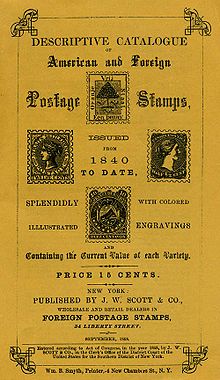 Am I correct in assuming that this was the first appearance of Scott numbers to Identify stamps? Or earlier? Or later?  -IBFS |
|
Send note to Staff
|
|
|
|
|
Bedrock Of The Community
United States
12128 Posts |
|
|
According to this timeline, the 46th edition (1888) first assigned "catalog numbers" to the stamps. Beforehand, it was just a year-by-year summary of the stamps: 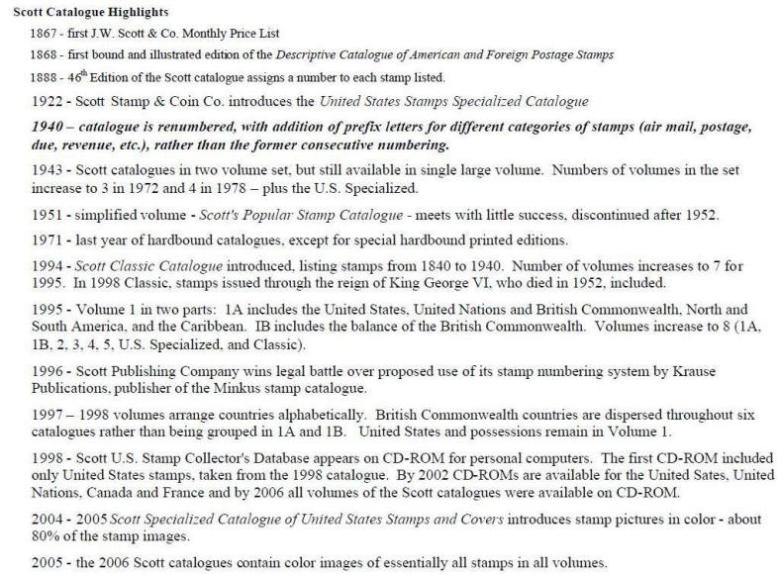 What is really confusing to me is when in 1940 they went and re-numbered the stamps, establishing sub-sections such as "C" for airmail, etc., and re-numbering all of the rest of the catalog. That must have been a very confusing time for collectors! |
Send note to Staff 
|
|
|
Pillar Of The Community
United States
6756 Posts |
|
|
I agree, it must have been a confusing time for dealers/collectors. But Scott didn't have much choice if they went the prefix route.
Using the old method, although stamps of within each type (regular, postage due, official...) may have been consecutively numbered, Scott was running out of room for the allocated range for each type of stamp. To solve this problem, Scott went to the prefix method, and took the opportunity to renumber the stamps for each prefix starting with 1.
Had they not renumbered from 1 for each major prefix, then modern K1 might have been K3280, and R1 might have been R3800. |
|
Send note to Staff
|
|
|
Pillar Of The Community
Canada
5821 Posts |
|
|
Quote:
What is really confusing to me is when in 1940 they went and re-numbered the stamps, establishing sub-sections such as "C" for airmail, etc., and re-numbering all of the rest of the catalog. Why did they do that. Basically it makes no sense to separate airmails and Semi-Postals from "regular" stamps. Other major catalogues don't do that. Even the term Semi-Postal I find odd. What is so semi about them? Primarily they pay a legitimate postal rate plus there is a surcharge for what is usually a charitable organization. |
|
Send note to Staff
|
|
|
Pillar Of The Community
United States
6756 Posts |
|
|
Quote:
Even the term Semi-Postal I find odd. What is so semi about them?
Primarily they pay a legitimate postal rate plus there is a surcharge for what is usually a charitable organization. You are not the first (in fact, many) to point this out. But... It depends on what you are applying the term "semi" towards. It could also mean exactly what you described. Part of the amount paid is applied for postal purposes, part of the amount paid is applied for non-postal purposes ==> hence, semi-postal (referring to the face-value of the stamp). First time I saw the term, I understood what it meant right away, and English was not my first language. The term seemed to match very well with the xx+xx inscription on the stamp. But I can certainly understand why there would be confusion if we applied the term "semi" to whether or not it is really a postage stamp. I don't think that was the interpretive intention of the person who coined the term. Always interesting to read different perspectives.  k |
|
Send note to Staff
|
|
|
Pillar Of The Community
United States
6756 Posts |
|
|
Quote:
Why did they do that. Basically it makes no sense to separate
airmails and Semi-Postals from "regular" stamps.
Other major catalogues don't do that. There are some collectors who refuse (or don't like to include) semi-postals in their collections, just like there are some collectors who don't collect any "Back-of-the-Book" stamps (another Scott concoction!). I've met some collectors who ONLY collect "semi-postal" stamps. I guess the catalog editor makes the rules for their own catalog. Agreed, none of the other major worldwide catalogs separate the "semi-postals" from the regular postage stamps. However, there are a few country catalogs that do, especially in Asia. |
|
Send note to Staff
|
|
|
Valued Member
378 Posts |
|
|
Quote:
According to this timeline, the 46th edition (1888) first assigned "catalog numbers" to the stamps. Beforehand, it was just a year-by-year summary of the stamps: wt1, I have never seen this interesting timeline before. Do you know where it is from? |
|
Send note to Staff
|
|
|
Bedrock Of The Community
United States
12128 Posts |
|
|
Pillar Of The Community
Canada
5821 Posts |
|
|
Perhaps the reason Scott separated Semi-Postals from regular stamps was the fact that the USPS did not issue any until 1998 whereas other countries especially European have issued stamps with surcharges for over 100 years.
So therefore these type of stamps seemed probably foreign or alien to the average American.
Same thing in Canada. The first ones where issued in 1974 to help support the 1976 Montreal Olympics.
Apropos semi-postals, I remember writing a letter to the Canadian Philatelic Centre in the early sixties or so asking why the Post Office did not not issue semi-postals like most European countries.
Answer was something about not being feasible because there would be
be too much accounting involved and it would be difficult to decide who would benefit from the surcharges.
I wonder in whose pockets the surcharges from the 12 Montreal Olympic
semi-postals went in? |
|
Send note to Staff
|
|
|
Pillar Of The Community
United States
6756 Posts |
|
|
Scott separated the semipostals long before the US began to issue semipostals. In fact, they separated semipostals even before the 1940 renumbering. I don't know specifically reason why Scott separated the listings.
For example, in the 1925 Scott catalog for which wt1 showed a couple of pages, the German regular stamps are numbered 1-336, airmails 401-428, and the semi-postals 475-481. Back then, Scott called them "Charity Stamps". |
|
Send note to Staff
|
|
|
Pillar Of The Community
United States
8566 Posts |
|
|
I believe in the early years of stamp collecting there were collectors who only collected airmails and/or semi-postals and there were catalogs and albums for such .Even clubs were established for them both locally and nationally .You can even see cut-outs of Postal stationeries in albums in those early years .Please remember the editors of those early catalogs were trying to look into the future to design a catalog that satisfy everybody . |
|
Send note to Staff
|
|
|
Pillar Of The Community
United States
6756 Posts |
|
|
Bedrock Of The Community
United States
12128 Posts |
|
|
For brevity, I simply photocropped the timeline from the same resource posted by khj. In fact, it is footnoted at the bottom of the Wiki link for the term "Scott Catalogue". |
|
Send note to Staff
|
|
|
Pillar Of The Community
United States
6756 Posts |
|
|
Quote:
For brevity, I simply photocropped the timeline from the same resource. Good job! The article is split into 2 parts, but the split is in the middle of that timeline. A real inconvenience to read. Your photo-cropping makes it more compact and usable! |
|
Send note to Staff
|
|
| |
Replies: 13 / Views: 3,045 |
|




 Posted 05/15/2013 5:06 pm


