Stamp Community Family of Web Sites
Thousands of stamps, consistently graded, competitively priced and hundreds of in-depth blog posts to read


Stamp Community Forum
 
Username:
Password:
Save Password
Forgot your Password?

This page may contain links that result in small commissions to keep this free site up and running.

Welcome Guest! Registering and/or logging in will remove the anchor (bottom) ads. It's Free!

Help Me Find The Plate Number On This Stamp!

 
To participate in the forum you must log in or register.
Author Previous TopicReplies: 15 / Views: 7,128Next Topic  
Valued Member

United States
107 Posts
Posted 06/30/2013   12:37 am  Show Profile Bookmark this topic Add lindseyr702 to your friends list Get a Link to this Message
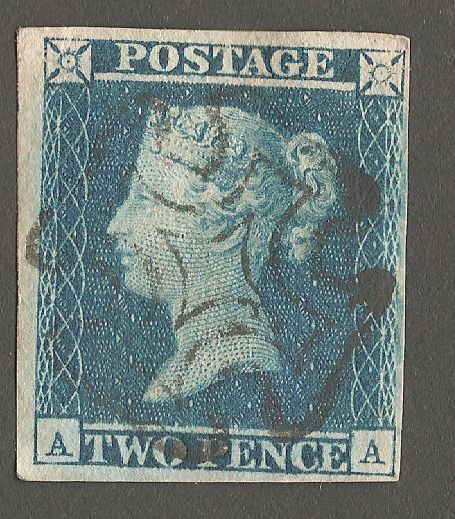
Okay - so I don't have a catalogue yet (it's been ordered!) but I'm trying to get the hang of identifying a stamp. Am I right that this is Imperf, bluish paper 2p stamp? The paper actually appears a little bluer IRL but I don't think this can be the imperf white paper stamp as that one didn't have horizontal lines above and below the vignette...right? WM is small crown.


Grrr...I hope this image is decent. I scanned it at 1200 dpi but it made the file waaaaaay to big to upload! :)
Send note to Staff

Valued Member
United States
107 Posts
Posted 06/30/2013   01:00 am  Show Profile Bookmark this reply Add lindseyr702 to your friends list  Get a Link to this Reply
Oh come on - you guys like to look at other people's stamp pictures... :D
Send note to Staff  Go to Top of Page
Pillar Of The Community
United States
6756 Posts
Posted 06/30/2013   01:26 am  Show Profile Bookmark this reply Add khj to your friends list  Get a Link to this Reply
Yes, you have 2d blue issue of 1841. In the Scott catalog, this would correspond to GB #4 -- imperforate on blued paper with small crown watermark. Nice corner position stamp with 4 clear margins, and clear centered Maltese Cross cancel.

The plate number is not inscribed directly on this stamp. The plate number has to be determined by plate characteristics. I don't have the plate characteristics in front of me right now; perhaps someone else can ID the plate number for you.
Send note to Staff  Go to Top of Page
Pillar Of The Community
Australia
1865 Posts
Posted 06/30/2013   01:27 am  Show Profile Bookmark this reply Add 22crows to your friends list  Get a Link to this Reply
The experts are probably still asleep.
Not sure if this will be helpful to you. The 2d stamp (impf) with white lines was printed from Plates 3 and 4. The number of the plate for this stamp was not indicated in the design of the stamp but was printed on the sheet margin (info from SG Great Britain Concise stamp catalogue).
Send note to Staff  Go to Top of Page
Valued Member
United States
107 Posts
Posted 06/30/2013   01:31 am  Show Profile Bookmark this reply Add lindseyr702 to your friends list  Get a Link to this Reply
Thank you to you both! How will I know which stamps have the plate numbers printed on them? Will that be indicated in my Scott cat? This is so exciting, I can't wait to get my cats!!
Send note to Staff  Go to Top of Page
Pillar Of The Community
United States
6756 Posts
Posted 06/30/2013   01:42 am  Show Profile Bookmark this reply Add khj to your friends list  Get a Link to this Reply
22crows is correct, there are only 2 plates for your stamp.

The Scott catalog will mention which stamps have the plate number on the stamp, but unfortunately doesn't tell you where to look. They appear on the 1847-1848 embossed issues, and then on most of the stamps issued from approximately 1858 through 1882. Most of the plate numbers will be obvious, but a few issues have the plate number in the scroll-work on the left and right sides.
Send note to Staff  Go to Top of Page
Pillar Of The Community
United States
6756 Posts
Posted 06/30/2013   01:50 am  Show Profile Bookmark this reply Add khj to your friends list  Get a Link to this Reply

Quote:
The experts are probably still asleep.

Since the postmark is Maltese Cross, I believe the stamp must be Plate 3, as the Maltese Cross cancel was no longer in use when Plate 4 was put into production.

Hopefully the experts can chime in and confirm/correct when they awake!

k
Send note to Staff  Go to Top of Page
Valued Member
United States
107 Posts
Posted 06/30/2013   01:55 am  Show Profile Bookmark this reply Add lindseyr702 to your friends list  Get a Link to this Reply
So for this stamp I wouldn't be able to differentiate between the two plates? Out of curiosity...what is the CV on this? I saw this stamp on Philippoppe and they had it listed as an 1840! They had the version without the horizontal lines (which, I believe is actually the 1840) and the one with the horizontal lines as both being the same issue and price
Send note to Staff  Go to Top of Page
Pillar Of The Community
United States
6756 Posts
Posted 06/30/2013   02:25 am  Show Profile Bookmark this reply Add khj to your friends list  Get a Link to this Reply
Yes, the 1840 issue is the original 2d blue (no horizontal white lines): GB #2 in the Scott catalog.

In my 2011 Scott catalog, GB #4 has a used catalog value of $85. My 2007 Scott Classic also lists the special cancels -- #4 used is $85, and #4 used with black Maltese Cross cancel is $210.

Again, a nice stamp. Definitely better than my #4!

Send note to Staff  Go to Top of Page
Pillar Of The Community
United States
6756 Posts
Posted 06/30/2013   02:28 am  Show Profile Bookmark this reply Add khj to your friends list  Get a Link to this Reply

Quote:
I wouldn't be able to differentiate between the two plates?

For this stamp, you would need a specialized book that contains descriptions of the differences between the 2 plates. This information is not in the Scott catalog.

However, as I mentioned, since it has a Maltese Cross, it theoretically should be Plate 3, as Plate 4 was put to press after they stopped using the Maltese Cross cancel.
Send note to Staff  Go to Top of Page
Pillar Of The Community
United States
7072 Posts
Posted 06/30/2013   09:30 am  Show Profile Bookmark this reply Add Cjd to your friends list  Get a Link to this Reply
There are several websites with some information. Here are two interesting examples:

http://www.pennyblackstamp.co.uk/tw...y_blues.html

and

http://www.johnlamonby.com/archive....owarticle=11

If a person is serious about these and wants to acquire some literature, there is Mike Jackson's Two Pence Blue Plating Guide from 2010.
Send note to Staff  Go to Top of Page
Valued Member
United States
428 Posts
Posted 07/05/2013   5:41 pm  Show Profile Bookmark this reply Add ldhaber to your friends list  Get a Link to this Reply
I had been away from the house and consequently my copy of the plating book was not available.

But, checking Mike Jackson's book, this copy of AA is indeed plate 3.

Imperforate with white lines can only be plates 3 or 4. With an MX on this stamp and plate 4 being introduced very late in 1849, this could not be from plate 4. Plate 3 was introduced in February 1841 whilst the MX was still in wide use.

But, the plating picture of AA was even clearer between plate 3 or 4.

Send note to Staff  Go to Top of Page
Pillar Of The Community
United States
6756 Posts
Posted 07/05/2013   6:56 pm  Show Profile Bookmark this reply Add khj to your friends list  Get a Link to this Reply
Thanks, ldhaber!

Lindsey, MX is abbreviation for Maltese Cross and refers to the cancel.
Send note to Staff  Go to Top of Page
Pillar Of The Community
United States
1125 Posts
Posted 07/05/2013   10:41 pm  Show Profile Bookmark this reply Add chipg to your friends list  Get a Link to this Reply
I wrote these up for a different site, but they may help. This is my little guide for the penny red:

Let's see if we can't get you started in figuring out what you have when you're looking at a penny red. Start with a basic question:

1- Does it have perforations?

If no (like yours), it's going to be SG catalog numbers 7-12. To narrow this down, you'll have to know a bit about how to plate the imperforate penny reds (no plate numbers are on any of the issued imperforates).

You can narrow the range of possible plates down in this way:
1a- Does it have a Maltese Cross cancellation?

- If yes, it's most likely from a plate from 1-40
- If no, it most likely from a plate from about 38-177
For the plates between 1 and 40, there are a few SG numbers - those stamps printed from the plates that printed penny blacks (1-11) are SG 7 (also referred to as (Specialized Catalog Number A2).

If it was from plates 12-40, it is one of SG 8-12 (but most likely SG8) (Specialized Catalog Number B1)

Now, moving on to the numeral-cancelled stamps (which your three are), we can look at the size and shape of the letters to put them into two batches - those printed with letters that were made with the first letter punch set - Alphabet 1 - and those made from the second letter punch set - Alphabet 2.
Alphabet 1 letters are found on plates 12-131 (still SG 8-12, but most likely SG8, and also referred to as Specialized number B1). Those printed with Alphabet 2 letters (plates 132-177) are also SG 8-12, but the Specialized numbering scheme differentiates the alphabets and calls these B2s. As a rule, the comparable letters from Alphabet 2 are larger than those from Alphabet 1 (the "G" is pretty close in both alphabets). Your middle stamp appears to have Alphabet 2 letters.

To further differentiate between SG8, 9, 10, and 11, you have to look at the colors. SG8 is red-brown; SG8a is on very blued paper; SG9 is pale red-brown; SG10 is deep red-brown; SG11 is lake-red (very rare); and SG12 is orange brown. Virtually everyone just calls the bulk of the stamps in this batch "SG8" unless there is a really good reason to think it's one of the others.

There are various ways to further narrow down individual stamps and match them to the plate that originally printed them. This has to do with looking at the position of the letters within the lower corner boxes, other marks that may have resulted from the plate making process (such as the blur on the top left of your first stamp), gaps in the lines around the stars at the top corners, remnants of guide lines, doubled letters, etc. Plating is about 50% science and 50% art and is beyond the scope of this note.

Now, moving on to the perforated reds:
There are many different varieties of these. I've chosen to just ignore the perforated reds in my collection (my choice). However, let me hit the high points:

2 - are there "stars" in the top corners, or letters?

If "stars," they'll fall in the range of catalog numbers SG 16-42 (Specialized numbers CE1-3 and C1-13). These are differentiated by the die used to print the profile (dies 1 and 2 were used for these issues), alphabet punch sets (1, 2, and a new set, 3, were used for these issues), perforation, paper, watermark, and color.

3 - If there are letters in all four corners, the stamps are SG 43-53 (Specialized category "G"). These are the stamps that have the plate numbers within the turnings at the sides of the Queen's head.

If you want a quick run down of the different stamps I'm talking about here (and relative values), you might want to check out the specialized price list put out by someone like Arthur Ryan. (http://www.gbstamps.co.uk). If you select his "stamp price list" link, then choose "Queen Victoria stamps." There, you'll see a list of all of the stamps with the SG number, the Scott number, and a brief description of the stamp.

Hope that helps get you started.
Chip
Send note to Staff  Go to Top of Page
Pillar Of The Community
United States
1125 Posts
Posted 07/05/2013   10:49 pm  Show Profile Bookmark this reply Add chipg to your friends list  Get a Link to this Reply
and here's the 2d blue:

More than you wanted to know about the 2d blues:
1840: Plates 1 and 2 issued. Plate 1 printed stamps that were available in early May. Plate 2 went to press in July. Both are usually cancelled by the Maltese Cross.
Note on the Maltese Cross - it was originally inked in red, but postmasters were instructed to switch to black in in February 1841 (though there were some trials of black ink in London in late 1840.
1841: New 2d plate made - Plate 3 - with white lines at top and bottom. This plate was registered on February 25, 1841 and went to press a day or so later. At this time, the standard cancellation was a black Maltese cross
1844: The Maltese Cross obliterators were replaced by a series of numeral cancellation devices - 5 different styles. Plate 3 continues to be used to produce 2d blue stamps
1849: Plate 4 of the 2d blue is put to press (and plate 3 retired). Note that this is 5 years after the Maltese cross was retired.
1854: Perforated stamps became the norm

Shades: pale blue, blue, dark blue - all the same value. Also, violet blue, which was only printed in 1851 (so therefore only on plate 4), is very scarce, has a catalog value of £1800, and requires certification. Unless you bought it as a violet-blue, it most likely isn't. Save your money on the certification fees unless you're virtually certain.

Therefore:
If it is a 2d blue with white lines and a Maltese cross, it is almost certainly from plate 3
If it is a 2d blue with white lines and a numeral cancellation, it can be from either plates 3 or 4.
As the MX was only used for 3 years on one plate, it has a premium value (SG catalog for an 1841 2d with MX is £250, with a numeral cancellation is £100)

Exceptions:
There are 1840 2d blues (no lines) that have numeral cancellations, but these are the exception and are worth a premium (SG catalog for an 1840 with MX is £850, with an 1844 numeral is £2500)
There may be a plate 4 with a MX, but I haven't seen one.

When you look at the perforated 2d blues (with the 1841 "white lines, letters on the bottom only," you're looking at something from plates 4 to 6. These can have different perforations (perf 14 or 16) and different watermarks (large or small crown).

Once you move to the ones with the letters in all four corners, you can find the plate number in the scroll work to the sides of the Queen's head.

Enough?

Chip
Send note to Staff  Go to Top of Page
Valued Member
United States
107 Posts
Posted 07/05/2013   11:33 pm  Show Profile Bookmark this reply Add lindseyr702 to your friends list  Get a Link to this Reply
Wow, thank you for all of the excellent information, I will be bookmarking this post!
Send note to Staff  Go to Top of Page
  Previous TopicReplies: 15 / Views: 7,128Next Topic  
 
To participate in the forum you must log in or register.

Go to Top of Page

Disclaimer: While a tremendous amount of effort goes into ensuring the accuracy of the information contained in this site, Stamp Community assumes no liability for errors. Copyright 2005 - 2026 Stamp Community Family - All rights reserved worldwide. Use of any images or content on this website without prior written permission of Stamp Community or the original lender is strictly prohibited.
Privacy Policy / Terms of Use    Advertise Here
Stamp Community Forum © 2007 - 2026 Stamp Community Forums
It took 0.25 seconds to lick this stamp. Powered By: Snitz Forums 2000 Version 3.4.05