| Author |
 Replies: 10 / Views: 2,075 Replies: 10 / Views: 2,075 |
|
|
Rest in Peace
7742 Posts |
|
|
Guys Can anyone tell me what colour this stamp is...red, orange, etc...???? 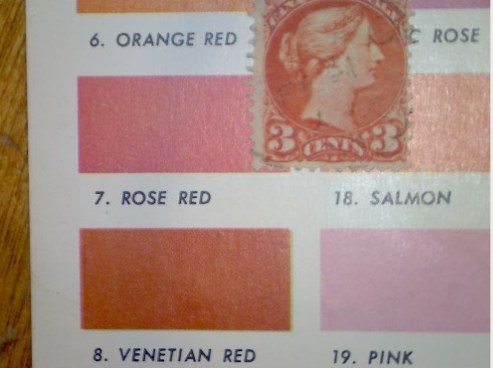 Or how about these three stamps to..?? 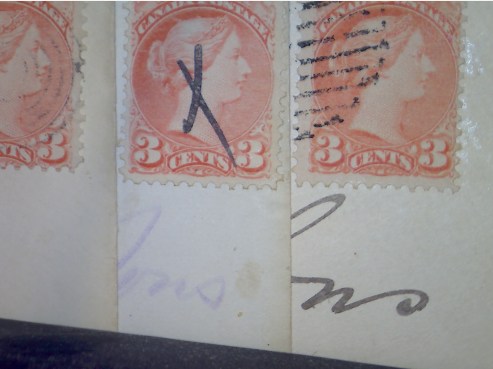 |
|
Send note to Staff
|
| Edited by wert - 09/14/2013 12:49 pm |
|
|
|
|
Valued Member
United States
8 Posts |
|
|
Can somebody help me out and tell me if these are the ones people dream about. I can't figure out and I am nowhere near a perforation gauge nor do I have much experience. I would live for them to be Scott 423e. SL would the one the helped identify them to be 423e's and they were right.... Shoot my windows phone wont upload these....grrrrr |
Send note to Staff 
|
|
|
Pillar Of The Community
Canada
1401 Posts |
|
|
Wert - the top stamp may be Brown Vermilion Red SC 41iv
The far left of the three - uncertain.
The meddle stamp may be Indian Red SC 37b
The right stamp may be Copper Red also SC 37b
Extremely difficult to tell. |
|
Send note to Staff
|
|
|
Pillar Of The Community
Canada
1401 Posts |
|
|
Sean - as there's no Canadian stamp numbered SC 423e, please post a photo or better description. |
|
Send note to Staff
|
|
|
Rest in Peace
7742 Posts |
|
|
BlackJag You know what..i checked the perforation on this cover stamp and it measured 12.5 perforation, now you say it may be a Indian Red Scott #37b..so I looked it up and if it is Indian Red, that would make it a Scott #37d..Or am I imagining things...See picture below. 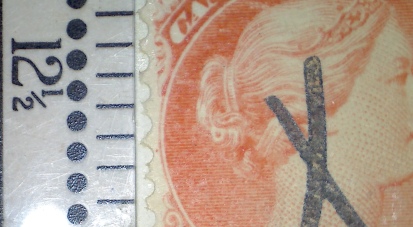 Sorry about the colour tinting..Not all USB Microscopes are the same. Below is another try at getting the reddish colour to come out in these pics. 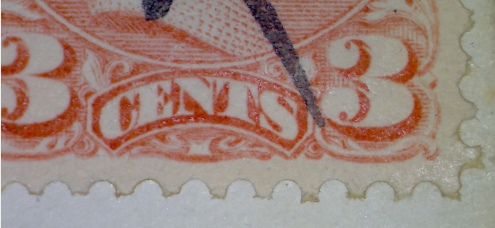 |
|
Send note to Staff
|
| Edited by wert - 09/16/2013 6:27 pm |
|
|
Rest in Peace
Canada
6750 Posts |
|
|
The top stamp looks like copper red to me, not allowing for any perf differneces.
The lower stamps, two on left, look like a rose shade, from #41 era.
The right stamp loos like a 41 vermillion or light orangish shade somewhat.
It is very hard to tell on a computer screen any colours of small Queens as the colouyrs shown by different monitors vary, the perfs vary (and I have littl ecperience with perfs myself unfortunately), and the colours canbe influenced by oxidising (really sulpheting or sulphurizing I think = turns stamps from orange shades to brown shades), and by washing in water alone or a soap and water combination.
Heavy waters also affec this, as well as added complimentary chemicals (not usually used by most stamp collectors), or even different exposures to sunlight or radiations.
Your cancels seem washed out and the stamps seem washed out (water) to me but also a bit sun-faded.
The best way to compare these is to have a bunch of them together or have ones that you know are identified and confirmed by others a sthe correct shade.
Your colour guide looks to be Stanley Gibbons made, which has colours named differently than on Scott colour guides and catalogues. Another perplexing thing to run into indeed.
I have found that stamps purchased from Morth American dealers / sales compare differently to those from other parts of the world, especially France and England. This means that stamps from certain cities were used to mail items to those countries, so you can have Ottawa and Montreal printnings and colours.
|
|
Send note to Staff
|
|
|
Rest in Peace
7742 Posts |
|
|
Hi Puzzler...is there any solutions that you can place a stamp in that will bring back the colour as close to original colour as possible, or is that not a good idea..??? |
|
Send note to Staff
|
|
|
Rest in Peace
Canada
6750 Posts |
|
|
Hydrogen Peroxide, that comes in the brown-coloured bottle, for 5 seconds, out of tthe sunlight.
Sunlight turns hydrogen peroxide into water.
Search on SCF for more explanations and examples.
Some solutions and mctures of stuff will remove older cancels. |
|
Send note to Staff
|
|
|
Rest in Peace
7742 Posts |
|
|
Pillar Of The Community
Canada
644 Posts |
|
|
Keeping in mind that with Hydrogen Peroxide, you are actually removing the top layer of the stamp.
Make sure you are doing that for the right reason. Some would never go there. I wouldn't with a stamp that has any real value; but to create a reference collection of shades on common stamps, maybe... |
|
Send note to Staff
|
|
|
Rest in Peace
Canada
6750 Posts |
|
|
Removing the top layer is true but then the sulphurizing or sulpheting has already done so through it's chemical reactions.
I am not a chemist.
The true colour is almost impossible to see through and under and 'rusting' / sulphureting so to see any colour you must, I feel, remove the external resulting layer. |
|
Send note to Staff
|
|
| |
Replies: 10 / Views: 2,075 |
|




 Posted 09/14/2013 12:19 pm


