| Author |
 Replies: 9 / Views: 2,939 Replies: 9 / Views: 2,939 |
|
|
Valued Member

United States
144 Posts |
|
|
This is my first post. I have just started collecting again after a 30 year break. I am transferring my old Minkus Comprehensive collection to a combination of Steiner and Albumgen pages. I cannot locate the stamp pictured below. It should be part of the 1886 King Luiz series. It is perforated 12 1/2. It is a 25 Reis value that is blue instead of red-violet. It should be Scott 19. What do I have. Am I missing something in the catalogue? A reprint or a color changing (red-violet to blue????). Any help would be appreciated. 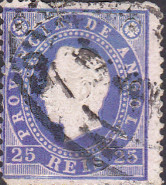 |
|
Send note to Staff
|
|
|
|
|
Pillar Of The Community
United Kingdom
544 Posts |
|
|
I'm a bit worried by the oval cancel. I am perfectly aware that postal authorities sometimes use oval handstamps - GB registration cancels, for one. But all too often ovality means fiscality.It might just be worth asking anyone who has the Bumper Book of Angolan Revenues to check whether they issued any fiscal stamps in non-postal colours. |
Send note to Staff 
|
|
|
Pillar Of The Community
Germany
1714 Posts |
|
|
Valued Member
United States
144 Posts |
|
|
Thank you both for taking the time to reply to my message. That was an interesting web site and my "BLUE" stamp does seem to match the color displayed on that web page. I probably should have posted a picture of both of my copies of the 25 reis stamp. There is a huge difference in color. I have added a new picture below. Guess I will mount both stamps on their own album page and do a little write-up and quote both of your reples. Thanks again. 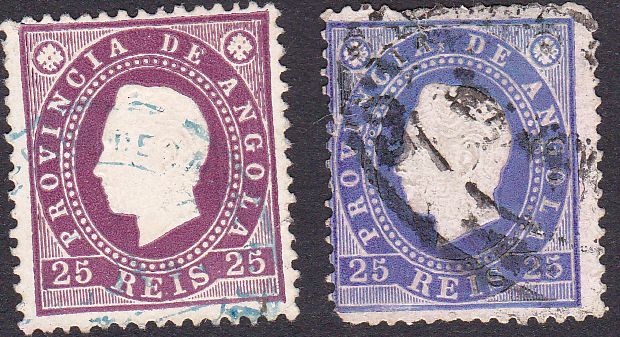 |
|
Send note to Staff
|
|
|
Pillar Of The Community
1448 Posts |
|
|
Pillar Of The Community
United States
7104 Posts |
|
|
Ruling out the revenue option is a fine idea, but according to Forbin's listings, by this time, there was a dedicated revenue stamp, in a tall rectangular format, 30mmx49mm.
Not a definitive answer, and based on 100-year-old information, but it might not pan out.
|
|
Send note to Staff
|
|
|
Valued Member
United States
144 Posts |
|
|
Thank you. I will add your comments to the page. Hopefully I will stumble on a definite answer someday and will post it to this list.
Happy New Year!
|
|
Send note to Staff
|
|
|
Valued Member
United States
104 Posts |
|
|
I had the same question as rascal. My stamp is a lighter shade of blue, with a different type of postmark. There is a pencil notation on the reverse reading 18b, or possibly 18g. Maybe the additional information will spark further insight. 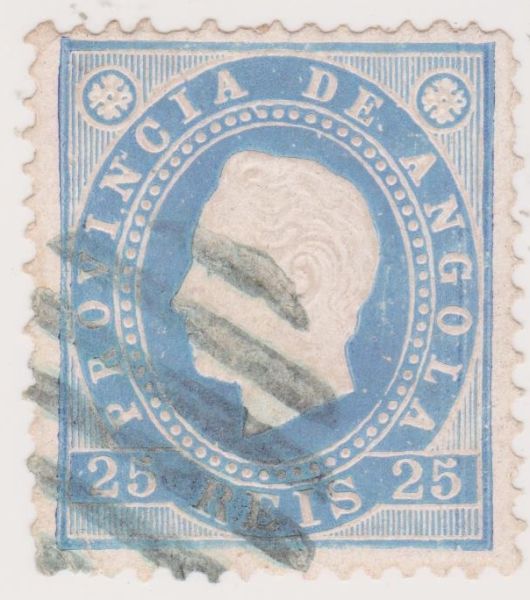 |
|
Send note to Staff
|
|
|
Pillar Of The Community
United States
1565 Posts |
|
|
The 2002 Afinsa catalogue for Portuguese colonies lists this stamp as being both violet and lilac. Seems that there would be various shades as all the classic Portuguese colonials are notorious for shades. I say "notorious" in a good way since all those shades enhance the collectibility! This particular example may be a changeling, as noted by Rascal, due to the great difference in the shade.
I wouldn't worry much about an oval cancel meaning fiscal use, as both oval and circular cancels were in use in the colonies during this time period. The hexagonal shaped cancels came in a bit later.
For johnconn, the 18b on the reverse of your stamp may be a reference to the Afinsa number. This stamp is #19 in Scott and #18 in Afinsa. Not sure what the "b" might be. The barred postmark is also common to the colonies at this time.
This stamp does have double and triple impression varieties (likely of the embossed head; I have a Timor stamp from this 1886 set with a double impression of the head). Scott numbers those as 19a and 19b. Afinsa also lists the varieties, but does not assign sub-numbers.
Thanks to both of you for sharing these neat finds. |
|
Send note to Staff
|
| Edited by Climber Steve - 07/21/2014 6:02 pm |
|
|
Valued Member
United States
104 Posts |
|
| |
Replies: 9 / Views: 2,939 |
|




 Posted 12/30/2013 6:56 pm


