| Author |
 Replies: 9 / Views: 3,379 Replies: 9 / Views: 3,379 |
|
|
Pillar Of The Community
United States
727 Posts |
|
|
|
Greetings all great philatelic gurus.
Seeking a source here:
Does anyone have any suggestions on where I can find what it would have cost to mail a standard letter from London to NYC in the early 1860s?
Thanks.
|
|
Send note to Staff
|
|
|
|
|
Pillar Of The Community
Germany
1714 Posts |
|
|
There was no universal agreement as such and countries made Treaties between themselves until the UPU 1875 one.
I believe the minimum cost of a letter to/from USA would be from port to port... then an inland rate on top of that. Not too sure of the exact rates at that time but it would be around 8 pence/ 16 cents for port to port(example Liverpool to New York or vice versa) then 1½ pence/5 cents for inland delivery.
You could Google "Postal Conventions" either US or GB for better info.
|
Send note to Staff 
|
|
|
Pillar Of The Community
United States
7104 Posts |
|
|
This is from empirepost.com in regard to an 1862 cover from Britain to New York: Quote:
The general Trans-Atlantic Packet rate from England to the United States at this time was 1 shilling for a standard weight letter (up to ½ ounce). This equaled 24¢ in US currency or 12 pence in British sterling. For American Packet carriage this sum was allocated as 3¢ (1½d) due England for its inland carriage to the Packet, 16¢ (8d) due to the packet itself for the ocean carriage and 5¢ (2½) due the US for its inland carriage. |
|
Send note to Staff
|
|
|
Pillar Of The Community
United States
727 Posts |
|
|
Ah ... great .. TY! And - being the dumb American that I am - would someone have used Penny Stamps for that? Like Penny Reds? |
|
Send note to Staff
|
|
|
Pillar Of The Community
Germany
1714 Posts |
|
|
The rates seem to have been decided by this...
British-American Diplomacy Postal Convention with Great Britain; December 15, 1848
ARTICLE I.
There shall be charged upon all letters not exceeding half an ounce in weight, conveyed either by United States or by British packets, between a port in the United States and a port in the United Kingdom, an uniform sea rate of eight pence, or sixteen cents; and such postage shall belong to the country by which the packet conveying the letters is furnished.
ARTICLE II.
There shall be charged by the post-office of the United Kingdom, upon all letters not exceeding half an ounce in weight, posted in the United Kingdom, and forwarded to the United States, or brought from the United States and delivered in the United Kingdom, whether such letters shall be conveyed by British or by United States packets, an inland postage rate of one penny halfpenny.
There shall be charged by the post-office of the United States, upon all letters not exceeding half an ounce in weight, posted in the United States, and forwarded to the United Kingdom, or brought from the United Kingdom and delivered in the United States, whether such letters shall be conveyed by United States or by British packets, an inland postage rate of five cents.
....................................................
So it seems there was no difference, for at least 14 years, in the rates in 1848 of 8 pence port to port and the 1½d and 5c inland additions right up to Cjd's 1862 rates of 8 pence port to port and the 1½ and 5c inland additions.
I'd assume stamps would be any values up to the total rate. A One Shilling stamp would be normal,I suspect but if any values were short then others might be used so Penny Reds are a possibility.
|
|
Send note to Staff
|
|
|
Pillar Of The Community
United States
1125 Posts |
|
|
London to NY - 1 Shilling per 1/2 oz.
NY to London - 24c per 1/2 oz.
(1d GB = 2c US)
Rate progression was 1x (up to 1/2 oz), 2x (up to 1 oz), 4x (up to 2 oz), 6x (up to 3 oz), etc. Partial payments were not accepted and were not credited to the final postage due.
On Jan 1, 1868, the rates were halved (6d per 1/2 oz. / 12c per 1/2 oz.)
Rates included inland postage, however, there was a 5c surcharge for mail to or from the West Coast of the US until July 1, 1863. |
|
Send note to Staff
|
| Edited by chipg - 01/03/2014 1:48 pm |
|
|
Pillar Of The Community
United States
1125 Posts |
|
|
scotzm:
That treaty determined who got what from the postage paid. For example, from NY to London, the 24 cents would be split:
US retained 5c for inland postage
The country with the contract for the transatlantic passage would retain 16c (and why you see some exchange office datestamps saying ("AM pkt." or "Br pkt." - American Packet or British Packet)
GB retained 3c for their inland postage.
In the case of the West coast, the inland postage was 10c, so the total would be 29c to send a letter from California to GB.
|
|
Send note to Staff
|
|
|
Pillar Of The Community
United States
1125 Posts |
|
|
One more (sorry) Black markings means "Due," red markings means "Credit." The two covers on this page were both sent collect. The top one was carried on a British packet has a "19 cents" marking, saying that the US owed GB that much of the final postage collected from the addressee for the GB inland (3c) and transatlantic carriage (16c) on a Cunard (British) steamer. 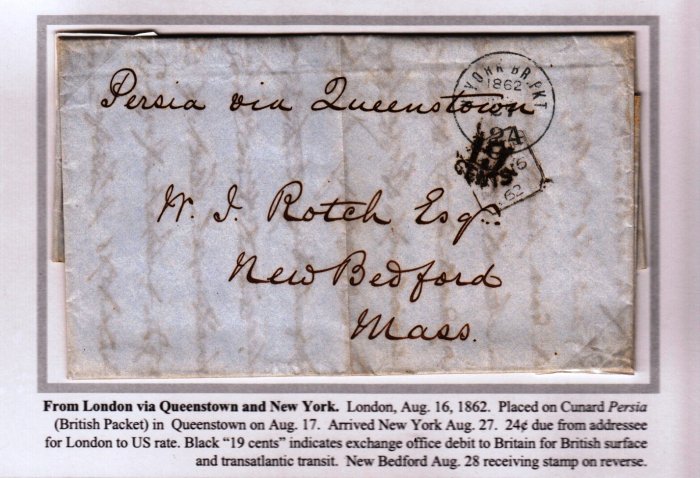 The bottom one has a black "3 cents" marking at the top, saying that the US owed GB 3c of the postage collected to cover their inland postage. The US would retain the other 21 cents, as the letter traveled on an American contract steamer (16c) and to cover the US inland postage (5c). 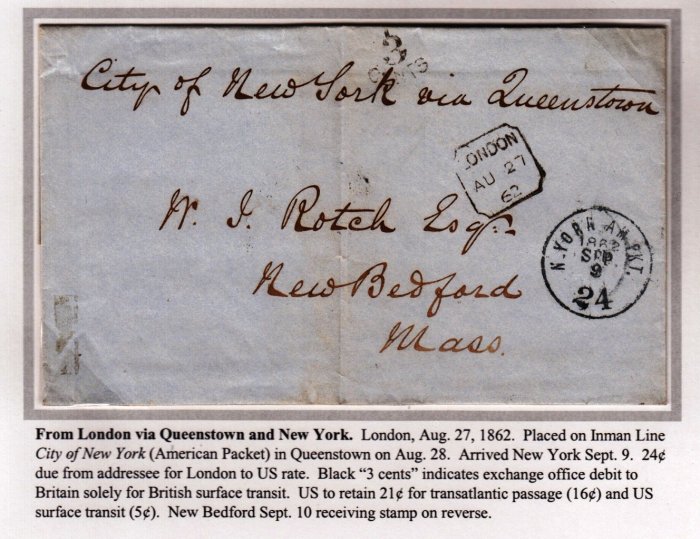 Make sense? Chip |
|
Send note to Staff
|
| Edited by chipg - 01/03/2014 1:46 pm |
|
|
Pillar Of The Community
United States
727 Posts |
|
|
Sorry to revive this (and I did do some searches here but came up empty).
What would the rates have been in England for domestic mail in 1863-64?
I am particularly interested in letters that would have been mailed from London, England, to Liverpool, England.
Thank you. |
|
Send note to Staff
|
|
|
Pillar Of The Community
United States
1125 Posts |
|
| |
Replies: 9 / Views: 3,379 |
|




 Posted 01/02/2014 06:59 am


