| Author |
 Replies: 15 / Views: 3,287 Replies: 15 / Views: 3,287 |
|
|
Pillar Of The Community
United States
577 Posts |
|
|
Australia issued a set of stamps on deep space objects. The Helix nebula, or NGC7293, is a very large planetary nebula in the constellation of Aquarius. The actual size is over two light years in diameter. It was discovered by Karl Harding sometime before 1824. One of the closest planetaries, about 700 light years distant. Although the magnitude is listed at about 6.5 it is rather spread out and that makes it more difficult to observe visually in moderate size telescopes. Scott number 1258, issued March 19, 1992.  |
|
Send note to Staff
|
| Edited by almach - 04/01/2014 2:50 pm |
|
|
|
|
Pillar Of The Community
United States
577 Posts |
|
|
Australia issued a set of stamps on deep space objects. M45 (Melotte 22) is a extremely bright open (or galactic) star cluster in the constellation of Taurus, about 440 light years distance. Only the Ursa Major group CR70, which includes five of the Big Dipper stars, is closer to us then M45. M45 was mentioned by Homer in 750 B.C. This cluster is also known as the Seven Sisters, although only six stars can usually be seen by most people. Some keen eyed observers have seen up to nine or even a dozen of the cluster's approximate 500 members. The cluster spreads out over four lunar diameters, some 2 degrees of sky. In Japanese, the name is Subaru, which is where the car gets its name. When the Pleiades rise in the east, winter is not far behind! Scott number 1259, issued March 19, 1992. 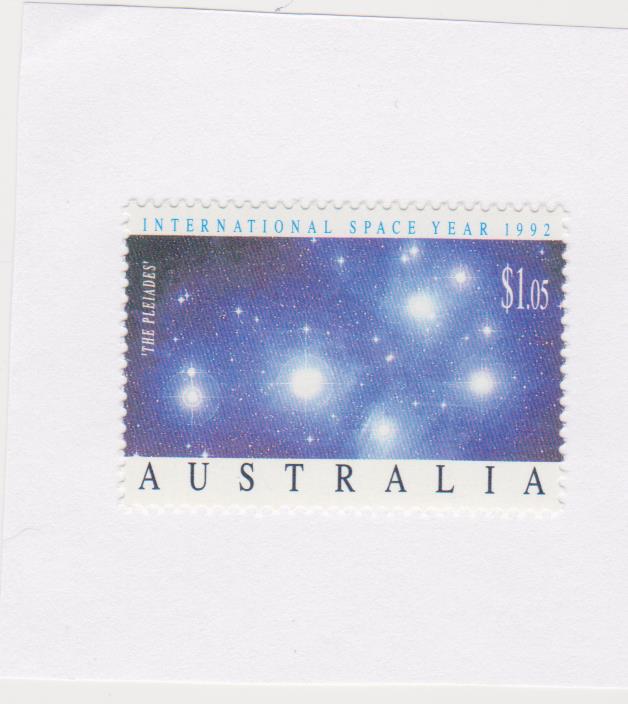 |
Send note to Staff 
|
|
|
Pillar Of The Community
United States
577 Posts |
|
|
Australia issued a set of stamps on deep space objects. NGC2997 is the brightest galaxy in the group it is in. The brightness is magnitude 10, meaning it requires a telescope, or large binoculars to visually see it. It resides in the southern constellation of Antlia. Scott number 1260, issued March 19, 1992. 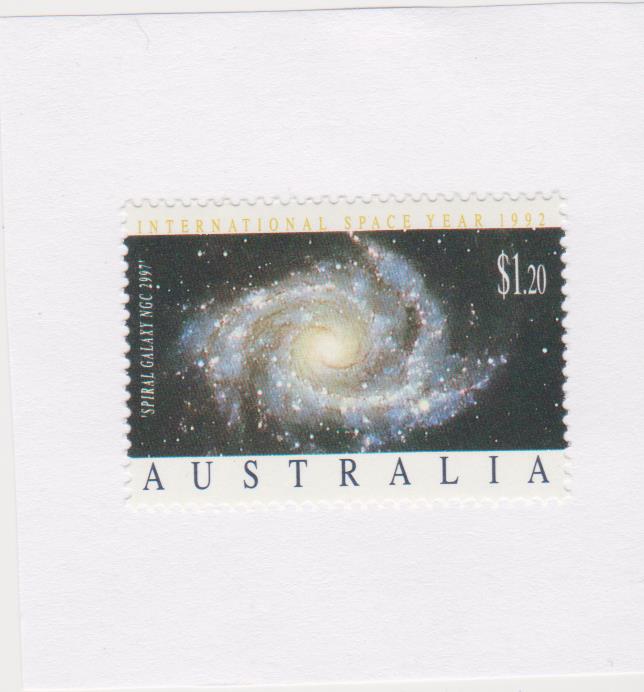 |
|
Send note to Staff
|
|
|
Pillar Of The Community
United States
577 Posts |
|
|
Great Britain issued a set of stamps on some Caldwell objects. NGC7009, or Caldwell 55, as shown on the stamp, is in the constellation of Aquarius, and is a planetary nebula (a dying star). One can see the protrusions on either side of the nebula, in a telescope, hence its name. Lord Rosse named it in the 1840's. About 2,400 light years distant, its overall brightness is about magnitude 8. William Hershel discovered it in 1782. As you can see on the stamp, this nebula is near the globular star cluster M72, some 53,000 light years away, and the asterism M73, which consists of a few stars. Scott number 2438, issued February 13, 2007. 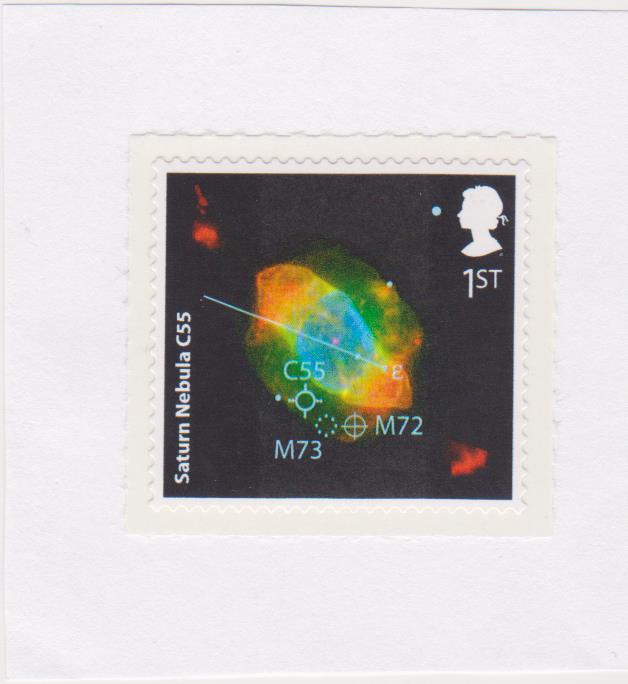 |
|
Send note to Staff
|
|
|
Pillar Of The Community
United States
577 Posts |
|
|
Great Britain issued a set of stamps on some Caldwell objects. NGC2392, or Caldwell 39, is known as the Eskimo or Clown Nebula in the constellation of Gemini. It is one of the easier planetaries to observe. The magnitude is listed around 10, but it is visually brighter than 10th magnitude. It was discovered by William Hershel in early 1787. Scott 2439, issued on February 13, 2007. 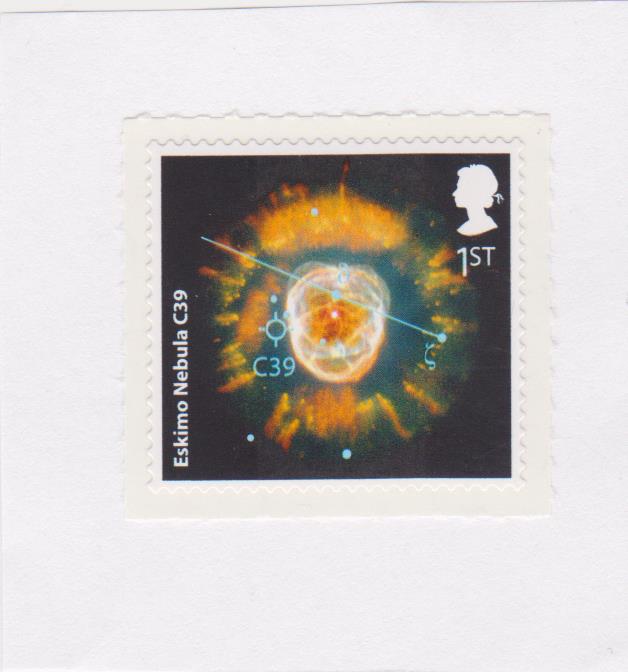 |
|
Send note to Staff
|
|
|
Pillar Of The Community
United States
577 Posts |
|
|
Great Britain issued a set of stamps on some Caldwell objects. NGC6543, or Caldwell 6, a planetary nebula, is in the constellation of Draco and is about 3,600 light years distant. It was discovered by William Hershel in 1786. The stamp shows the outer halo which was discovered by E.E. Barnard and has its own designation, IC4677. Scott number 2440, issued February 13, 2007.  |
|
Send note to Staff
|
|
|
Pillar Of The Community
United States
577 Posts |
|
|
Great Britain issued a set of stamps on some Caldwell objects. The Helix nebula, NGC7293, or Caldwell 63, is a very large planetary nebula in the constellation of Aquarius. The actual size is over two light years in diameter. It was discovered by Karl Harding sometime before 1824. One of the closest planetaries, about 700 light years distant. Although the magnitude is listed at about 6.5 it is rather spread out and that makes it more difficult to observe visually in moderate size telescopes. Scott number 2441, issued February 13, 2007. 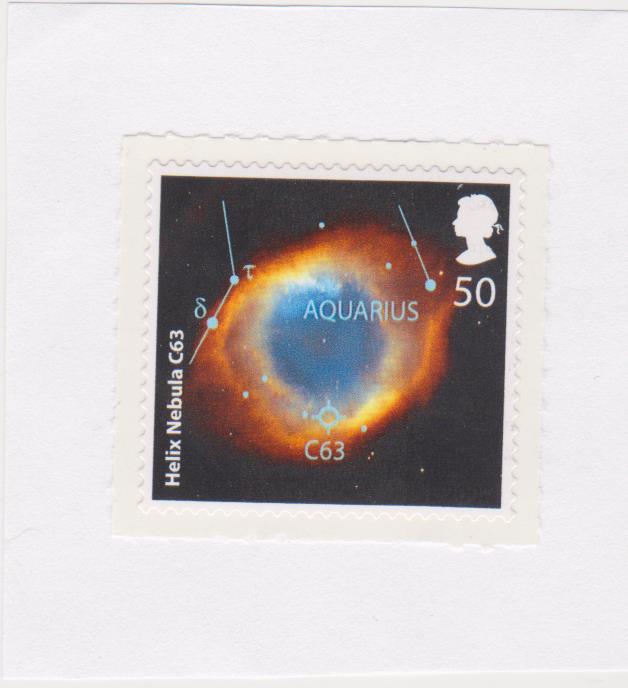 |
|
Send note to Staff
|
| Edited by almach - 04/01/2014 3:42 pm |
|
|
Pillar Of The Community
United States
577 Posts |
|
|
Great Britain issued a set of stamps on some Caldwell objects. The Flaming Star Nebula, or Sh2-229, or Caldwell 31, as shown on the stamp, is in the northern constellation of Auriga, and it is some 1500 light years distant. It is both an emission and reflection nebula, meaning it shines by both its own light and light from other nearby stars. It is near M36 and M38, two bright open clusters. Scott number 2442, issued February 13, 2007. 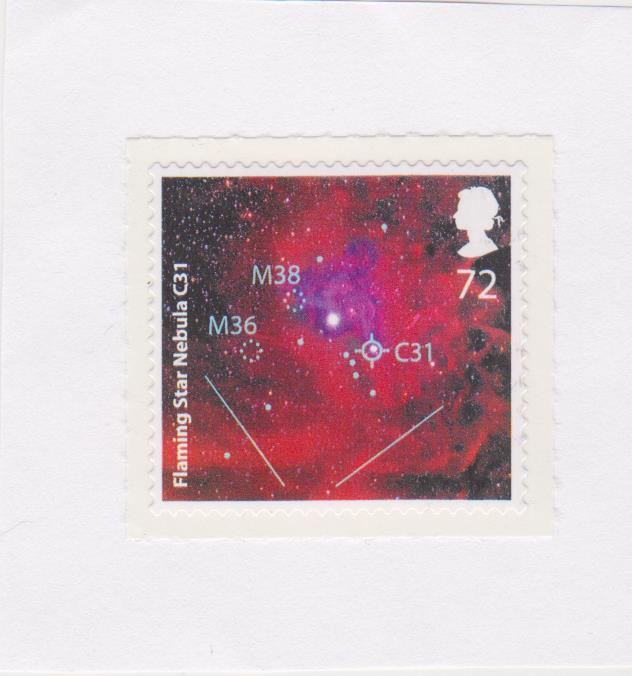 |
|
Send note to Staff
|
|
|
Pillar Of The Community
United States
577 Posts |
|
|
Great Britain issued a set of stamps on some Caldwell objects. NGC3115, or Caldwell 53, is a lenticular galaxy, that means it shows no spiral structure. It is in the constellation of Sextans, some 31 million light years distant. Scott number 2443, issued February 13, 2007. 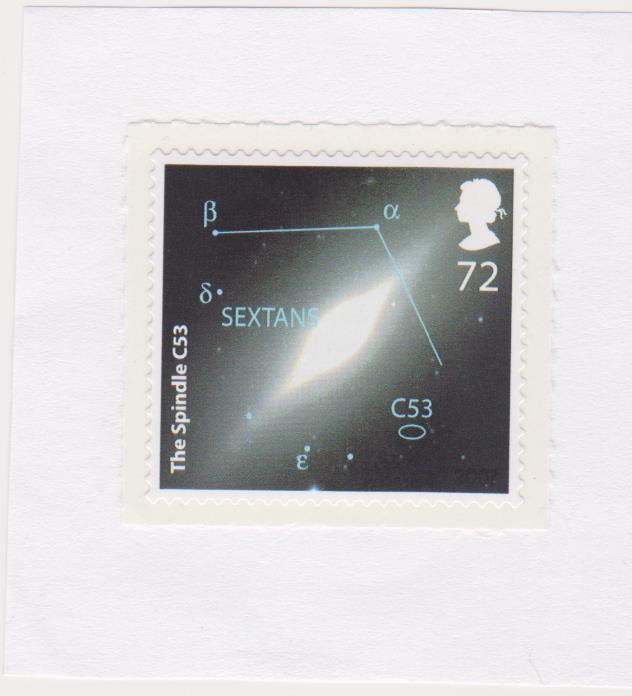 |
|
Send note to Staff
|
|
|
Pillar Of The Community
United States
577 Posts |
|
|
Great Britain issued a set of stamps on deep sky objects in 2002. Upper left image. The Ant Nebula, Mz3, is a bipolar planetary nebula in the constellation of Norma. It is about 8,000 light years distant. Its magnitude is 13.8. The nebula was discovered in 1997 by Bruce Balick and Vincent Icke. Upper right image. NGC6751 in Aquila is a planetary nebula about 6,500 light years from Earth. It is .8 of a light year in diameter, or about the diameter of 600 solar systems. This nebula is expanding at around 25 miles per second. Lower left image. ESO 97-G13 is a Seyfert galaxy, 13 million light years away in the southern constellation of Circinus. Its magnitude is 12.1. Lower right image. NGC7742 is a Seyfert galaxy in the constellation of Pegasus. Like other Seyfert galaxies, a black hole is suspected at their centers. This galaxy is 72 million light years distant; that means that the light we see today left there when dinosaurs roamed the Earth (during the Cretaceous period). Scott number 2075A-D, issued on September 24, 2002. 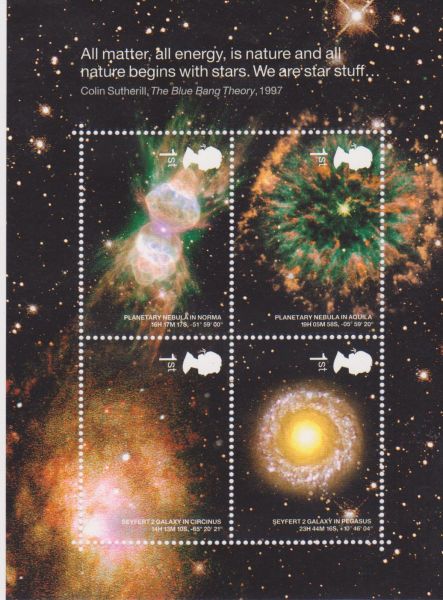 . |
|
Send note to Staff
|
|
|
Pillar Of The Community
United States
577 Posts |
|
|
Mexico issued a set of stamps for the Astrophysics Congress and the inauguration of an observatory at Tonanzintla. This stamp shows the Whirlpool galaxy, M51 and its companion NGC 5195, an irregular galaxy that may have interacted with M51 in the past, in the constellation Canes Venatici. M51 is 23 million light years distant. The spiral structure can be seen on a clear, steady night with a moderate or larger telescope. Charles Messier discovered this galaxy in 1773. Scott number 776, issued February 17, 1942. 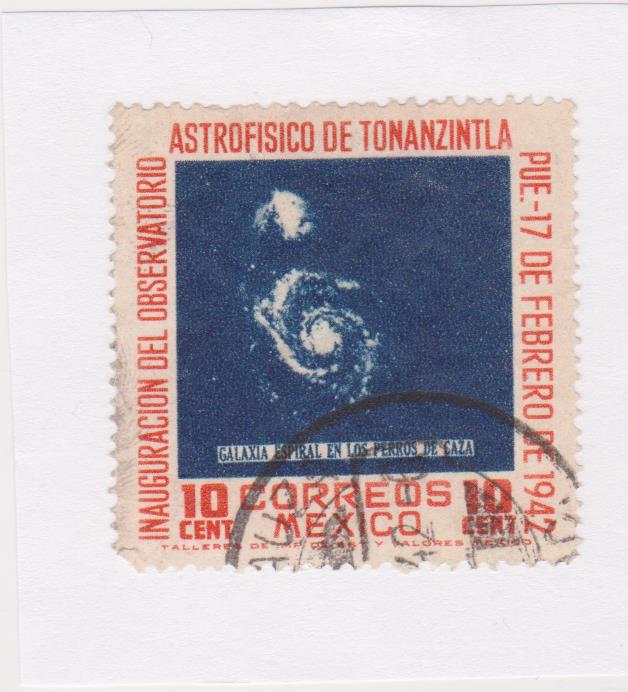 |
|
Send note to Staff
|
|
|
Pillar Of The Community
United States
577 Posts |
|
|
Mexico issued a set of stamps for the Astrophysics Congress and the inauguration of an observatory at Tonanzintla. This stamp depicts the Ring Nebula, M57, or NGC6720, a planetary nebula in the constellation Lyra. Easily seen in binoculars, M57 is an amazing sight in even a small telescope. It lies between Beta and Gamma Lyrae and is about 2,300 light years distant. Scott number C124, issued February 17, 1942. 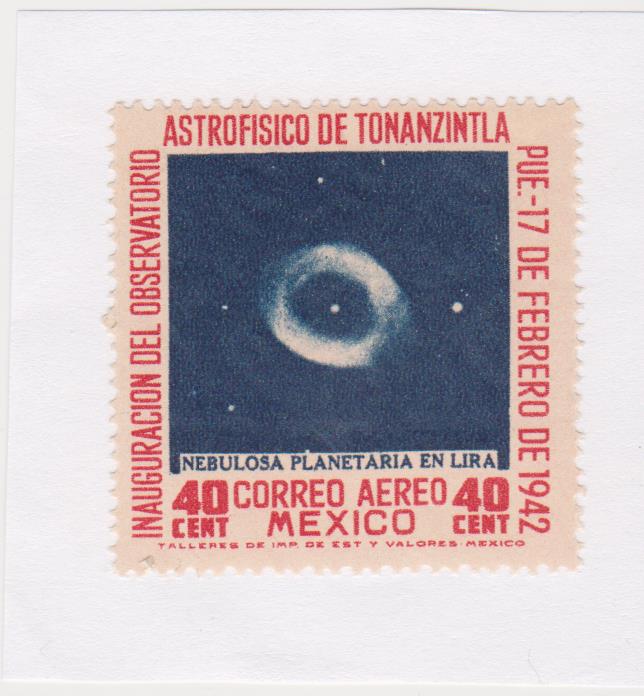 |
|
Send note to Staff
|
|
|
Pillar Of The Community
United States
577 Posts |
|
|
Mexico issued a set of stamps for the Astrophysics Congress and the inauguration of an observatory at Tonanzintla. This stamp depicts the Sombrero galaxy, M104, or NGC4594 is in the constellation of Virgo and lies some 28 million light years distant. Scott number C123, issued February 17, 1942. 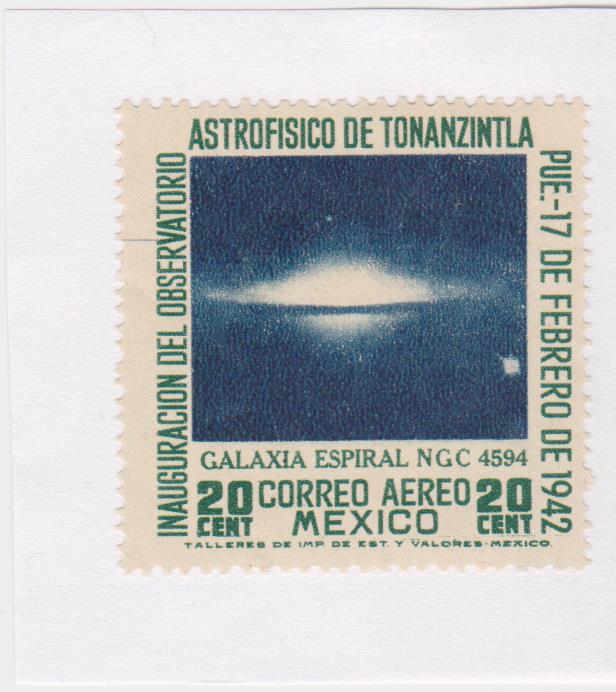 |
|
Send note to Staff
|
|
|
Pillar Of The Community
United States
577 Posts |
|
|
Mexico issued a set of stamps for the Astrophysics Congress and the inauguration of an observatory at Tonanzintla. This stamp shows the Horsehead Nebula, a dark and diffuse nebula, Barnard 33, in the constellation of Orion, that can be seen due to the illumination of background stars. It is about 1500 light years distant and is east of the easternmost star in Orion's belt, Alnitak. The bright area to the left of the Horsehead Nebula is IC434, the Flame Nebula. Scott 774, issued February 17, 1942. 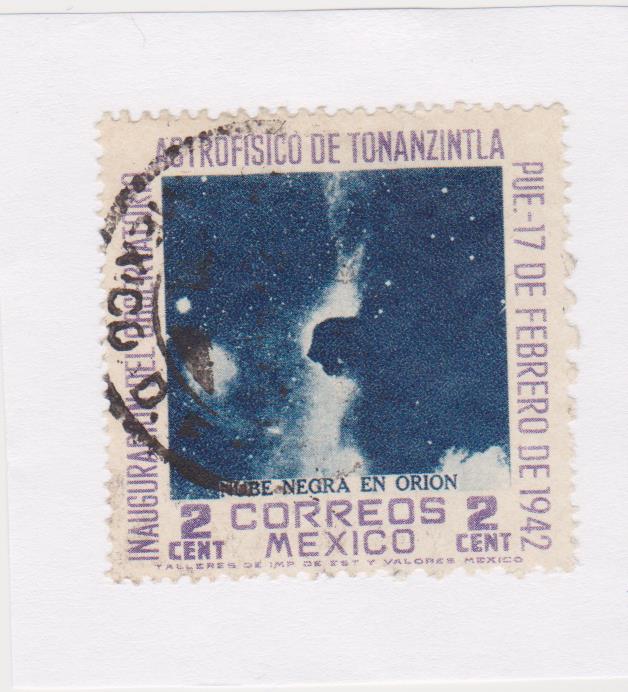 |
|
Send note to Staff
|
|
|
Pillar Of The Community
United States
577 Posts |
|
|
United States issued a set of stamps on Hubble photographs. From the top row, from left to right, here are the descriptions of the photographs. M16 is a open cluster/diffuse nebula and is known as the Eagle Nebula, in the constellation of Serpens. The stamp shows the portion known as the Pillars of Creation. The Pillar shown is about a light year long. M57, or the Ring Nebula is a planetary nebula in the constellation of Lyra. It is rather bright and easy to spot in a telescope. It is 2,300 light years distant. The Lagoon Nebula, or M8, is an emission nebula in the constellation Sagittarius, about 4,100 light years distant, and the actual size is 110 by 50 light years. It was discovered by Giovanni Hodiema before 1654. The Egg Nebula, CRL 2688, is a protoplanetary nebula (meaning that the nebula has not yet become a full fledge planetary nebula) in the constellation of Cygnus about 3,000 light years distant. NGC1316 is a lenticular galaxy in the constellation of Fornax. It is about 70 million light years away. Scott numbers 3384-3388, issued April 10, 2000.  |
|
Send note to Staff
|
|
|
Pillar Of The Community
United States
577 Posts |
|
| |
Replies: 15 / Views: 3,287 |
|




 Posted 04/01/2014 2:45 pm