They don't particularly bother me that much either, but I have removed quite a few by erasing - and I have never caused any "additional damage". The key is that you MUST use a kneaded eraser, a shield, and a very light touch. The kneaded eraser is the gray colored type that usually comes wrapped in cellophane and is about .25" x 1.5" x 1.25" and has a consistency just a bit stiffer than cold "silly-putty". No other easer will do.
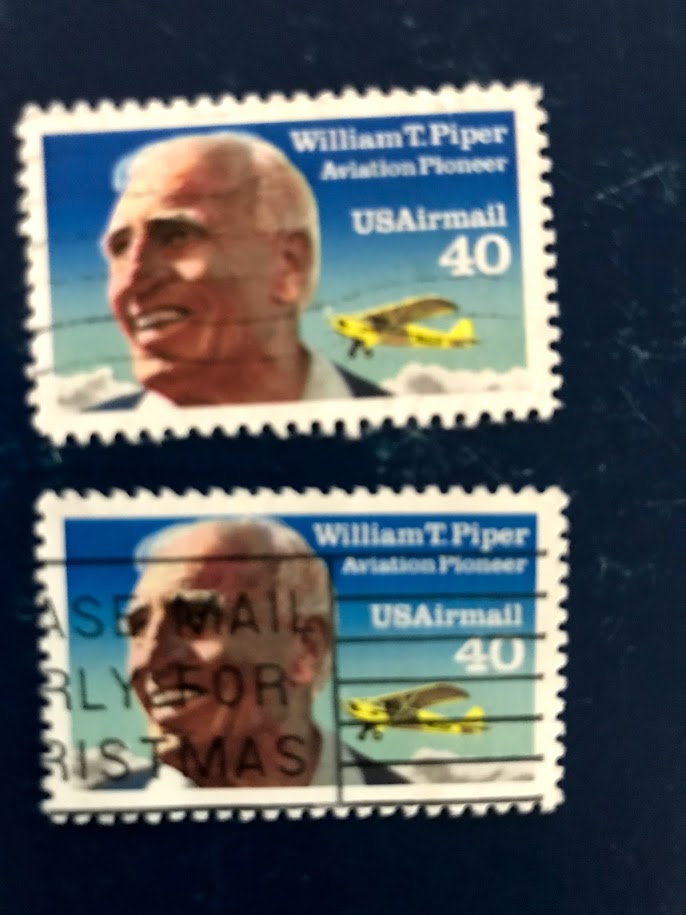
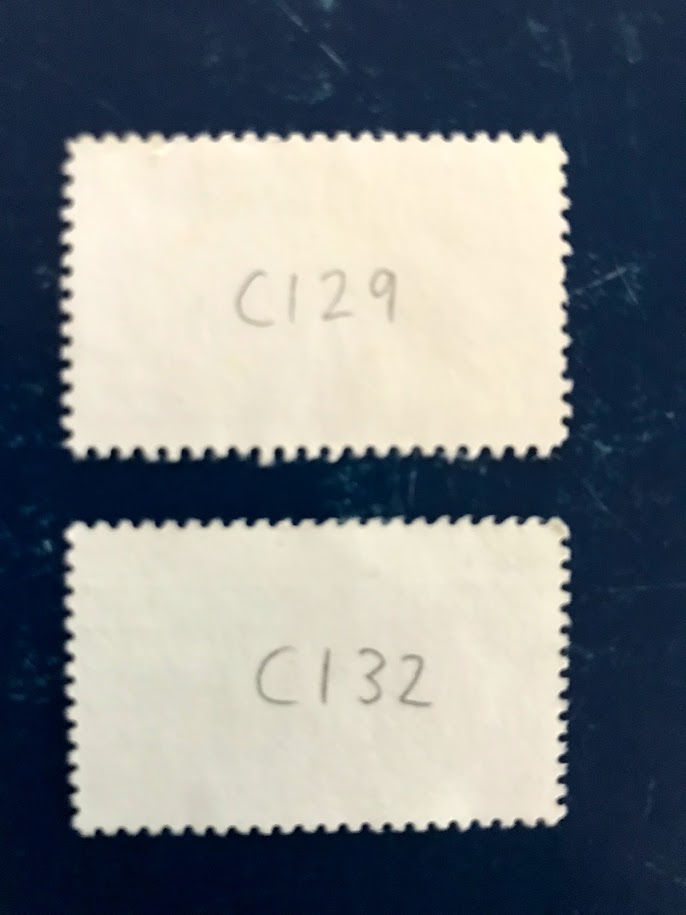
I use pencil markings sparingly and would not shy away from a stamp with pencil markings. Here is an example of why to add pencil markings. These stamps are common and they are a pain to re-identify because the prefs only differ by 2 points.
The Piper stamps are very easy to ID without a perf gauge. As Scott notes: C129 has blue sky above Piper's head and is line-perf, having irregular perforation intersections at the corners. C132 has Piper's head touching the upper frame and is bullseye perf, with perfect corner intersections.
If the pencil notation is light and does not damage the stamp paper I have no objections on a used or even a no gum unused stamp but would not like it on a gummed stamp for the simple reason that writing on gum is more difficult, creates skips and has higher chance damaging a stamp, although I do not regard these notations as damage. Certainly a dull pencil point should be used.
Of course some of these notations could be expert marks as well. In the autograph field, Mary Benjamin, Paul Richards and Charles Hamilton would have small notation on historical documents. Richards for example would put the last 2 years of the date and the price in the upper left hand corner of for example a presidential appointment. And this was on the face of the document. I wouldn't of course condone this for stamps but for autograph collectors I don't think anybody really minded it. It certainly was not regarded as a flaw or damage and was often appreciated as a historical curiosity as it provided a historical pricing guide, expertization and provenance all in one fell swoop.
It's been my experience that if the stamp comes with a number written on the back , look closer at identifying it . I sometimes buy large lots and I've seen stamps have 3 different Scott numbers on the back !
Disclaimer: While a tremendous amount of effort goes into ensuring the accuracy of the information contained in this site, Stamp Community assumes no liability for errors. Copyright 2005 - 2026 Stamp Community Family - All rights reserved worldwide. Use of any images or content on this website without prior written permission of Stamp Community or the original lender is strictly prohibited. Privacy Policy / Terms of UseAdvertise Here





 Posted 04/04/2014 9:36 pm