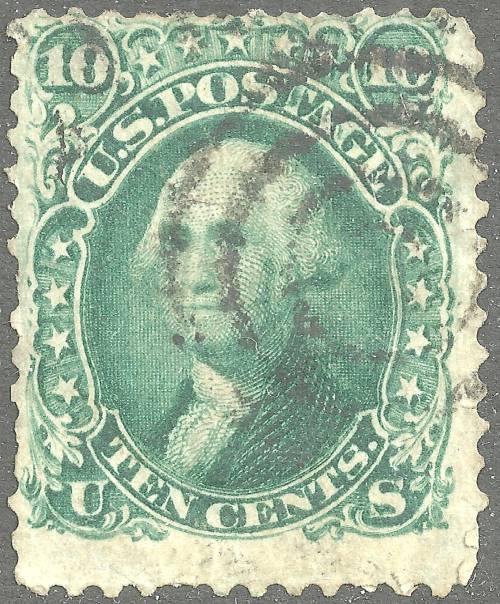
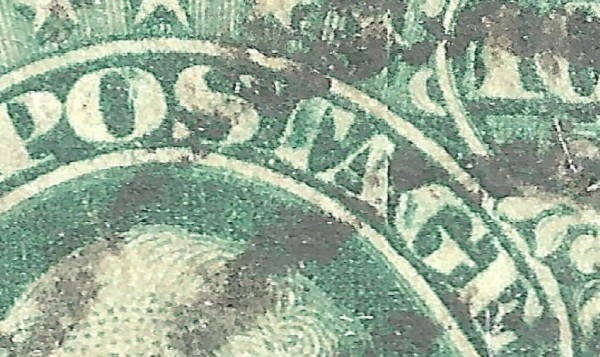
| Author |
 Replies: 24 / Views: 7,805 Replies: 24 / Views: 7,805 |
|
Valued Member
410 Posts |
|
|
I am anxiously awaiting the arrival of a 68 & 68a,both with the double transfer showing on the "TAG" of POSTAGE. I was very surprised to see the pop. report on Siegel at about 150 for the 68 and 50 for the 68a,which I believe includes all "TAG" variety stamps. Of course there are many more but only so many are graded. Neither of these stamps was offered as the "TAG" double transfer. 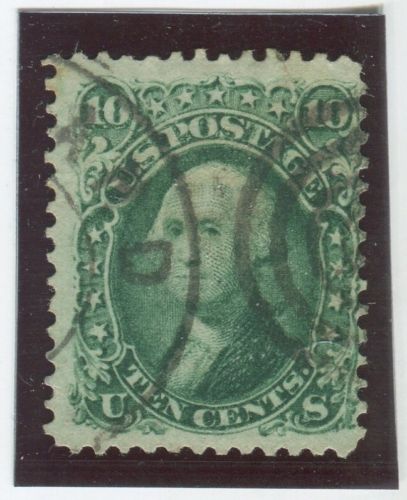 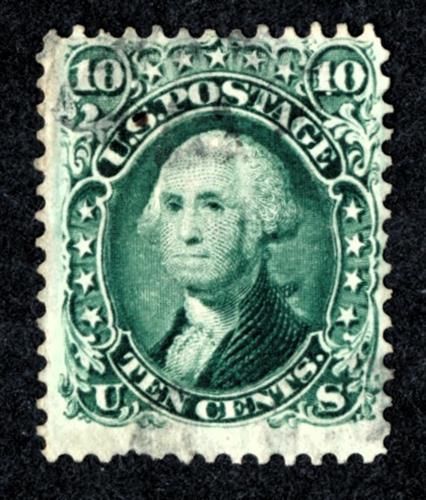 |
|
Send note to Staff
|
|
|
|
|
Pillar Of The Community
United States
2230 Posts |
|
|
CoinWatcher, thanks for posting this. I have a few #68s in my collection but haven't heard of this variety. |
Send note to Staff 
|
|
|
Valued Member
410 Posts |
|
|
Classic Coins the double imprint is illustrated on re-entries.com by Ralph Trimble and several are also on Siegel Auctions. |
|
Send note to Staff
|
|
|
Pillar Of The Community
United States
2230 Posts |
|
|
Looks like one of my #68s is the TAG variety, although not as pronounced, no?  |
|
Send note to Staff
|
| Edited by Classic Coins - 06/04/2014 11:11 pm |
|
|
Valued Member
410 Posts |
|
|
CC I am not sure about that one. It doe's seem to have the doubled LR corner. |
|
Send note to Staff
|
|
|
Pillar Of The Community
United States
2230 Posts |
|
|
Valued Member
410 Posts |
|
|
Pillar Of The Community
United States
644 Posts |
|
|
It's not rare and it occurred on more than one position which has been proven by blocks. My father (who collected the 10c 1861) actually wrote an article on the "TAG" variety in Chronicle #85 which can be accessed in the members section of the USPCS.
The TAG variety is not a double transfer, it's a defective transfer which originated on the transfer roll itself. The TAG stamps don't carry any monetary premium.
|
|
Send note to Staff
|
|
|
Valued Member
410 Posts |
|
|
Here is a quote from Lester G. Brookman's book, "The United States Postage Stamps of the 19th Century"....Volume 2,1966,on the Scott 68.
"Double transfers of greater
or lesser degree are fairly common but one
variety that usually is called a double transfer may not be a double transfer
at all. We refer to the defective lettering of " TAG " of " POSTAGE . This
variety, which is a prominent one, has been known to students for a long time.
It occurs in blocks but we have never seen it in combination with a stamp that
did not have this variety although such may very well exist. It seems probable
that the defect was caused by the use of a transfer roll upon which some bits
of metal had become lodged. The variety is prominent on some stamps and
less prominent on others which indicates that the bits of metal wore away, or
became more deeply embedded in the roller so that they made a lesser impression on the plate."
He doe's go on to say that there are other theories. |
|
Send note to Staff
|
|
|
Pillar Of The Community
United States
644 Posts |
|
|
Some later research has turned up more info about the TAG stamps.
10c Type 2 stamps were printed from 2 plates, 15 and 26. 15 was put into use in July of 1861 and was the first plate used. When Brookman wrote his books it was believe that TAG stamps. Ly came from the later issued plate 26, it turns out that plate 15 was re-entered quite a bit some time around 1863 as that's the EKU of TAG stamps. |
|
Send note to Staff
|
|
|
Moderator

United States
5105 Posts |
|
|
Pillar Of The Community
1151 Posts |
|
|
Hi All This is just one of those interesting varieties. Besides the "TAG" variety, I've noticed on various copies of the TAG variety other varieties related to this stamp. As an example, closely examine the stamp image scan by "Partime", look at the "E" on postage, also look at the "O" in postage. Now examine the scan by "Classic Coins", see the "U.S." at top, I can't quite make out what is going on here. Loran C. French, author of the book "Encyclopedia of Plate Varieties on U.S. Bureau Printed Postage Stamps", discussed this stamp. I always believed this was a double transfer, but Cloudy made the argument that is variety is really Extraneous Transfer. I've always enjoyed ebay stamps section, on the #68 stamps, I enjoy looking at the various other varieties not noted on the sellers listed. Does anyone else enjoy this activity? |
|
Send note to Staff
|
|
|
Pillar Of The Community
United States
1036 Posts |
|
|
Yeah, I enjoy collecting DTs, but this is not one of them. TAG variety is interesting but quite common. I have 10 examples of scott 68 in my stock book, most poorly centered or faulty, and 4 have TAG variety.. I don't think there is any increase value in this variety compared to normal scott 68.
Interesting, E grill Scott 89 also see TAG variety (very common) but absolutely never in F grill Scott 96???
Thus a 10c grill with TAG variety is always an E grill, never F. Thus... shortcut... No need to count grill points!! ???? |
|
Send note to Staff
|
|
|
Pillar Of The Community
United States
3515 Posts |
|
|
I will just pile on and add my 2c to this and say that I found many of these in dealer's stock, and although I didn't scientifically study them, it is pretty safe to say, from my small study, that these double transfers on this stamp are common enough.
Given their relative ease of acquisition, it might be ripe for some more study/plating, yet. Who knows. |
|
Send note to Staff
|
|
|
Pillar Of The Community
1151 Posts |
|
|
Moderator
United States
5105 Posts |
|
|
Let's not lose sight of the overall issue. Even if we do consider this a double-transfer, Scott only gives this a $5.00 premium over a standard used copy. I'm sure if Scott recognized this issue as a true variant, it would only warrant a very small premium. |
|
Send note to Staff
|
|
|
Replies: 24 / Views: 7,805 |
|




 Posted 06/04/2014 1:19 pm