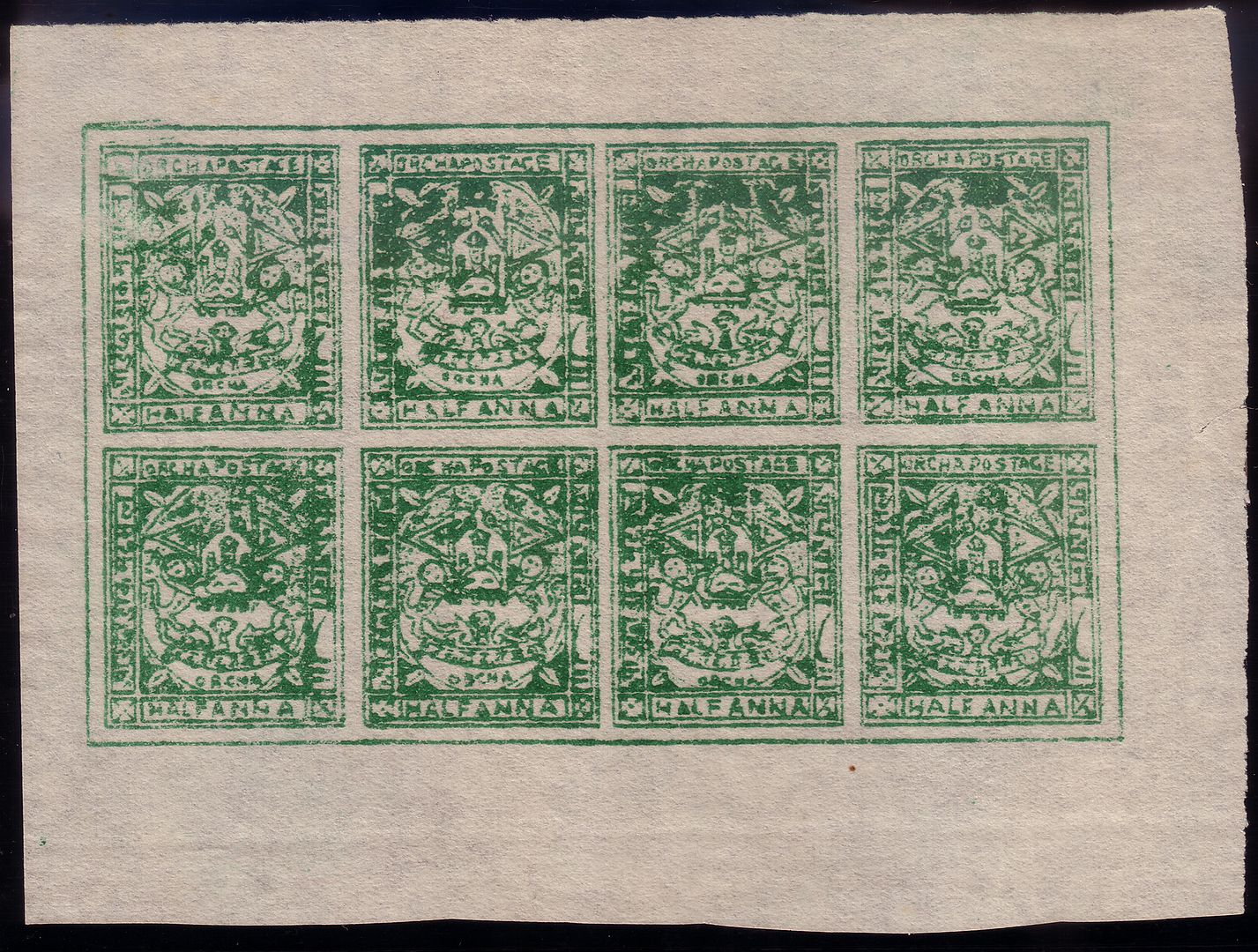
By 1935, the Orchha State administration was in a complete mess; the British Indian authorities moved in a few years later to tidy it up. However, in that year Orchha made the unfortunate decision which made its name stink in philatelic circles for years.
It contracted with the Lakshmi Art Printing Works of Bombay to produce a long set - of 22 values - showing the Maharaja in Western-style dress. The set ran from ¼ Anna to 25 Rupees, even though the need for a value as high as 1 Rupee was highly arguable. The Lakshmi Art Printing Works had been responsible, under another name, for the shambles of the 1931 pictorial set of the neighbouring State of Charkhari, but this didn't discourage Orchha.
It would be tiresome and redundant to show the entire set, but here are the lowest (¼ Anna) and highest (25 Rupees) values

For unexplained reasons, the 1 Rupee was issued in both this format, and with a different style of portrait:

Like the ill-fated Charkhari set, this one also was dumped on the market at below face value. (By way of comparison, the contemporary Indian 25 Rupees stamps is catalogued mint at £275; Gibbons rates the Orchha 25 Rupees at £16.)
So far, a not uncommon story, and all too familiar to modern collectors: unnecessary high values, dumped on the market and so on. But there's rather more to this set. To begin with, ten different perforation gauges were used for it, although they aren't to be found on all values. Most, if not all, values also exist imperf and in imperf between pairs

CTOs exist, but unlike the Charkhari set, they
are much less common.
Finally, in desperation, the Orchha authorities decided to stamp a State seal on the backs of stamps that were sold properly, at face value, across the post office counter:
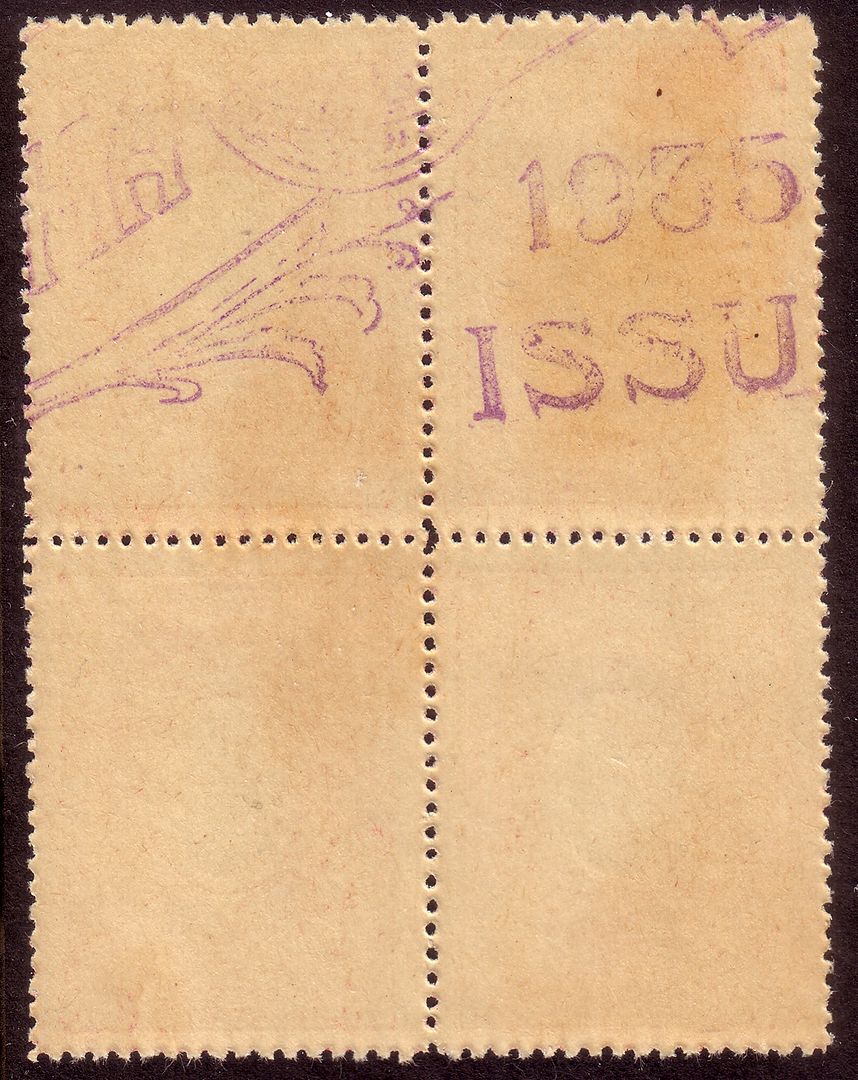
This is the back of a block of the 10 Rupee value:
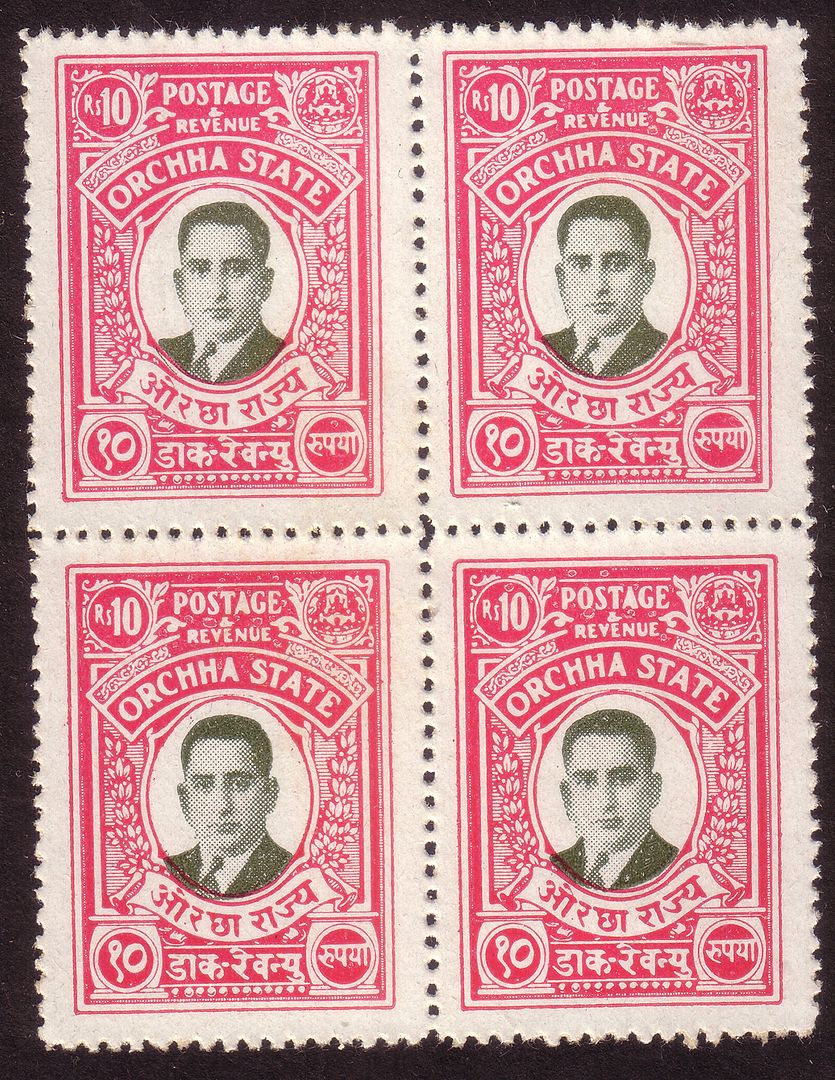
meaning that some blithering idiot paid 40 Rupees for this - bearing in mind that the average pay for a State postman at the time was about a rupee a day.
Of course, the set was a complete disgrace. For many years, Gibbons simply refused to list it at all. Finally, in 1939, the State turned to the Indian Security Printers, who produced a nice enough set (if you like that sort of thing)

to replace the disgraced set. And yet ... it
did see legitimate use


- even the imperfs, as you can see. So while the set may be thoroughly disreputable, it still has a place in any collection of legitimate issues.
This was the last of the delightfully ugly issues of Orchha. The State has suffered a bad press on its account, but it didn't deserve it. If you're looking for a side collection with a bit of meat on it, you could do much worse than look at Orchha.





 Posted 06/09/2014 02:04 am