Although there are obvious design differences between the Large and Small Queens in addition to the sizes, it is still difficult for someone who is inexperienced with these issues to identify them without other stamps or a reference to compare them to.
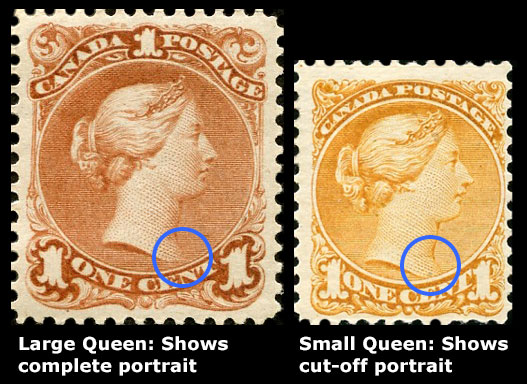
The portrait of the Queen is in fact slightly reduced on the Small Queen issue but not nearly as much as the rounded frame that it sits in. This provides the best key for identifying the stamps. All of the Small Queens show the front of the Queen's portrait slightly cut-off by the portrait frame. Whether facing left or right, the tip of the Queen's lower neck/chest area always extends into the portrait frame.
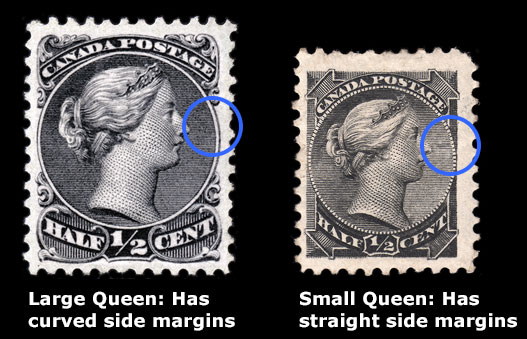
For the large Queens, the portrait is always complete and the neck/chest area is never cut-off by the portrait frame. There is only one exception to this and that is the 1/2 cent value where the portrait is cut-off like the Small Queens. Adding to the confusion is the fact that this value is smaller than the other stamps for both issues so that the Large Queen half-cent is actually about the same size as most of the other Small Queen values. The Small Queen half-cent value is even smaller. The easiest way to remember how to differentiate the half-cent values is that the Large Queen version has the usual outer frame consisting of various curved features from the portrait frame and other flourishes in the corners of the stamp, whereas the Small Queen frame is generally a rectangle that contains all the flourishes and portrait frame within it except for the sharp corner ornaments.
So, in a nutshell, here are the simplest rules that I know of:
Large QueensAll values except the half-cent show the complete portrait of the Queen. The half-cent value has curved side margins from the portrait oval.
Small QueensAll values show the Queen's lower neck/chest area cut-off by the portrait frame. The half cent value has straight side margins at center where the portrait oval is contained within the straight outer frame.





 Posted 04/19/2015 08:50 am