| Author |
 Replies: 7 / Views: 1,778 Replies: 7 / Views: 1,778 |
|
|
Bedrock Of The Community
United States
12128 Posts |
|
|
A cute graphic and a valid question, is the USPS charging UPS and FedEx enough to deliver their packages? 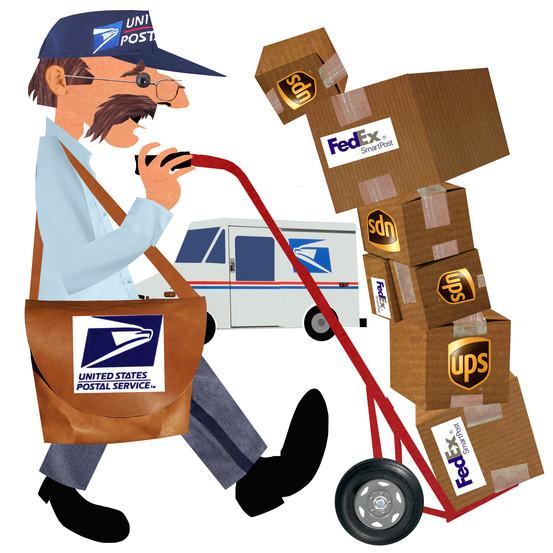 http://online.wsj.com/articles/u-s-...s-1407182247 http://online.wsj.com/articles/u-s-...s-1407182247The article concludes with this statistic that might be of interest to stamp collectors ... assuming these figures are accurate (and there's no telling what it may or may not include) it suggests that about 11.15% of its revenue is generated from "selling stamps": Quote:
Under law, the USPS must pay its own way. It generated $67.3 billion in revenue in 2013, $7.5 billion of which came from selling stamps. |
|
Send note to Staff
|
| Edited by wt1 - 08/05/2014 11:59 am |
|
|
|
|
Pillar Of The Community
United States
2055 Posts |
|
|
I really don't know what fair market pricing would be for this service. But I imagine they've done some math about how much additional revenue they can generate with this within their existing infrastructure. In other words, they probably figured that they could absorb some packages from UPS and Fedex without having to hire more carriers, run more trucks, etc. Like any business, they have to balance the desire to get the most money possible for their service without driving their customers away with high prices.
The article does say that UPS and Fedex packages are beginning to tax the system, and if that's the case, the USPS probably can and should nudge the rates a little higher. Again, I'm no expert on logistics and don't know what the right price point is for both parties, but it must be a pretty good deal for those carriers if they're having the USPS deliver so many packages for them. In most businesses, it's of course advantageous to be the lowest priced, but to maximize profits you usually want to be a just a little bit lower, not dramatically so. It appears right now that the USPS is dramatically lower and could thus raise their prices somewhat without driving off customers. |
Send note to Staff 
|
|
|
Bedrock Of The Community
United States
12128 Posts |
|
|
Another point made in the article is that the USPS doesn't reveal contract terms with these shippers, so the American public doesn't really have the full picture: Quote:
Neither the Postal Service nor these big customers will reveal contract terms. "There should be more transparency" to make sure the agency is properly compensated, says Mark Jamison, a retired Postmaster from North Carolina, a frequent critic.
Mr. Donahoe says the criticism is unwarranted. "We make money on it. We wouldn't do it if we didn't make money on it," Mr. Donahoe said. |
|
Send note to Staff
|
|
|
Rest in Peace
United States
4052 Posts |
|
|
Pricing: a sensible place to begin would be marginal cost to carry FDX/UPS packages. That marginal cost may only be a very small fraction of the price of the package. Good on USPS to figure-out how to leverage their advantages (hitting every address every day, lotsa branches where folks can come-in to pick-up a parcel, etc) and avoid going head-to-head with FDX/UPS where they have the competitive advantage (reputation, marketing, billing, accounting).
Politics: letting FDX/UPS be the 'front end' lets USPS neatly finesses the issue of 'unfair' competition, and leaves USPS 'free-er' to price its own parcel services as suits it best.
Stamps are 11% of revenue? I would have guessed less.
Contract terms? The FOIA does not apply to the USPS? Seriously?
Cheers,
/s/ ikeyPikey |
|
Send note to Staff
|
|
|
Bedrock Of The Community
United States
12128 Posts |
|
|
Quote:
Contract terms? The FOIA does not apply to the USPS? Seriously? I've encountered this sort of question before. Yes, there is certain USPS information available through FOIA, but not contract terms with competitors such as FedEx or UPS. The same "brick wall" was hit last year when the special arrangements for USPS delivery of Amazon packages hit the news. The USPS considers it "proprietary" information that would put the USPS at a competitive disadvantage if the information between parties were made public. In fact, if you go to the Postal Regulatory Commission website there are some documents on USPS rate setting that contain certain "blacked out" pieces of information that the USPS considers damaging to their competition if they were to disclose the information to the public...or more specifically, to their competitors. Even Linns Stamp News had made a FOIA request about the sales numbers of the Inverted Jenny Souvenir Sheet and thus far, the USPS has won the argument that the information will not be released to the public. |
|
Send note to Staff
|
| Edited by wt1 - 08/05/2014 3:03 pm |
|
|
Moderator
1589 Posts |
|
|
Quote:
Stamps are 11% of revenue? I would have guessed less.
Except for mail from stamp/cover sellers, very little of the mail I get is stamped. Most of it is junk mail, at bulk rates, or metered. And very few people send parcels with stamps any more. They stand in line in front of me at the PO with boxes piled up in their arms, and the clerks weigh and meter the postage for them. But I wonder how profitable stamps are compared to bulk and metered mail and parcels? I might think that as a segment, the "profit" is higher, but I really do not know. |
|
Send note to Staff
|
|
|
Rest in Peace
United States
4052 Posts |
|
|
wt1: Well, shame on me, I was thinking that the hobby press would not file/pursue a FOIA request because it would endanger their precious access, by which they provide us with all those scintillating interviews with the Third Deputy Assistant Postmaster General for Perforations, Rouletting & Sealing Wax. Good on Linn's to file/pursue.
The Jenny lotto is not over yet, so I can see the USPS wanting to withhold sales figures because they might drive sales to zero, or not, depending on how customers react. OTOH, I wouldn't mind their firing everyone who had a hand in dreaming-up the Jenny lotto, but that's me.
blcjr: Yes, on the one hand, many stamps go unposted. OTOH, the handling & processing & fiddling expenses of stamped mail exceed those of metered mail. Just because it is a traditional business segment, and just because it is profitable, does not mean that the USPS should be in the stamp business. (what, me heretic?)
Q/ How many years before the USPS decides to outsource the *entire* stamp business unit - including design & printing & distribution & retailing - lock, stock & barrel?
Cheers,
/s/ ikeyPikey |
|
Send note to Staff
|
|
|
Pillar Of The Community
United States
798 Posts |
|
|
I sometimes chuckle a bit when there is discussion on how the USPS makes its money by selling 'stamps'. The USPS makes its money by selling a service (delivering communications and goods and some services)at a base universal price (by product). The local public pays for this service by purchasing stamps (one of several modes of payment) and applying these to articles to show proof of payment for those services. Payments are also made by credit cards with meter indicia applied, or computer generated labels applied. Revenues (money) are also obtained via contracts, paid by check, credit card, electronic transfer etc. Stamps are but ONE means of revenue generation. Contracts with other delivery entities are a source of revenue. Rates are determined by a very complicated method, and are usually 1-2 years behind current costs. Does the USPS make money off UPS & FEDEX??? Don't know. Do know that UPS & FEDEX charge more. Do know that when economic condition warrant UPS & FEDEX upcharge (surcharge) customers. do know that the universal USPS pricing is determined for a break even (not profit). Do not know today why so many still think stamp sales would not be connected to the total revenue generation stream of the USPS & not the ONLY revenue generation stream.  |
|
Send note to Staff
|
|
| |
Replies: 7 / Views: 1,778 |
|




 Posted 08/05/2014 11:57 am


