lithograving - Thanks for joining in and special thanks for the link to the earlier issues of the
Postal Bulletin. The one I was interested in and which you kindly let me have the link to specifies the order which the two plates were printed in as well as the inks applied (I can see that I mistook the dark blue for the black). Much appreciated.
As a matter of fact I was puzzled about
Arago's order of presentation of the two plate proofs: the one in black coming first and the other in brown coming second and, moreover, with a note in pencil at the foot of it saying "
( 2 pl. Gi.)" knowing that lighter colours are printed first as Pappy24 confirms for the French
Chambon presses.
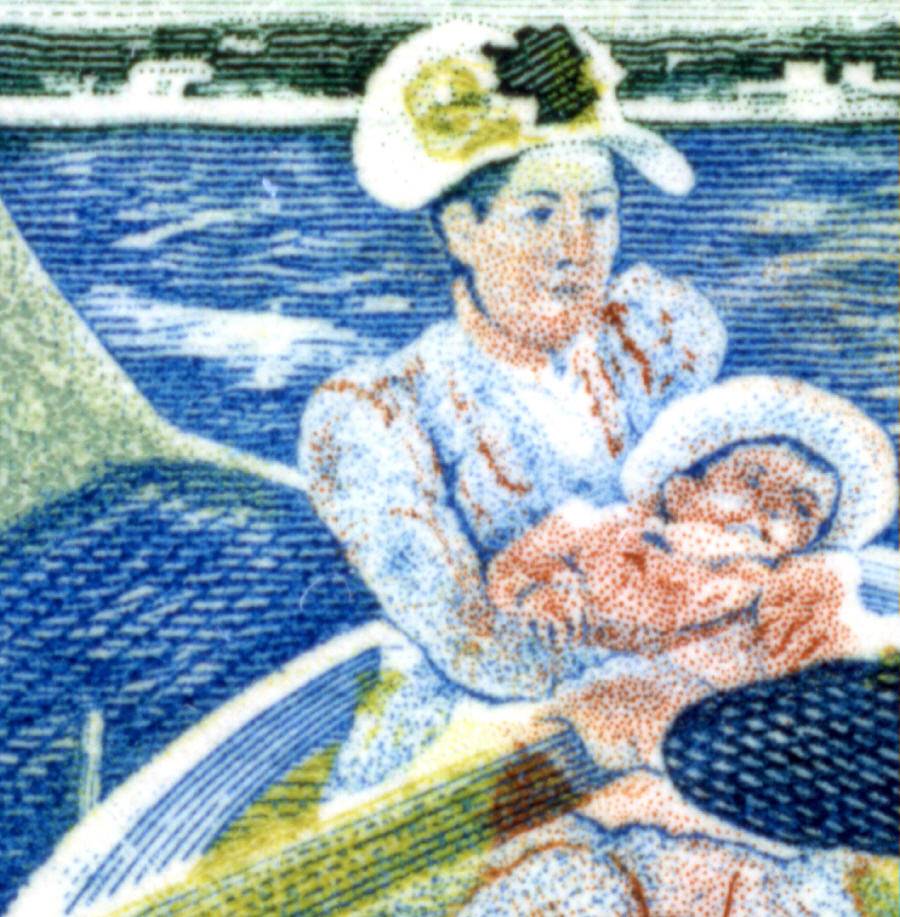
Thank you for the excellent enlarged images of your example of US Scott 1322 showing the misregistration (
repérage imparfait in French) of the colours. What surprises me are the irregular shifts (
décalages irréguliers) in the colours which seem in some places OK, but not in others even though printed from one colouring plate. My stamp happens to be in perfect registration as luck would have it although I regret poor registration, be it by a half millimetre only but, sadly, in most telling positions, with a few other stamps in my collection.
As for "
Die Proofs" by Giorgio Leccese, the version of it in English is nothing to go by because done by machine translation which usually plays havoc with technical terms. Thus the term "
taille-douce di riporto" in the Italian original, which translates as "indirect recess / offset recess" into English, is badly mutilated as "
amount carried over recess printing" in MT into "English". What one should go by is the original version in Italian: the link to it is
http://www.dieproofs.it/tipi_stampa.html





 Posted 12/03/2014 1:42 pm