Stamp Community Family of Web Sites
Thousands of stamps, consistently graded, competitively priced and hundreds of in-depth blog posts to read


Stamp Community Forum
 
Username:
Password:
Save Password
Forgot your Password?

This page may contain links that result in small commissions to keep this free site up and running.

Welcome Guest! Registering and/or logging in will remove the anchor (bottom) ads. It's Free!

Corner Cards

 
To participate in the forum you must log in or register.
Author Previous TopicReplies: 10 / Views: 3,747Next Topic  
Pillar Of The Community
United States
3167 Posts
Posted 10/15/2014   1:08 pm  Show Profile Bookmark this topic Add littleriverphil to your friends list Get a Link to this Message
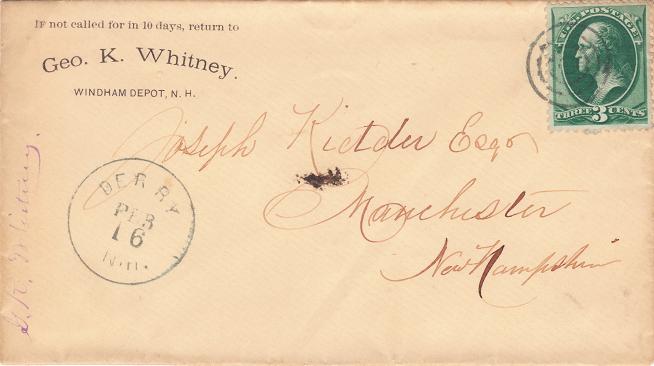
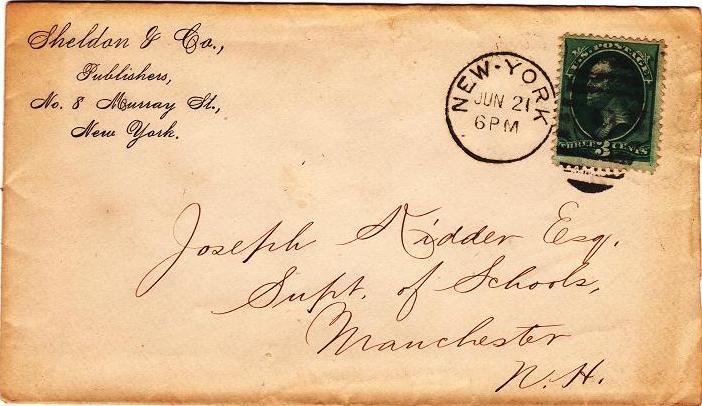
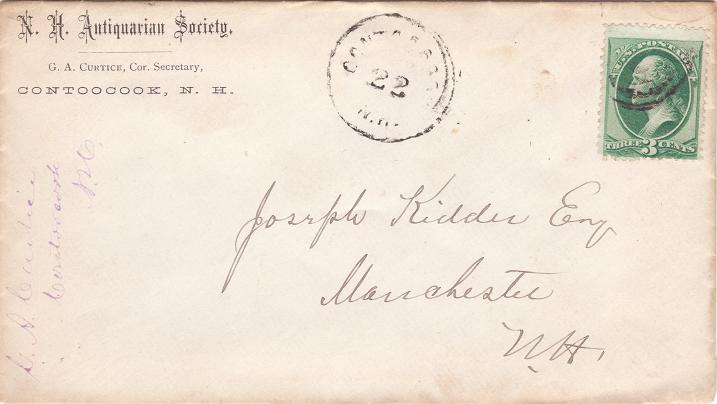
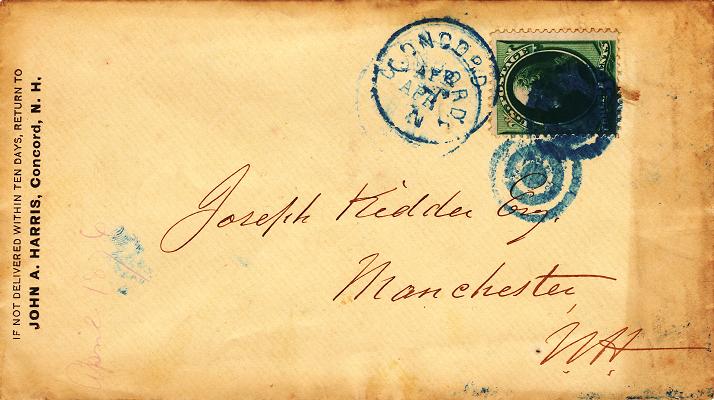
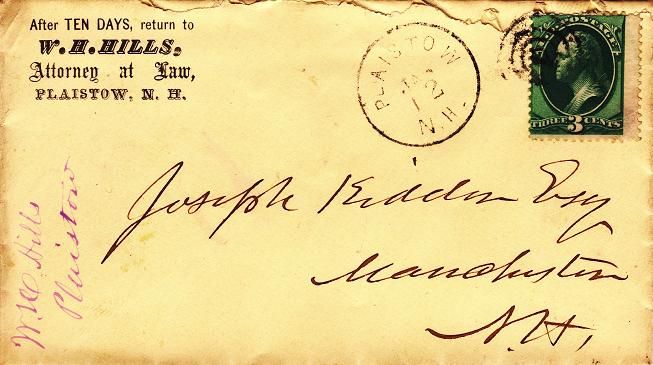
Does the name of a corespondence go to the addressee, for instance would these be part of the Joseph Kidder correspondence? Howvere it goes, here's a couple of interesting corner cards.


Send note to Staff

Bedrock Of The Community
United States
12128 Posts
Posted 10/15/2014   3:22 pm  Show Profile Bookmark this reply Add wt1 to your friends list  Get a Link to this Reply
Some history on the addressee, Joseph Kidder of Manchester, NH:


Quote:
Aurore Eaton's Looking Back: Joseph Kidder, newspaperman and merchant

On a gentle slope to the south of Pine Avenue in the Valley Cemetery, a little beyond the Sage family plot, is a prominent granite monument that marks the resting place of Joseph Kidder.

Joseph was born in Manchester in 1819. His father Samuel P. Kidder came to Derryfield (later named Manchester) in 1794 to work as a clerk for Samuel Blodget, who was in the early stages of building a transportation canal to bypass Amoskeag Falls on the Merrimack River. When the canal was completed in 1807, Samuel Kidder was put in charge of the locks, a job he held until his death in 1822. His wife was Betsey Stark, a granddaughter of Revolutionary War General John Stark.

At the end of 1840, when he was only 21 years old, Joseph published his own newspaper in Pembroke, New Hampshire, the People's Herald. He produced only four issues before selling the paper in February 1841 to Joseph C. Emerson, the publisher of the Amoskeag Memorial. Emerson changed the name of his paper to the Manchester Memorial and People's Herald and hired Joseph Kidder as editor. He resigned in January 1842 and in April of that year he partnered with William H. Kimball to establish the Manchester Democrat. Within a few months, Joseph had sold his interest in this paper. In July 1845, he became editor of the Manchester Saturday Messenger. He stayed in this job until November 1847, when the paper was sold.

On January 24, 1851, a new paper, The Union Democrat, emerged as a voice for the Democratic Party of Manchester. Joseph Kidder was on the committee that established this publication. In 1861, the paper's name was changed to the Manchester Union. When new owners took over in January 1863, the paper again became The Union Democrat. The paper changed hands again almost immediately. On March 1, 1863, the reincarnated newspaper began publishing as the Manchester Daily Union. This was the beginning of the New Hampshire Union Leader's 150 year history.

In about 1848, Joseph began working in his brother John S. Kidder's store on Elm Street, which sold dry goods, hardware, flour, grain, cheese and other supplies. He became co-owner of the business, and was later a partner in another general store on Elm Street. By 1870, Joseph had retired from the mercantile business, and in 1877 he became the Grand Secretary of the International Order of Odd Fellows, which owned a building on Hanover Street. Joseph had joined this benevolent fraternal society in 1845 and was completely devoted to the organization. The Odd Fellow name is said to have originated around the time of its founding in 17th century Britain as a charitable organization. During this era of poverty and hardship, a person who wished to provide aid and comfort to the needy was apparently considered to be odd.

Joseph Kidder served as Grand Secretary of the I.O.O.F. in New Hampshire until his death on October 29, 1902. He was known affectionately as the "Grand old man of New Hampshire Odd Fellowship." The monument was erected in 1903 by the I.O.O.F. to honor Joseph's many years of faithful service. On the front of the monument is carved a three-link chain and a stylized tent. The links of the chain represent friendship, love and truth. The tent represents the Encampment order of the I.O.O.F., which strives to abide by the principles of faith, hope and charity. In his job as Grand Secretary, Joseph published many articles about the order's activities for local and state newspapers.

On August 23, 1838, at age 19, Joseph Kidder began keeping a diary, which he called "A Manuscript Journal." He started with his "Preparatory remarks and suggestions." He wrote, "Ours is a world subject to every variety of change which the prolific and inventive mind of man can imagine — yea more." His "remarks" ended with "A good resolution…Revolved that not a single day 'shall pass unheard by' without noting down facts and occurrences which have fallen under my own immediate observation and experience." Joseph wrote faithfully in his diary every day until his death in 1902. He would fill 67 journal books, which are now kept in the archives of the Manchester Historic Association.

Aurore Eaton is executive director of Manchester Historic Association; email her at aeaton@manchesterhistoric.org


A lot of typos at this link (including an incorrect date of death) but at least it shows the correct gravesite of Joseph Kidder:

http://www.findagrave.com/cgi-bin/f...Rid=63326146
Send note to Staff  Go to Top of Page
Edited by wt1 - 10/15/2014 3:27 pm
Pillar Of The Community
United States
3167 Posts
Posted 10/15/2014   4:11 pm  Show Profile Bookmark this reply Add littleriverphil to your friends list  Get a Link to this Reply
Thank you wt1, very informitive, as usual. I asked if this group of cover addressed to Joseph Kidder would be correctly refered to as the Kidder correspondence, these two are but a small part of the group of covers I have addressed to him. Would that be the correct way to refer to them?
Send note to Staff  Go to Top of Page
Edited by littleriverphil - 10/15/2014 4:12 pm
Bedrock Of The Community
United States
12128 Posts
Posted 10/15/2014   4:27 pm  Show Profile Bookmark this reply Add wt1 to your friends list  Get a Link to this Reply
Yes. Covers from the 19th century very often don't have any return address (although yours do) so the writer is often unknown unless contents from the covers are present. So in most cases, one has to rely on the addressee (recipient) of the cover to more accurately identify its history.

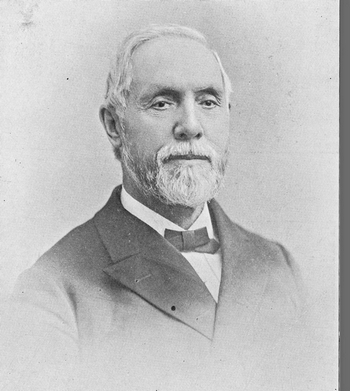
Back to the story about the addressee, Joseph Kidder, the quote above is but one of several multi-part stories about this individual published in the Manchester Union-Leader Newspaper in 2013. Here are links to a couple of other related stories -- the first link even contains a photograph of Joseph Kidder:

http://www.unionleader.com/article/...06/130819824

http://www.unionleader.com/article/...06/130829387


Send note to Staff  Go to Top of Page
Edited by wt1 - 10/15/2014 4:31 pm
Pillar Of The Community
United States
3167 Posts
Posted 10/15/2014   6:48 pm  Show Profile Bookmark this reply Add littleriverphil to your friends list  Get a Link to this Reply
Joseph Kidder

Send note to Staff  Go to Top of Page
Rest in Peace
United States
7097 Posts
Posted 10/16/2014   05:35 am  Show Profile Bookmark this reply Add I_Love_Stamps to your friends list  Get a Link to this Reply
WOW I just love this type of thread! Great material and great information!
Send note to Staff  Go to Top of Page
Pillar Of The Community
United States
3167 Posts
Posted 10/18/2014   5:36 pm  Show Profile Bookmark this reply Add littleriverphil to your friends list  Get a Link to this Reply
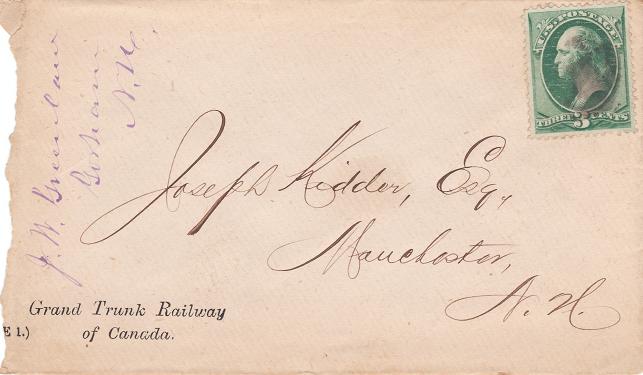
Saw mention of the Grand Trunk Railway in another thread, so thought that I post another J. Kidder cover, has no identifing postmark. I went throught that box of cover and have found about 15 covers addressed to Joseph Kidder, the majority of which have a notation of the senders name and place of origin, Gorham in this case. I think that maybe it's Mr. Kidder's notes, as they look like they are written by the same hand.


Send note to Staff  Go to Top of Page
Bedrock Of The Community
United States
12128 Posts
Posted 10/18/2014   7:23 pm  Show Profile Bookmark this reply Add wt1 to your friends list  Get a Link to this Reply
It's curious that the cover refers to Grand Trunk Railway of Canada, but was obviously mailed in the US because of the US postage stamp. Too bad it doesn't have a CDS showing from where it was mailed.
Send note to Staff  Go to Top of Page
Pillar Of The Community
United States
3167 Posts
Posted 10/18/2014   9:15 pm  Show Profile Bookmark this reply Add littleriverphil to your friends list  Get a Link to this Reply
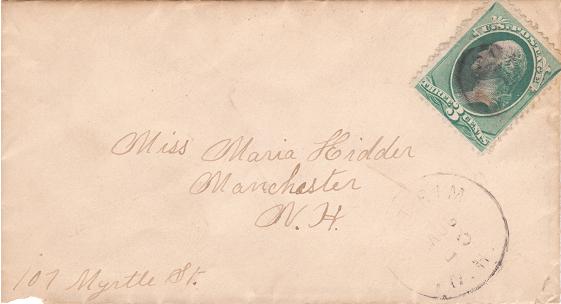
I thought that it was required to postmark each piece of mail, wonder how this got out of the P.O. with out a mark? I did find quite a few more covers addressed to Joseph kidder and one to Miss Maria Kidder.

Love the town name and the corner card of this next cover. Must be an Indian name.


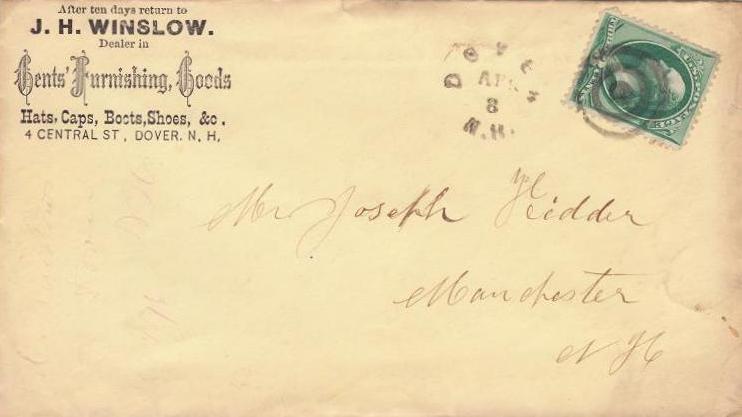
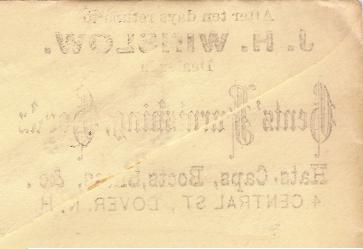
This cover has an almost perfect offset on the back side of the cc.


Like all of the rest of this corespondence, the postmarks are weak, and or the cover is faulty. I'm sure that this lot was culled from a much larger holding.

This is the Maria Kidder cover. I've tried and tried but just can't find any more than --TRIM N.H. I wonder if the word had the same slang meaning as it does now.


Send note to Staff  Go to Top of Page
Bedrock Of The Community
United States
12128 Posts
Posted 10/18/2014   11:13 pm  Show Profile Bookmark this reply Add wt1 to your friends list  Get a Link to this Reply
The last cover is probably postmarked Antrim, NH:

http://en.wikipedia.org/wiki/Antrim,_New_Hampshire

As for the cover from Contoocook, NH, it is indeed an Indian name. This is excerpted from Wiki:


Quote:
Contoocook is named after the Contoocook River that runs through it. The name Contoocook came from the Pennacook tribe of Native Americans and means "place of the river near pines". Other variations of the name include the Abenaki meaning "nut trees river" or Natick language meaning "small plantation at the river".


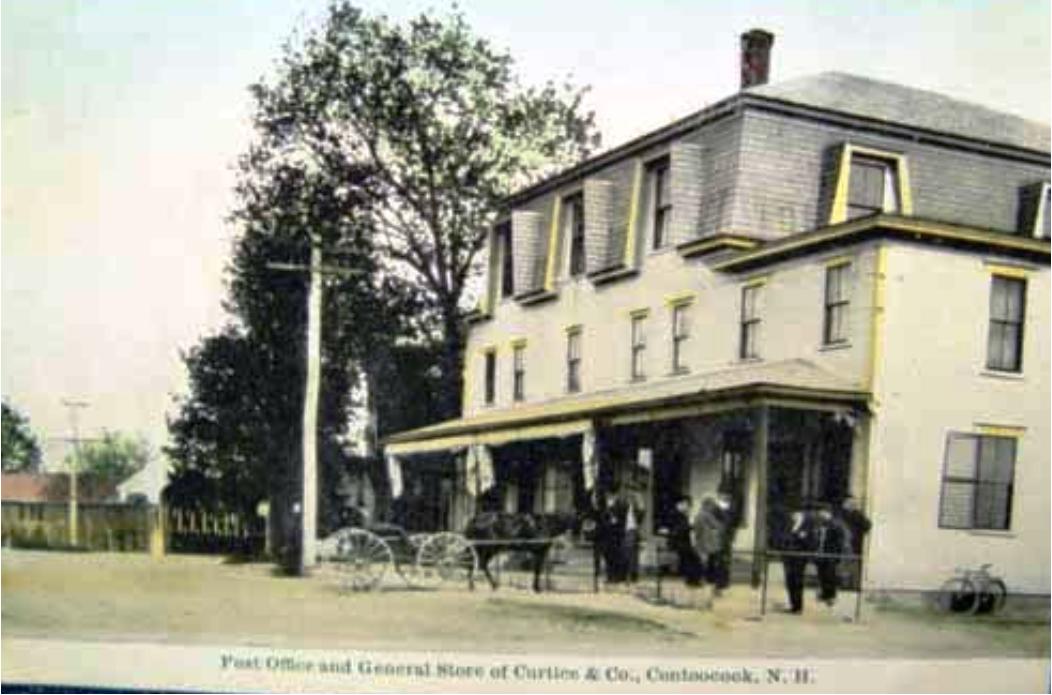
I also found this period postcard online that shows what the post office would have looked like at the time that cover was mailed:


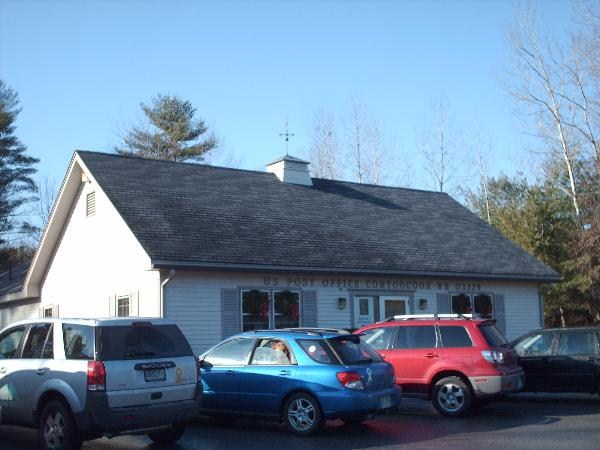
Compare it to the Contoocook, NH post office as it looks today:


The Antiquarian Society at Contoocook (part of Hopkinton, NH) still exists although its present building is dated to 1890 a few years after the cover would have been mailed.
Send note to Staff  Go to Top of Page
Edited by wt1 - 10/18/2014 11:19 pm
Pillar Of The Community
United States
3167 Posts
Posted 10/19/2014   11:49 pm  Show Profile Bookmark this reply Add littleriverphil to your friends list  Get a Link to this Reply
Nice find on the post office pic! Thanks!
Send note to Staff  Go to Top of Page
  Previous TopicReplies: 10 / Views: 3,747Next Topic  
 
To participate in the forum you must log in or register.

Go to Top of Page

Disclaimer: While a tremendous amount of effort goes into ensuring the accuracy of the information contained in this site, Stamp Community assumes no liability for errors. Copyright 2005 - 2026 Stamp Community Family - All rights reserved worldwide. Use of any images or content on this website without prior written permission of Stamp Community or the original lender is strictly prohibited.
Privacy Policy / Terms of Use    Advertise Here
Stamp Community Forum © 2007 - 2026 Stamp Community Forums
It took 0.18 seconds to lick this stamp. Powered By: Snitz Forums 2000 Version 3.4.05