| Author |
 Replies: 112 / Views: 21,800 Replies: 112 / Views: 21,800 |
|
|
|
Pillar Of The Community
923 Posts |
|
|
Pillar Of The Community
923 Posts |
|
|
Scottamer's suggestion of the Ram Tanks in the War Issue #258-9 [1942-3] certainly qualifies, as there were no WWII tank battles in Canada. (Could be training at Val Cartier, at a stretch.) Interesting that only those 13¢ & 14¢ stamps out of the ten pictorials issued depict actual combat. These are the fifth example, however! The fourth is #244 [1938] Vancouver Harbour. 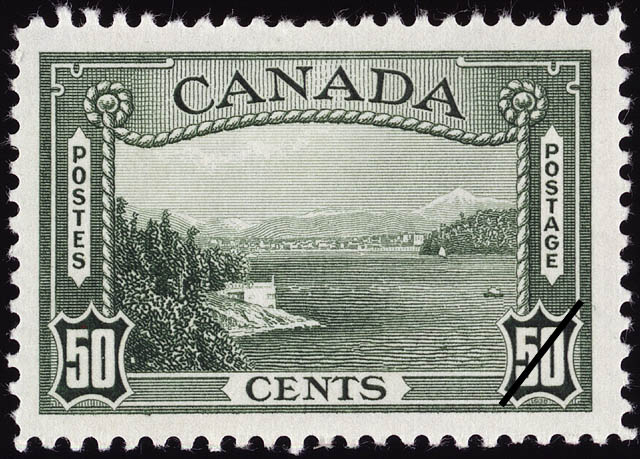 As pointed out in the Canadian Postal Archives (and verified on Google Earth), the "design shows the view from West Bay on the northern side of the entrance to Vancouver Harbour where the Lookout at the Narrows is situated. Prospect Point and part of the city appear in the background. This is Canada's western gateway to the Orient and the Pacific. In the distance looms Mount Baker in the State of Washington." That's my suggestion for the day... what's yours? |
Send note to Staff 
|
|
|
Valued Member
United States
146 Posts |
|
|
What about Paul Henderson celebrating the goal (victory) on Soviet ice? |
|
Send note to Staff
|
|
|
Pillar Of The Community
923 Posts |
|
|
xyyz has spied the twenty-first example of foreign soil (ice): #1659-60 [1997] the 25th anniversary issue of the "Summit Series". 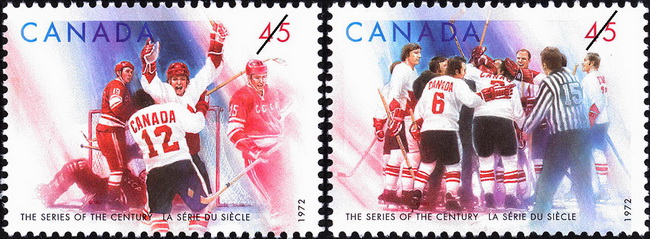 Most of us will remember where we were on that day... and how we suffered the longest 34 seconds in hockey history! PS. There is still time on this Remembrance Day for someone to celebrate today's honourees. |
|
Send note to Staff
|
|
|
Pillar Of The Community
923 Posts |
|
|
Inasmuch as there has been a slight pause in participation, I feel compelled to post on the last minute of November 11th, the ninth example: #487 [1968] John McCrae Memorial. 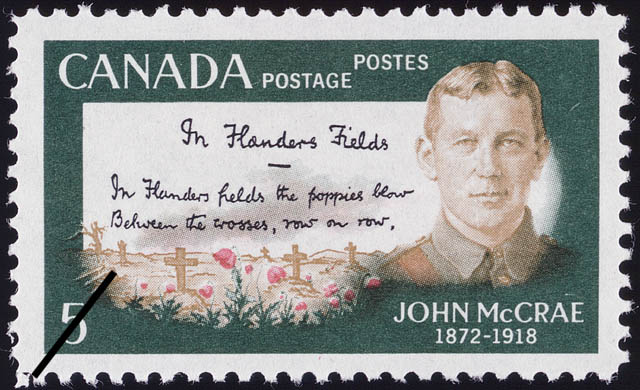 The red poppies depicted in the background, blowing between the crosses, row on row, are in Flanders fields, Belgium, of course. Lest we break faith with those who died. |
|
Send note to Staff
|
|
|
Pillar Of The Community
United States
1497 Posts |
|
|
Quote:
Scottamer's suggestion of the Ram Tanks in the War Issue #258-9 [1942-3] certainly qualifies, as there were no WWII tank battles in Canada. (Could be training at Val Cartier, at a stretch.)
Interesting that only those 13¢ & 14¢ stamps out of the ten pictorials issued depict actual combat. Ram tanks as depicted on the two Canada stamps never saw combat. By the time Rams were being produced, they had been totally outclassed by German armor. Rams were sent to Great Britain for crew training. Some Ram tanks had their turrets removed, and were sent to the mainland to be used as armored personnel carriers, being known as Ram Kangaroos. Other modifications of the Ram tank included artillery observation vehicles, gun towers and self-propelled howitzers (known as the Sexton). The stamps could depict live fire training in England, so that would be foreign soil. Robert |
|
Send note to Staff
|
| Edited by Trainwreck - 11/12/2014 12:57 pm |
|
|
Valued Member
Canada
228 Posts |
|
|
Assuming we do not count (although this would be reasonable) the ancient architecture shown in the background symbols on the Education stamp (#396) and any furniture shown on the portrait of the Churchill stamp (#440), then my take on the next foreign soil stamp is the British House of Commons with the Thames shown on the 1966 London Conference stamp (#448). 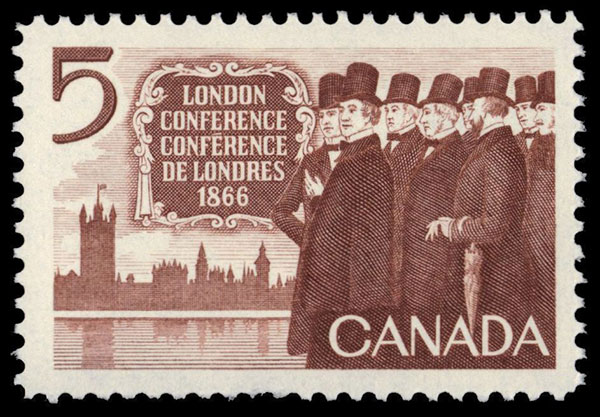 |
|
Send note to Staff
|
|
|
Valued Member
Canada
228 Posts |
|
|
The Ram Tank stamps are clearly designed to show the tank in combat. Whether this was only wishful thinking by the Canadian Military, the government, and the designers of the stamps, I believe that it still depicts foreign soil even if only on a fictional basis.
Note that these tanks only went into production in November of 1941 (according to Wikipedia) and the first Ram Tank stamp was released on July 1, 1942. I think it is safe to say that it was clearly thought that these tanks would see action at that time. |
|
Send note to Staff
|
|
|
Valued Member
Canada
228 Posts |
|
|
If the Power Plant stamp (#394) is the sixth in our series and we include my choice of #448, then I am hard-pressed to find another stamp depicting foreign soil before number 9 (John McCrae, #487).
While much of the Red River settlement was in the present-day USA, I do not think that land on stamp #397 can be pinpointed to show US soil. Likewise with the Alaska Highway definitive (#461), since the vast majority of this "highway" is in Canada, I do not think that the stamp can be evaluated to show Alaskan soil.
The lock shown on the 4 cent Seaway Centennial definitive (#457) could be argued to show US soil but I am too unfamiliar with Canadian/US locks to make any judgement here.
Sak, I look forward top your next submission. |
|
Send note to Staff
|
|
|
Pillar Of The Community
923 Posts |
|
|
Scottamer puts the seventh example on the wall: #448 [1966] celebration of the Canadian discovery that one did not need to go to revolutionary war to gain independence from Britain! Quote:
(There is another similar but reversed snag ahead.) On December 3, 1970 the FLQ crisis came to its climatic conclusion with the transfer of five kidnappers into the custody of the Cuban Consul-General Ricardo Escartin. The transfer was made at the Canadian Pavilion which was temporarily declared Cuban territory! #469 [1967] 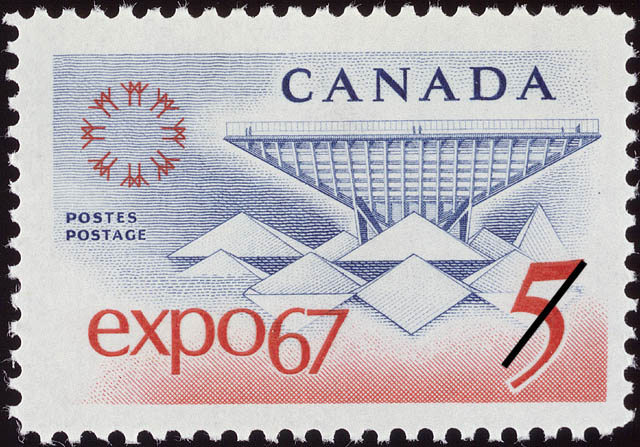 |
|
Send note to Staff
|
|
|
Valued Member
Canada
228 Posts |
|
|
OK Sak, you got me with this one! I appreciate your cleverness with this selection, however this was only a temporary territory claim that appeared years after the stamp was issued. To state that it "depicts" foreign soil is a bit of a stretch. By this standard, you could say that many of the scenic views of Canada depicted on stamps are foreign soil because they belonged to France and England in the past.
Of course I realise that this is all in good fun, so I applaud your creativity. I think the final list of this stamp scavenger hunt and the stories behind the "foreign soil" depicted would make a great stamp exhibit. I suspect that someone may have already done this however. I know I have seen exhibits of Canadian and US soil depicted on foreign stamps.
Since I have supplied or at least guessed number 6 and 7, you have now supplied number 8, and number 9 was provided by Jogil, I will wait for a day or two for someone else to chime in with a suggestion for number 10. Great fun! |
|
Send note to Staff
|
|
|
Pillar Of The Community
923 Posts |
|
|
Kind words, Scottamer. I want only to have fun. As an history buff, I have always been drawn to the stories behind the issues. We seem to be getting dozens of hits and I hope most of them are not rolling their eyes.
I have counted 6 examples before the onslaught of WWII memorials in 1989ff
Steve |
|
Send note to Staff
|
|
|
Moderator

United States
4788 Posts |
|
|
SAK -- excellent and timely addition.  As you say, "lest we break faith..." Kirk |
|
Send note to Staff
|
|
|
Pillar Of The Community
923 Posts |
|
|
The odd circumstances surrounding the "Katimavik" pavilion at Expo'67 reminded me of another incident involving Canadian territorial claims. On January 19, 1943, Princess Margriet of the Netherlands was born in Ottawa. The Dutch Royal Family had been living in Canada since the Nazi occupation of Holland in 1940. The maternity ward in which she was born was temporarily declared to be extraterritorial by the Canadian government. (Not Dutch territory, however.) Thus, not being born in Canada, she took her mother's citizenship and was solely Dutch.) So, inside this hospital (the Ottawa Civic Hospital) was a black hole of extraterritoriality! 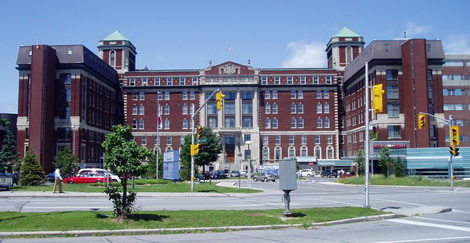 I hope someone remembered to claim it back for Canada! Although no Canadian stamp commemorates this event, here she is on a Netherlands one, issued September 16, 1946, after she returned safe and sound to Holland. (Michel # NL 465) 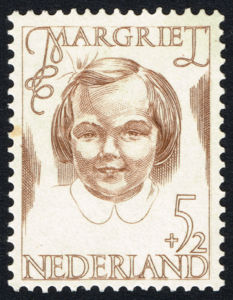 She is a fine lady today - a mother and grandmother - and secret Canadian! |
|
Send note to Staff
|
|
|
Pillar Of The Community
Canada
1416 Posts |
|
|
I think this one should qualify, as this was the arrival of a train in France 1st moving picture by les frères Lalumiere 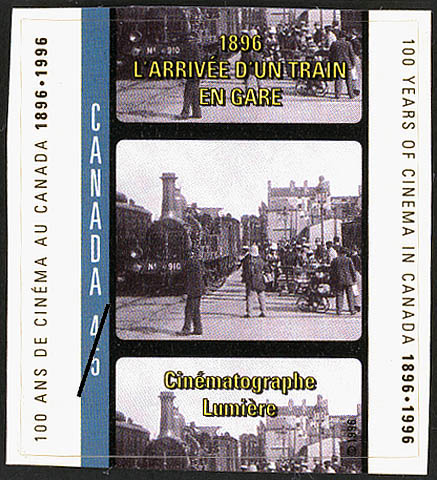 |
|
Send note to Staff
|
|
|
Replies: 112 / Views: 21,800 |
|




 Posted 11/10/2014 9:13 pm


