I spent quite a while reading up on corals, expecting to find that the joint issue with Hong Kong on the subject would reveal Asian territory, even if submarine. Alas, all could be Canadian. Or perhaps I should say, hurrah!
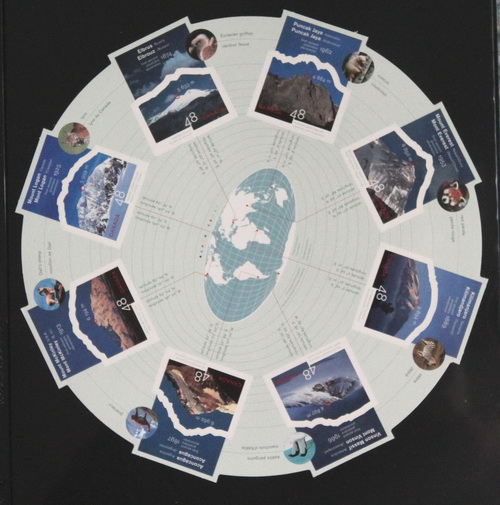
The next example is as foreign as it can get, with depictions of every continent on the globe: #1960 (2002) United Nations International Year of the Mountains issue:
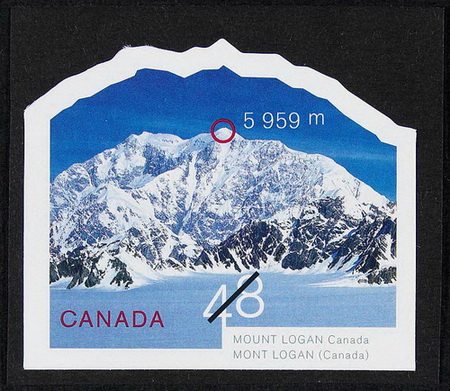
In fact the only Canadian subject is, of course, our own Mount Logan (which explains why there are eight stamps and only seven continents!)
The highest mountain in Canada and the second-highest peak in North America, after Mount McKinley (Denali). It is named after Sir William Edmond Logan, a Canadian geologist and the founder of the Geological Survey of Canada, and remains so after an aborted attempt to rename it after P.E.Trudeau! It is 5,959 metres (19,551 ft) high and rising ever so slightly. It was first climbed in June 23, 1925 by a team of Canadians and Americans.
I must say that this is a fascinating topic. When I began reading it, I had no idea of the intricacies involved. Turns out that the designation of "soil" is a bit flexible.
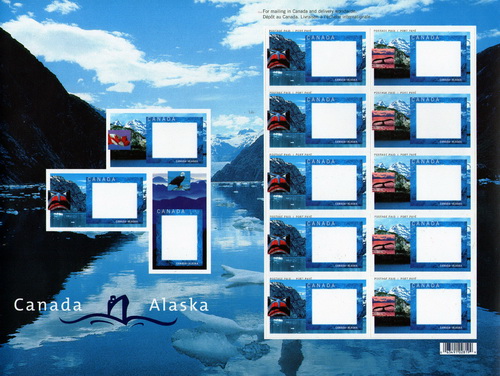
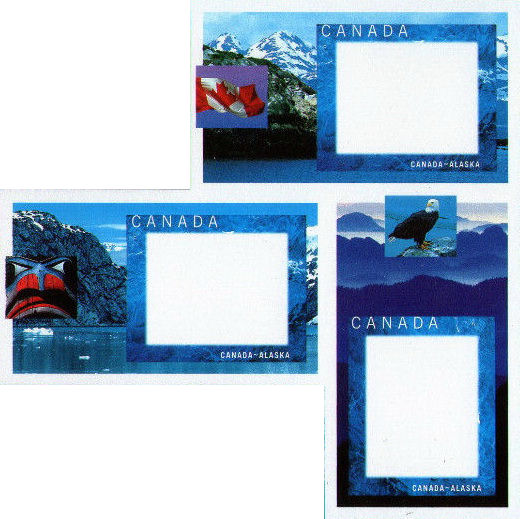
The next example is #1991C & D (2003) (It is a strange Scott/Unitrade number, coming right after #1991, the Vancouver overprint on a flag definitive. There is no #1991A or B.)
The Canada-Alaska Cruise Picture Postage issue. Cruisees were encouraged to have their picture printed on these "vanity stamps".
I am going out on a limb here for I could not identify the views, blocked as they are by those big white squares, but I assume that there must be a piece of Alaska in there somewhere.
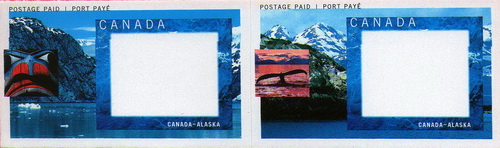
A close-up of the pair shows a totem pole and a whale's tail:
Although there was no 48¢ denomination, I don't think they can now be used as permanent stamps. At centre left there were three labels (no "postage paid") along the top. There is the totem again along with a Canadian flag and an (American?) bald eagle. (A strange hybrid set-up.) I have seen these erroneously listed in ebay as stamps for sale.
As discussed in a previous topic, legitimately used stamps (with a photo) are rare indeed. I have only seen one offered on ebay. Unitrade says it is worth $75. I can't remember what it went for, probably more. I think this must be Glacier Bay, Alaska, one of the highlights of the cruise.
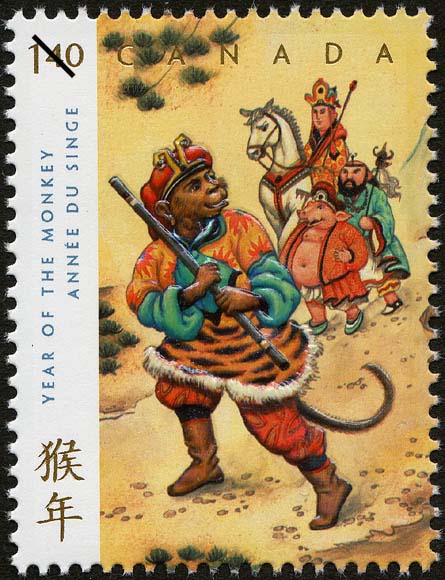
The next example is #2016i (2004) The Year of the Monkey:
Although the domestic rate stamp shows Sun Wu-k'ung, the Monkey King, on a cloud, the international rate stamp shows the troublemaking trickster travelling from China to India on an errand for the Buddha.
... thus contradicting Rudyard Kipling who declared that "East is East and West is West, and never the twain shall meet." (although it is unclear if Sun Wu-k'ung ever met Shania in person.)
The next example, like the Vimy Ridge commemorative suggested by jogil at the beginning of this thread, is territory that is soaked in Canadian blood. (So, #486 (1968) should be on this list, retroactively, inasmuch as the Vimy Memorial sits on French soil, albeit given to Canada in perpetuity but never ceded.)
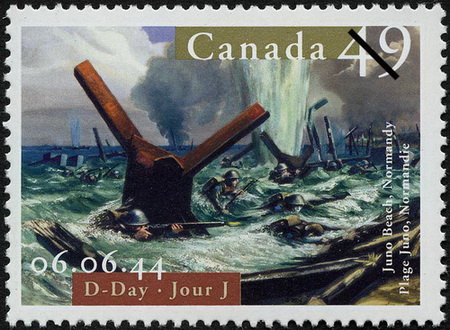
Here is #2043 (2004) the 60th anniversary of the D-Day landings:
The 3rd Canadian Infantry Division landed at Juno Beach, and succeeded in pushing farther inland than any other landing force on D-Day.
Fortunately, Churchill nixed the original code name for the beach: "Jelly". The two on either side were named after fish: goldfish & swordfish.
The Canadians suffered 961 casualties including 340 killed. At Vimy there were 10,600 casualties including 3598 killed.
sak, that #2043 D-Day Landing is very attractive with a great feeling for the action of the moment. Do you know if this artwork was commissioned specifically for the stamp or if the design is based on an existing painting?
That Shania Twain stamp also has some attractive qualities!
The painting was made by Orville Fisher, an official Canadian war artist, who landed with the boys on Juno Beach in 1944. His biography is on the Canadian War Museum site: http://www.warmuseum.ca/cwm/exhibit...er1eng.shtml
Quote: here is another interesting one. The race won by Hanlan on this stamp took place in Australia, in front of 100000 Aussies.
It occurred to me, looking back through this thread, that the image of Ned Hanlan (and as a Canadian and former oarsman myself, I have to say, Great Stamp!) I don't see any 'Foreign Soil' depicted in that stamp at all.
I have decided against including #2049 (2004) Olympic Summer Games because the stylized race track, though overprinted with the Greek word for Athens, represents every track in the world.
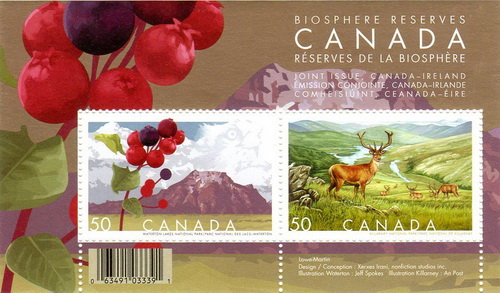
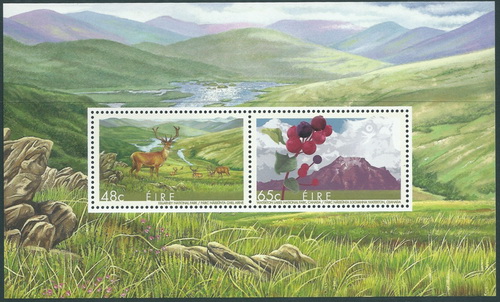
Which brings us to #2106 (2005) UNESCO Biosphere Reserves - a joint issue with Ireland.
The stamp on the right is Killarney National Park in County Kerry, Ireland. Here is the Irish counterpart: (#1611-12)
Now on the right are two old blog-topic friends, the Waterton Lakes National Park and Vimy Peak. Originally called Sheep Mountain, it was renamed in honour of the Canadian soldiers who took Vimy Ridge in 1917. Few philatelists noticed the great cloud hawk in the upper right corner.
There are currently 631 biosphere reserves in 119 countries all over the world, Canada with 16. The idea is to foster sustainable development, balancing the needs of people with the preservation of nature.
Well, my friend, to tell you the truth, when I started the topic I had only investigated up to 2000. I liked the idea, had counted enough examples (not too many, not too few), saw some interesting twists, and I wanted to get it going with what I had. Now that we're into the next millennium, it just sorta rolls along. Not being a "fly-specker" I figured I could add a little fun. I'll try to keep it going as long as the interest continues. Steve
You know, it's just a few short hops between: a) Oh, there's another "foreign soil" entry by sak. b) I wonder what the next one will be? c) Ah, there it is. I'll post it before he does.
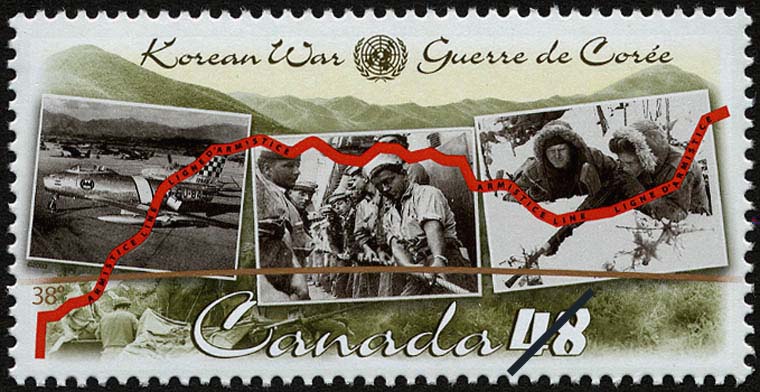
We slip back for this example: #1993 (2003) 50th anniversary of the Korean War Armistice:
Started in June 1950, when communist North Korea suddenly invaded South Korea, this war has not officially ended! It was the first military action of the Cold War.
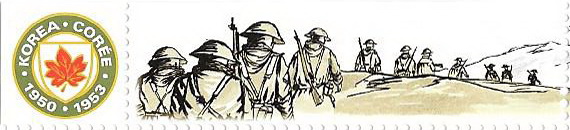
The red line represents the armistice line drawn when the opposing forces reached stalemate. The straight gold line is the "starting" line - the 38th parallel. Lots of Korean soil on the selvedge, too:
Nearly 5 million people died - more than half of these were civilians. About 22,000 Canadian soldiers and 3,600 sailors saw service in Korea. Of this number, approximately 500 gave their lives.
Largely forgotten, the most famous representation of the war was the TV series "M*A*S*H" which was set in a field hospital in South Korea. Running from 1972 until 1983, it generated a lot of anti-war sentiment and its final episode was the most-watched in television history.
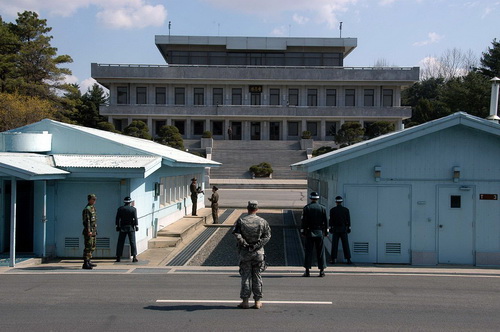
Today, the two sides still stare at one another over the De-Militarized Zone:
(That is nothing compared to what happens every night at the Wagah crossing between India and Pakistan!)
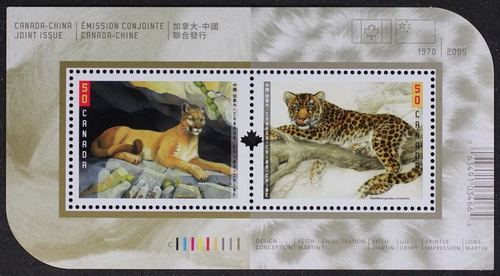
The next example is #2312 (2005) Big Cats joint issue with China:
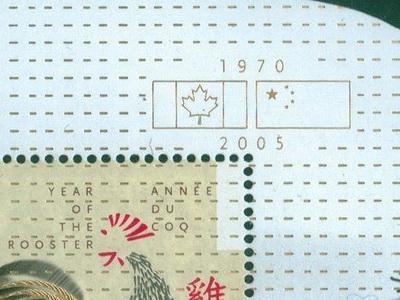
The one on the right is an Amur leopard lying on a tree limb in Manchuria. Not really about cats at all, the issue celebrates 35 years of Canada-Chinese relations. You can see the little flags in the top right corner. (The same New Year's souvenir sheet (of the Rooster) had the same design overprinted.)
Canada played a leading roll in getting China internationally recognized as a great power and was an early supporter of China's need to be represented at the United Nations. P.E.Trudeau had already visited China twice before Nixon went there (albeit not yet as PM.)
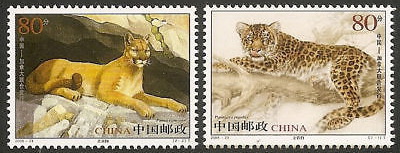
The Chinese version was two separate stamps:
Canada in Chinese characters looks like this: (which you can see on the side.)
Incidentally, this is the first use of the maple leaf perforation. It seems to pop up in joint issues (Anne of Green Gables with Japan and Marine life with Sweden.)
Steve
P.S. Sorry about that big video blob at the end of the last post. It was supposed to be just a one-line link to a YouTube video.
The so-called (by some) "Korean Conflict" cease-fire has never been replaced by a formal peace treaty. Signing were North Korean, Chinese military leaders and the US-led United Nations command. But, no South Korean representatives put their signatures on the agreement. This explains why "Today, the two sides still stare at one another over the De-militarized Zone" It also explains "the futility of war". Some lessons are never learned.
Disclaimer: While a tremendous amount of effort goes into ensuring the accuracy of the information contained in this site, Stamp Community assumes no liability for errors. Copyright 2005 - 2026 Stamp Community Family - All rights reserved worldwide. Use of any images or content on this website without prior written permission of Stamp Community or the original lender is strictly prohibited. Privacy Policy / Terms of UseAdvertise Here





 Posted 11/29/2014 12:45 am