|
This page may contain links that result in small commissions to keep this free site up and running.

Welcome Guest! Registering and/or logging in will remove the anchor (bottom) ads. It's Free!
To participate in the forum you must log in or register.
| Author |
 Replies: 144 / Views: 28,552 Replies: 144 / Views: 28,552 |
|
|
|
Moderator

United States
12330 Posts |
|
|
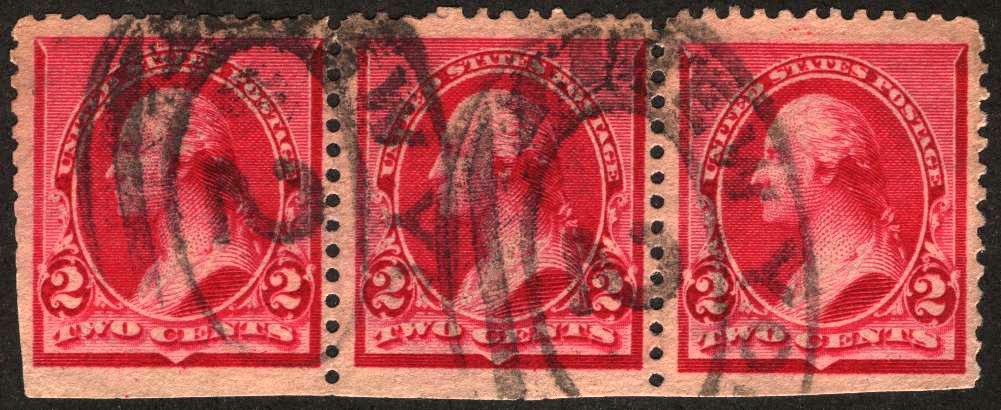
If there is a 'cap on both twos' plate is it not possible that through inking process ink could fill the left cap on some stamps, leaving just the right cap visible?
Proving there was plate flaw (and not just an inking issue) involved would make it a more desirable collectable to many hobbyists. I think that in the time since this stamp got its cert there has been less agreement on the legitimacy this as a plate flaw, not more.
Don
APS #094826 |
Send note to Staff 
|
|
|
Pillar Of The Community
United States
1414 Posts |
|
|
Don,
The cap on the left two and both twos was the result of small pieces breaking off of the transfer roller. Someone may know whether or not other transfer rollers were used for this issue. I don't have the necessary information. It seems like it would be difficult to envision a plate flaw that would extend the surface area of the two at the top and extend the unprinted area enough to form the "cap". Unless the flaw can be explained by some scenario involving another transfer roller, it would be necessary to accumulate enough foreign matter at the top of the "2" to extended the boundary of the unprinted area defining the outline and shape of the "2".
Clark |
|
Send note to Staff
|
|
|
Pillar Of The Community
United States
1946 Posts |
|
|
Here is a link to an earlier discussion of the "capped 2" relief break varieties: https://goscf.com/t/38921In that thread I give you a couple of published references for the study of these breaks. They are called " relief breaks" because an entry on a transfer roll is called a "relief." The introduction to the Scott US Specialized explains the process for intaglio plate making and describes all the steps. We can do that here if necessary. However, for now let us simply say that when parts of a relief image on a transfer roll starts to break up, that trouble is going to reproduce for every position on every plate where that relief has been used to "enter" the plate. The cap varieties appear in multiple examples, and in one case as a progressive break, on a couple of plates used for the 2c. The Morris book I mentioned, and the later USSS study paper #22, both discuss the known stages of these breaks. |
|
Send note to Staff
|
|
|
Valued Member
5 Posts |
|
|
The controversy surrounding this stamp truly amazes me. First I'd like to address certification. One certificate from the NYPF (New York Philatelic Foundation) is ALL that is needed. They ARE the grandfathers of certification and have the final say on what is genuine and what is not. Second. Here is an excerpt taken from a personal email from former Scott Editor, Jim Kloetzel, regarding his understanding of how these caps came to be. {Jim Kloetzel}: "They almost certainly were caused by what we know as "ink scooping" or "scooped color," where during the final wiping of the plate by hands before the plate is run through the press, the printers fingers or palm removes small bits of ink that should have been left on the plate". My issue with this is that he says, "almost certainly". Why does he say this? Because there is actually no written proof, anywhere. I know this because he told me so. Everything about these caps is pure speculation. If people would actually read my ebay listing, view all of the images, and understand that 18 months of research went into it, they might have a different view as to how these caps were caused. In my listing you can read Mystic Stamps reason for the caps. There is no way that anyone can convince me that these caps were not intentional so that the engravers could distinguish the different shades of ink after the harsh criticism of the ink color of the original Scott 220. I personally viewed the only existing proof sheet of the 220a, cap on left, and the photo is in the listing. The others were destroyed in a fire. I could go on and on. The listing is up on ebay. Please take the time to read, view, and judge for yourself. http://www.ebay.com/itm/-/231936970751? |
|
Send note to Staff
|
| Edited by Philatelic Rocker - 05/07/2016 4:57 pm |
|
|
Moderator
United States
12330 Posts |
|
|
Sorry, but all certification bodies have made mistakes and PF is no exception. As just one example, PF cert #463694 for a block of WV2 is incorrect and the block is a fake. PF was notified several years ago and said they would correct the issue. A follow up was done 10/2/2014 and I have emails in which PF admits that the cert is incorrect and the block is a fake. At that time they said the block had been removed from the marketplace and would not be offered for sale in the future.
Obviously as the person asking $95,000 for your stamp you have a vested interest. Rather than trying to convince others to listen to your opinion, why not send it out for one or two additional certifications? Having multiple certs would certainly help remove some of the questions on this stamp and justify a higher value for it. Seems like a no-brainer.
Don
|
|
Send note to Staff
|
|
|
Pillar Of The Community
United States
1868 Posts |
|
|
What is the ebay listing number of the 2008 ebay listing you used to purchase this? If it had a catalog value of $35 in 1939, how does it have a retail value of $100,000 in 2016? (You've changed the price, again, to $100K.) Quote:
There is no way that anyone can convince me that these caps were not intentional so that the engravers could distinguish the different shades of ink after the harsh criticism of the ink color of the original Scott 220. It is statements like this that make your listing the subject of commentary. If you are correct, this has to be the largest, most obvious and clumsiest "secret mark" of the 19th century, and therefore exceedingly unlikely. |
|
Send note to Staff
|
|
|
Pillar Of The Community
United States
1946 Posts |
|
|
Welcome to the list Philatelic Rocker!  I hope everyone will discuss your assertions with deference and respect, and that we will enjoy your company for a good while. I have not only read your comments some months ago on your "right cap" variety, but I have archived them for future reference. However, I have not been following your attempts to sell your stamp, and may not have the latest word from you on the subject. I too am surprised that there is controversy over these varieties or the exisence of a "right 2 only" cap variation. I can think of no reason why such a thing could not exist. Frank Stanton cataloged the various relief breaks in 1926, and would not illustrate the "right 2 only" variety because he could not find any two that were identical. Richard Morris followed Stanton in most things, but in this case he classed two of the "right 2" variants as Relief G and H breaks and illustrated them with drawings, as he did for everything else. I would like to see corroboration of what you have found to confirm that the form is consistent, and in that sense, for me the jury is still out on the "right 2 only" variety. I think the question is interesting, open, and should not be seen as earth shaking. However, your comment here I do not think is correct: Quote:
There is no way that anyone can convince me that these caps were not intentional so that the engravers could distinguish the different shades of ink after the harsh criticism of the ink color of the original Scott 220. I hope that is hyperbole on your part, since your assertion that these marks were related to color concerns has little to support or even suggest it. I suspect that you are deriving that idea first and foremostly from the fact that these breaks do not occur on these stamps in the shades of lake. However it is quite a leap to go from that to the assertion that these marks were intentionally used as markers of an alternative color variant. Let us examine that. The initial complaints ("harsh criticism") were against the deep shade of lake that was used in February of 1890 on the stamp now listed as 219D. The essential complaints were that the ink color was too lurid and thick, so much so that the NY Times reported it was not color fast. Much of their complaint was hype directed against John Wanamaker, a man who understood the power of glitz. However, the complaint that stuck was the charge that this stamp color was produced from aniline ink, which had been expressly forbidden in the specifications to bidders prior to issuing the contract. Whatever the merits of that charge, it is a fact that the stamp producers were directed to find a non-aniline alternative, and I have some unpublished correspondence that demonstrates the extent of that search; not only for the 2c but for other denominations as well. Nothing in the ABNCo correspondence mentions any such plan as you have proposed to intentionally mark any essays, proofs, or issued stamps with design variants as part of the color changes. Neither were there any notes explaining the purpose of the earlier so-called "secret marks" of the Continental BNCo., but this simply points out that given the official silence on the matter, it is presumptuous to assert a meaning. Moreover, there are serious problems with the suggestion that the "cap 2" varieties were intended to serve that function. For one thing, L. Brookman recounts the record of Arthur Owen that the first four rows of the lower right pane from plate VV246 had a cap on the left "2" only, but that the rmaining 6 rows had a cap on both "2"s. Since both varieties could occur on the same plate, it is hard to imagine that they were intended to signal a color discrimination or any other intentional matter of production. Here we should also mention that not all plates used only for printing in carmine shades have the cap varieties. If these really were "intended" to signal production in the new color, as you asserted, then it was a token effort that failed more than it succeeded. Richard Morris wrote about his efforts to date the occurrence of the various relief break varieties he studied, and concluded that they did not begin to occur until 1892. By then the carmine shades had completely taken over production, and nothing was being pulled in lake shades any more. While the change in color was certainly intentional, the fact that the cap varieties occur only on the later shade is more a matter of timing than design. Speculation aside, if there is anything that could be offered as proof of the assertion, now is the time to produce it. Let me comment briefly on the comment you quoted from Jim Kloetzal. Jim is a nice person and a careful editor, who depends on the expertise of others who advise him. I know this from direct personal experience as a consultant to Scott working with him myself. He does his personal best to try to comprehend their lines of thinking, but he is not an authority on this topic. Attributing the cap varieties to "scooped ink" is simply confusion. More importantly, it completely overlooks the studies of students of these varieties like Frank Stanton, Richard Morris, and Harold Sollenberger (USSS study paper #22) who have presented significant descriptive data that these breaks are the result of progressive degeneration of specific reliefs on one of the transfer rolls used for the production of the printing plates which bear these anomalies. That is a body of research that goes all the way back to 1926, as well as 2003 and 2014. My earlier discussion of the detail of these breaks and reference to an earlier thread on the subject (above) has some relevant information. I hope it will be useful. |
|
Send note to Staff
|
|
|
Moderator
United States
12330 Posts |
|
|
I am open to new findings, even if they come from a person with a financial motivation.
In my mind, extraordinary claims require extraordinary evidence. But so far I have seen nothing more than speculation. The speculation is interesting, even fun at times, but trying to promote/sell a stamp for that kind of money demands a consensus of many philatelic experts as to the existence of this variety. Hence my recommendation to secure additional certified opinions.
I hope that discovery and closer examination of this potential variety continues but without the 6 figure sale hanging over the situation. New evidence being presented in an empirical way is what gets creditability. This means doing discovery, writing and publishing articles for review, allowing time for proper vetting, having multiple known and respected experts opinions come into agreement. This is quite different than floating a theory in a forum, having a few anonymous opinions added, and trying to promote the theory with the intent of a sale.
Don
|
|
Send note to Staff
|
|
|
Valued Member
5 Posts |
|
|
The listing is up. I hope people take the time to read it. 18 months of research, including a list of experts in the "Special Thanks" section, a photo of the only existing cap on left proof sheet (which has a cap on every stamp), an original Scott listing, and still the controversy continues. Hyperbole? Not at all. Former ASDA President, Jim Lee, has one of the largest, if not the largest plate block collections in the world. He too feels that a left, right, and both caps, are just too coincidental and that my theory is very possible. With all do respect, some of the comments here are just insulting (not from you essayk). My 18 months of research is summed up as "floating a theory"? Wow! I never said that the caps were "secret marks", and my listing is not to try and promote a "theory" for financial gain or the "intent of a sale". My "claims" are far from "extraordinary". I have the first and only known cap on right 2 in the world. If someone wants it in their collection, that's my price. 6 figures. To suggest that the NYPF made a mistake is a joke. Everything that has ever been written about the caps is still speculation and the fact that there are several theories as to how they came to be tells me that we will never know the truth. essayk! My number is at the bottom of the ebay listing. Feel free to call me anytime. I'd like to know your thoughts about the cap on left, proof sheet. These are relief breaks on 400 stamps? RC/NY |
|
Send note to Staff
|
| Edited by Philatelic Rocker - 05/08/2016 08:48 am |
|
|
Pillar Of The Community
United States
937 Posts |
|
|
Philatelic Rocker, The case you present concerning your stamp is interesting. I have not read the USSS study paper #22 mentioned by essayk, so my thoughts may be from an uneducated point of view. My major qualm with your arguments is that most if not all of them are logical fallacies. For example, you frequently present an "argument from authority" fallacy as proof: https://en.wikipedia.org/wiki/Argum...om_authorityYou purport to not claim that these caps are "secret marks", but you do believe them as being intentional: Quote:
There is no way that anyone can convince me that these caps were not intentional so that the engravers could distinguish the different shades of ink after the harsh criticism of the ink color of the original Scott 220. If we continue that line of argumentation, then I am left wondering why such marks were needed given that the color of a produced stamp would be identifiable by a significant color difference alone. Regardless of that, why does only one such example of this variety exist? According to the early catalog image in your ebay listing, this variety should be nearly as common as the 220c caps on both "2" variety. Occam's razor https://en.wikipedia.org/wiki/Occam's_razor seems useful here in that a simpler explanation is more probable. Expertizers are human and have been known to miss noticing that ink has been scraped away as well as noticing scraped away ink that actually was not. Also, the very well known 220a and 220c varieties have some rounding of edges of the caps. This is very difficult to do with a sharp edge. Your purported 220b has no rounded edges. Simply put, it does not fit the pattern that the other two varieties exhibit. I believe that your stamp could have been intentionally modified after being printed. My hypothesis should be easily tested by immersing your stamp in any watermarking fluid. A difference in light transmission should be easily identified between the major body of the right hand "2" and the supposed cap. Even better would be to utilize "wet scanning": https://goscf.com/t/45157We can only speculate and argue about prior observations until you present us with images that support your assertions. Please provide us with a 2400 dpi or higher scan of the right "2". You should also provide us with a wet scan of that area. Also, USB microscopes are cheap and can give an even higher level of detail such as the images here: https://goscf.com/t/49126#424621I am very skeptical, but I always welcome argumentation. So far, none of your arguments conclude your assertions. Further proof is needed. Your list of others supporting your assertions means nothing until there is conclusive evidence supporting themselves. I have no stake one way or another concerning your stamp. I desire only for objective evidence. For your sake, I hope that you have what you think that you have. However, I highly doubt it. Please present us with evidence and argumentation that supports the theory that your stamp is #220b and be careful to avoid logical fallacies. Edited for clarity. |
|
Send note to Staff
|
Ryan = HDNAC = DNA = HDC = Hysterical DNA Collector = Historical DNA Collector = me who just loves stamps :) |
| Edited by Historical DNA Collector - 05/09/2016 12:49 pm |
|
|
Rest in Peace
7742 Posts |
|
|
Pillar Of The Community
United Kingdom
8628 Posts |
|
|
Robert
The money's in the post. I'm paying in Star Trek mini-sheets, if that's OK.
Geoff |
|
Send note to Staff
|
|
|
Rest in Peace
United States
4052 Posts |
|
|
Quote:
... There is no way that anyone can convince me that these caps were not intentional so that the engravers could distinguish the different shades of ink after the harsh criticism of the ink color of the original Scott 220 ... Q/ Why wouldn't a Color Change mark be placed in the selvage? (Yes, were one to want one at all.) Cheers, /s/ ikeyPikey |
|
Send note to Staff
|
|
|
Pillar Of The Community
United States
1946 Posts |
|
|
I have to back up a bit here and ask the group to give us some space if the seller is willing to discuss this item with me/us here.
This discussion is already degenerating into a quarrel over marketing, and some of the rhetoric is already taking a nasty turn. In this environment needling the seller does not seem to be a productive approach to understanding, and I would ask those with emotion about the matter to pull back and let saner heads prevail. In particular, those who hold nothing but disdain for the seller or the issues involved are kindly asked to keep their thoughts to themselves as we attempt to come to a common understanding. Permit me also to suggest that discussion about what this item is worth is premature, seller pricing notwithstanding. Let us first agree on what this item is, before we delve into questions of market value.
I would like to take up the question of whether or not the PF opinion puts this stamp in the same class as the other cap varieties, which are classified by the most authoritative scholarship on the subject as "relief breaks."
In the interest of civility, order, and common courtesy can we limit our comments to that technical question for now?
On the matter of identity, the PF has issued an opinion that the item is a "genuine 220 variety" with "cap on right two." It does not specify more than this much. I have not seen any reference to further discussion by the PF on the implications of that certification. In the absence of any contrary statement, we must accept that this is a "cap variety" for the right numeral two alone. Questions of the fallibility or infallibility of the PF or its opinions have no bearing on our assessment of the data relating to understanding what this variety is or how it came to be. May we agree to leave that out of the discussion for now?
|
|
Send note to Staff
|
|
|
Pillar Of The Community
United States
937 Posts |
|
|
essayk, I agree. This discussion needs to remain civil and objective. Quote:
I would like to take up the question of whether or not the PF opinion puts this stamp in the same class as the other cap varieties, which are classified by the most authoritative scholarship on the subject as "relief breaks." That and your last paragraph leaves me a bit confused. Quote:
...assessment of the data relating to understanding what this variety is or how it came to be. This seems to be what you are specifically asking for the discussion to focus on. If so, then I agree in that it is the primary issue that necessitates understanding. The physical conditions resulting in the "relief breaks" of #220a and #220c have manifested as very similar shapes. This potential #220b displays a cap that appears quite different than the others. That outright is not enough to dismiss the possibility that it is #220b, but at least adds another layer of difficulty in identifying a variety that has nearly no documentation nor prior imaging in the approximately 120 years since it would have been produced. Again, I have not heavily researched the cap relief breaks nor have read any detailed published research concerning them. However, I believe that the physical conditions that caused any of the three possible types would be very similar. I.E. similar metal physical characteristics, similar transfer roller hardening procedures, similar transfer procedure such as pressure and speed of applying the transfer roller to a plate, and similar storage conditions. My assumptions are strengthened by the estimate that only 6 or so plates were produced when the relief breaks were present on any transfer roller. Various procedures were experimented with over time, but the time frame here is relatively condensed. So, a relief break occurred on the transfer roller which resulted in #220a having a left "2" cap. Considering that the physical characteristics of the left "2" are nearly identical to the right "2", then it would seem logical that the same could subsequently happen to the right "2". So much the same, that the caps of both of those varieties have a nearly identical shape. That progression of physical changes on a transfer roller does not allow for the third type. A relief break on the transfer roller resulting in a cap on only the right "2" would require that a different transfer roller was utilized. Do we have evidence that a different transfer roller was used? Because of the physical similarities of the left and right "2", I don't doubt that a different transfer roller could have the right "2" first experience a relief break that would be any more probable than starting with the left "2". So the question that needs to be answered first in my mind is if a different transfer roller was used. Regardless, the image of the possible #220b is lacking in detail such that the cap's shape is not clearly seen. It appears different than the other two possibilities, but an uncertainty will remain until a detailed image is presented. |
|
Send note to Staff
|
Ryan = HDNAC = DNA = HDC = Hysterical DNA Collector = Historical DNA Collector = me who just loves stamps :) |
|
|
Replies: 144 / Views: 28,552 |
|
|
To participate in the forum you must log in or register. | |
Disclaimer: While a tremendous amount of effort goes into ensuring the accuracy of the information contained in this site, Stamp Community assumes no liability for errors. Copyright 2005 - 2026 Stamp Community Family - All rights reserved worldwide. Use of any images or content on this website without prior written permission of Stamp Community or the original lender is strictly prohibited.
Privacy Policy / Terms of Use Advertise Here |
| Stamp Community Forum |
© 2007 - 2026 Stamp Community Forums |
| It took 0.27 seconds to lick this stamp. |
 |
|
|
|


 Posted 04/03/2016 11:37 am