| Author |
 Replies: 144 / Views: 28,556 Replies: 144 / Views: 28,556 |
|
|
|
Pillar Of The Community
United States
2947 Posts |
|
|
HDNAC wrote: Quote:
I thought that essayk was saving this for the future meeting at NY2016, but I was wrong. Since it's unlikely I'll be able to attend that meeting, I am very appreciative of essayk, and everyone else, taking the time here. I do hope PhilatelicRocker is able to attend. This seems like the stuff future papers, essays and articles could be written about. |
Send note to Staff 
|
|
|
Pillar Of The Community
United States
1946 Posts |
|
|
Quote:
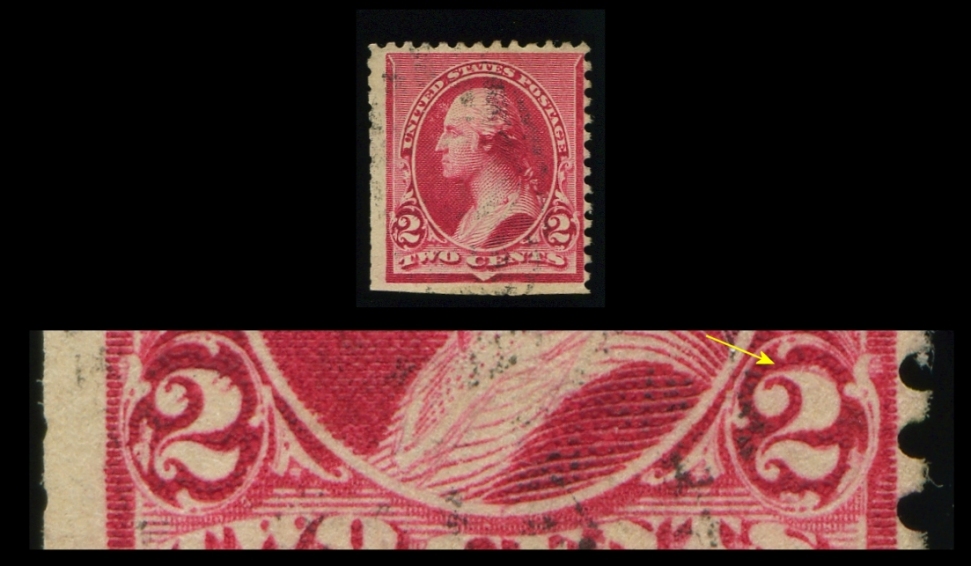
I have one with cap on right only (albeit with a few condition issues) Don, would you be willing to show us a scan of your example here, in this thread? For comparison? |
|
Send note to Staff
|
|
|
Moderator

United States
12330 Posts |
|
|
Pillar Of The Community
United States
1946 Posts |
|
|
Thanks, Don. Yes, I would agree in view of the other spots of missing ink within the same oval on your stamp, let alone in other parts of the design. I am still looking into it, but I think that one of the reasons the PF issued a cert for the item in question is because that stamp does not show other spots of missing ink. That is in its favor as a possible relief break as opposed to an inking flaw. That said, the PF cert does not specify the kind of 220var they are certifying it to be beyond the fact of a cap over the right numeral "2." Since there is now no catalog listing for 220b as a relief break, they did not have the option of identifying it with the old listing. We need to hear more about their opinion, I think. Apart from the cap, does anyone here see anything about the stamp under discussion (on ebay) that gives evidence of an inking problem in its printing? |
|
Send note to Staff
|
| Edited by essayk - 05/13/2016 4:52 pm |
|
|
Pillar Of The Community
United States
1868 Posts |
|
|
The image in the listing is low resolution, but there appear to be many candidates, of which the "cap" is merely the most prominent. Only in-person inspection would improve or disprove this evidence, but I am not holding my breath that that will ever be possible with this owner. 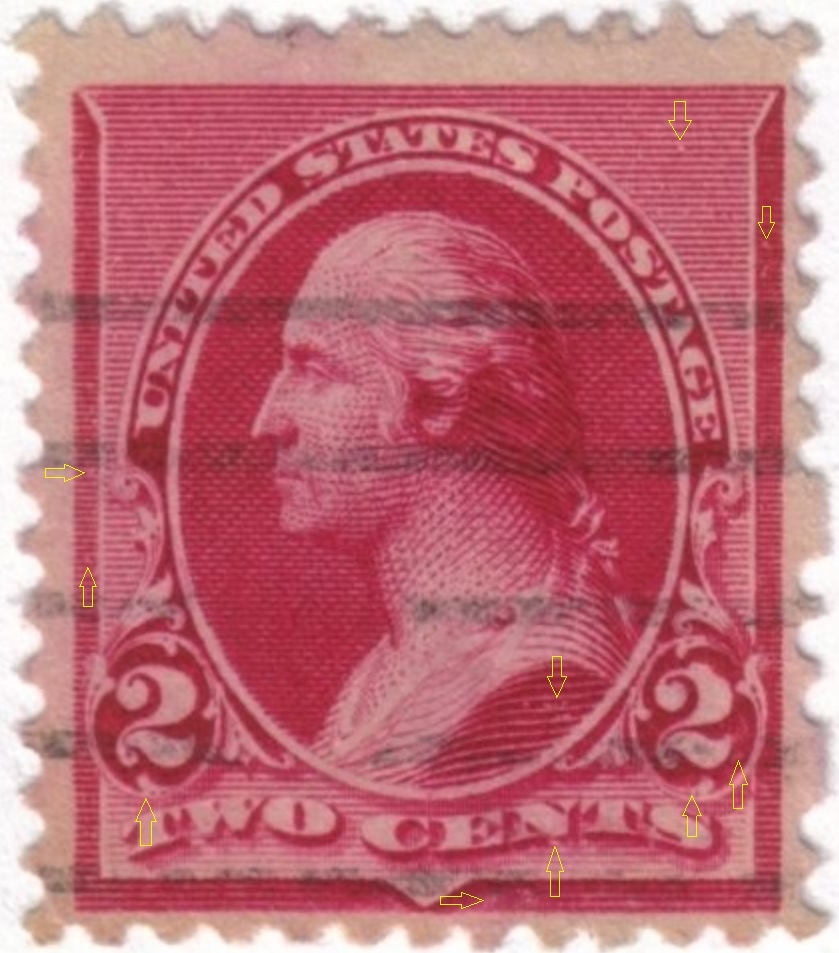 |
|
Send note to Staff
|
|
|
Pillar Of The Community
United States
1946 Posts |
|
|
Quote:
Only in-person inspection would improve or disprove this evidence, but I am not holding my breath that that will ever be possible with this owner. Thanks for the annotated image, CJ, I will certainly be taking a closer look at those points. As for your comment quoted here, I'm not as skeptical as we all might have been. Earlier today I had about an hour of conversation with the seller by telephone, and it was an enjoyable time for both of us. He is making plans for sure to be at the meeting in NY on June 3, and he has promised to send me a 1200 DPI image (scanner limits) of the stamp. Given the pricetag he has on the stamp, and the value he feels it has, he is reluctant to bring it to the show. I am sympathetic to his reservations and did not press him on that, but I did point out that he would score big publicity points if he could say it was shown at the 2016 International show. Since the group meeting is officially registered and rostered by the show committee, that would be a legitimate statement. I also gave him some suggestions as to how he could prepare it for display and handling at the meeting. |
|
Send note to Staff
|
|
|
Moderator
United States
12330 Posts |
|
|
What do you guys think about the possibility of starting a new, online census for Scott #220 varieties? I think there may be value in starting a community effort in which folks could freely contribute and build a repository of high resolution images. It would be built using a SQL database backend and we can design it to store whatever information we feel would be of value. Users would be able to log-in, add new entries and upload images without any administrative intervention. It would be similar to the Stamp Smarter 3¢ 1851-57 Plating Initiative.
Once the census became populated, everyone would be able to view, compare and better understand the existing examples of these interesting varieties.
Do you think this would be a worthwhile effort? Are people willing to participate in something like this? If there is interest I can set this up in the next week or so.
Don
APS #094826 |
|
Send note to Staff
|
|
|
Pillar Of The Community
United States
2947 Posts |
|
|
I have another observation, don't know if it has any bearing on the conversation. The cap on the right 2 of any 220c that I have, does not match the cap on the right 2 of Philatelic Rocker's stamp. Not sure if this bolsters his assertion. |
|
Send note to Staff
|
|
|
Pillar Of The Community

United States
1273 Posts |
|
|
Don, are you suggesting just a census of the established varieties, 220a, 220c and possible 220b or are you thinking exploring other potential varieties akin to fly specking the issue? In an August 2014 issue of The United States Specialist, Harold Sollenberger denotes 118 stages of relief breaks on this issue. This does not include "...die flaws, plate-image faults, or pseudo-breaks..." (his terms). I suppose there are other anomalies too, and perhaps even more relief breaks and/or stages of them. It could become a large undertaking for a relative inexpensive issue (220b as an exception)? Just some thoughts....  |
|
Send note to Staff
|
|
|
Moderator
United States
12330 Posts |
|
|
Al,
Encompassing any variety would be ideal; if you limit inclusion you might miss some important clues in the 'big picture'. Are there intermediate or progressive steps to any of these varieties? Are the shapes of the caps consistent across all stamps? All kinds of questions might be answered with a well-populated census.
The tool certainly would be able to handle a large amount of images and data. This is exactly the kind of effort in which 'crowd sourcing' (a community effort) is ideal. But of course it makes little sense to build this if the interest is not sufficient.
Don |
|
Send note to Staff
|
| Edited by 51studebaker - 05/15/2016 06:05 am |
|
|
Pillar Of The Community
United States
568 Posts |
|
|
Just looking at some information on The Swedish Tiger site.
It was stated that there were six billion of this stamp issued.
When I said I have approximately 1,800, I thought that might be a drop
in a bucket. With that # issued, it seems that I have more like a drop in the ocean.
I started looking at them yesterday. Out of 60 that I looked at,
there were four 220a's and two 220c,s. As we all do, I hope to find something of interest to report.
Don, I thought it was a great idea to have "a community effort".
I would be interested in your census. |
|
Send note to Staff
|
|
|
Pillar Of The Community
United States
8956 Posts |
|
|
I agree with the previous poster. Don, I think it is a great idea. Believe it or not, I am doing something similr on a modern stamp, Scott 2128a!
Peter |
|
Send note to Staff
|
|
|
Pillar Of The Community
United States
4174 Posts |
|
|
What I REALLY don't undertsand is Rockers claim that the cap on right is an intentional mark to denote a new color. Besides the fact that the new color is blatantly different from the original lake, why would there be a cap on only a right 2 on so few stamps that we are arguing about a possibly unique stamp, and plus have a cap on only the left 2 on a lot of stamps, plus caps on both 2's on a lot of stamps and no caps on others? A tad bit inconsistant on the part of the plate maker if they were intentional.
Peter - can you start another topic in the Modern US folder to explain what you are researching on the 2128a? |
|
Send note to Staff
|
|
|
Valued Member
United States
56 Posts |
|
|
Don are you thinking the db to be exclusive to the 220's or potentially expand to other number varieties as well? Regardless  Thanks. |
|
Send note to Staff
|
|
|
Pillar Of The Community
United States
1946 Posts |
|
|
Don, I like your idea of rounding up examples in a database. But please permit me to make a suggestion. Along the lines of what Al was saying, you will want to avoid reinventing the wheel. What I mean is this: Since studies have already been published cataloging relief break varieties based on research dating back to the 1930s, I would suggest that you use one of those to create the types standard for your database. If you just start harvesting raw images and assign them slots in a database without a standard reference, your work will be ignored by serious specialists who are already committed to another system. That would not serve your contributors nor the hobby at large very well.
The listings from either Morris or Sollenberger are readily available to you (see biblio references earlier in this thread). |
|
Send note to Staff
|
|
|
Replies: 144 / Views: 28,556 |
|




 Posted 05/12/2016 10:31 am