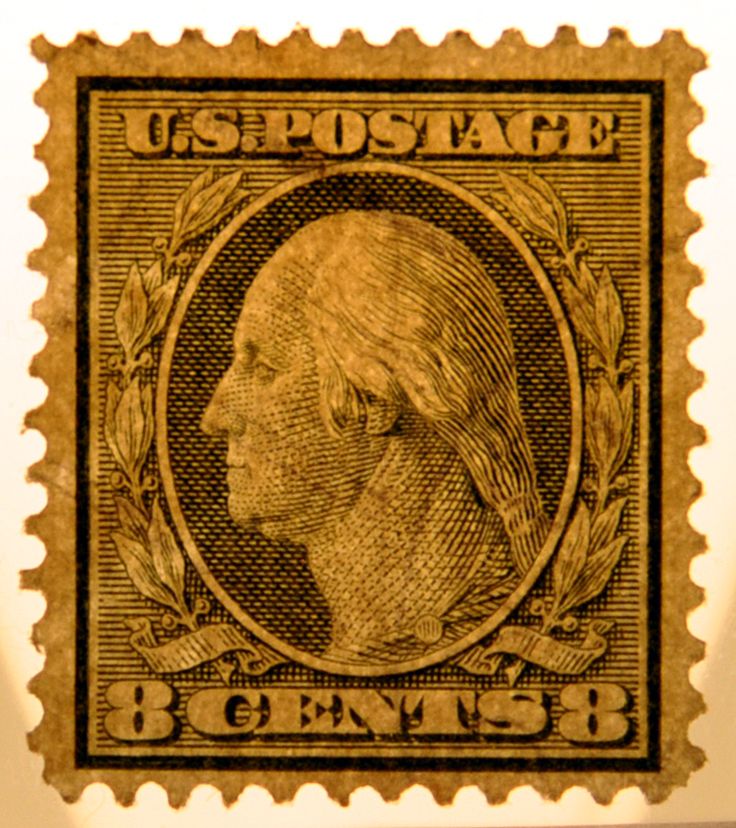
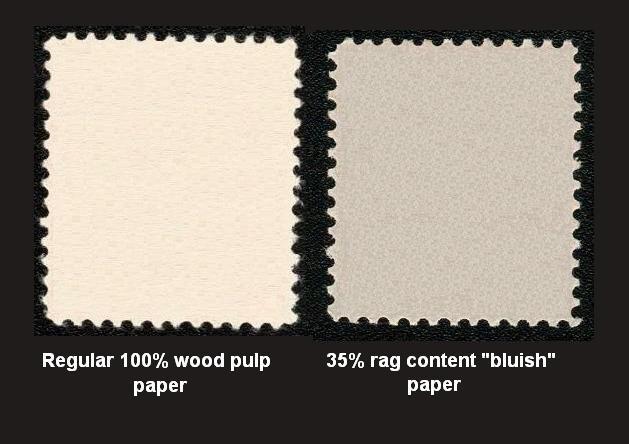
As Don said, an orange background does help identifying "bluish" paper when compared alongside regular paper. Scroll to about half way down this page to see an image that is representative of "bluish" versus regular paper:
http://www.jamesdire.net/W-F.html-EDIT: I'll just post the picture since I already attributed it:
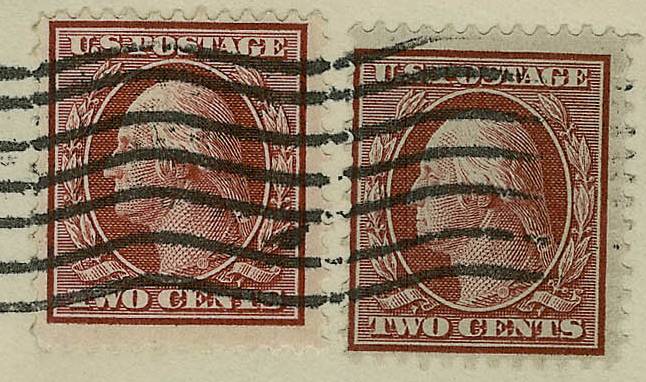
-EDIT 2: Here's another image of a "bluish" paper stamp next to a regular issue (source unknown, contact me for attribution):
Here's a copy and paste of my unorganized notes on research about the "bluish" paper issues:
A Bluish Paper Observation
In recent years I have noticed the bluish paper stamps of 1908-1909 (Scott 357-366) are becoming increasingly rare with guide line straight edges. Can it be that all of these have now been reperforated?
- George B. Sloane Sloane's Column Stamps June 16, 1934
Cinders in the Bluish Papers
A very close examination of the bluish experimental paper stamps will almost invariably reveal small black specks imbedded in the texture of the paper.
There are some to whom the these marks will appear as undesirable blemishes, or defects, but they are, as a matter of fact, a rather good sign of genuineness, when they are present.
- ibid. May 18, 1935
Note: Bluish Paper - paper with 35% rag content (instead of all wood pulp) and a blue mineral colorant used to print certain 1909 postage stamps. The resulting stamp papers have a pale bluish color.
Examples: Scott 357-366.
BLUISH PAPER US STAMPS.
Many new collectors are not only surprised but also disappointed
after seeing a bluish paper stamp for the first time (Scott #357-366)
Also Scott #369 .
Best way to help see the "bluish" paper is to place the stamp in
question FACE down on a large sheet of orange paper, the complementary
color will help to accentuate the bluish color present in the stamp paper.
Actually the color of the paper is better described as pale bluish gray. Note that heavy inking on some can hide the paper color so effectively that it is impossible to tell from the front (face side) whether the stamp is a bluish paper variety.
ALSO NOTE: When held to the light, genuine bluish paper will appear
to have a fine, yet cloudy texture. Whereby regular pulp paper stamps
will show a distinct mesh. Genuine bluish paper US stamps have numerous tiny dark specks in the paper itself.
FAKE BLUISH PAPER STAMPS are made by soaking normal stamp in a pale
blue dye. The perf tips will show a strong conscentration of dye. The
orange paper will accentuate this.
THE BLUISH PAPER SCANDAL
The best known of the paper experiments were the bluish papers (Scott 357-366) which were made with 35% rag stock rather than 100% wood pulp paper stock then in general use. This was basically
a reversion to the combination paper stocks used to print some of the
American Banknote stamps such as the 2¢ lake of 1890. They have a light bluish-gray cast, which used to be more troublesome to identify before the high quality auction catalog color pictures of today which show the shade clearly.
The objective was to reduce paper shrinkage so as to reduce
misregistration as well as to reduce paper curling and breaking at the
perforations in the postoffice drawers. The Bureau paper supplier was the firm of Jessup & Moore had been experimenting with mixed pulp paper stock and on November 20, 1908, Bureau chief, J. E. Ralph, wrote the Treasury Secretary asking permission to supply the firm a watermarking dandy roll so that an experiment could be made with
the part-rag paper.
On November 24th a letter from Ralph stated, "...The Jessup and Moore Paper Company has been directed to forward to your office 10,000 sheets of 18½ x 20¾ 34 pound paper for postage stamps to be used by this Bureau for experimental purposes."
This was the paper used for the bluish paper stamps. It was a sufficient quantity to print 4-million stamps, which included the 1908 experiment and the 1909 archival printing.
Roy White did tests of examples and found the rag stock was only 10%
rather than the 35% reported in the Scott Specialized . It might be
noted that the 34-pound weight was a heavier stock than used in earlier years, a point I don't recall noted anywhere else.
There were two printings of the bluish papers, one experimental
and the later second an archival printing.
Based on the dates that various plates went to press, it seems
likely that the one and two cent Washington-Franklins went to press
on November 30th or December 1st in 1908 as one plate was only on
press at that time.
The experimental printing was released in early February 1909,
following a letter of that date by Ralph asking permission to
deliver the already-printed 1¢ and 2¢ bluish papers through
regular orders for the color, "variation was not sufficient
to justify destroying the printed stamps."
On February 16, 1909, Third Assistant Postmaster General
A. L. Lawshe reported the stamps were to be sent on requisition
to the Washington, D.C. post office and the Washington post
master was to report, "whether they less tendency to curl than
the stamps of the regular wood pulp paper and are found
otherwise satisfactory."
He also instructed the postmaster to have the stamp clerks observe,
"whether the greater strength of the paper facilitates the
separating and minimizes the tendency to tear away from the
line of perforation."
On or about the same February 1st date a decision was made to add
the 2¢ Lincoln to the experiment and the Lincoln plates first went
to press February 5th. These solid star plates were apparently
ready January 22nd. The Annual Report for the year ending
June 30, 1909 reports 1,480,000 1¢ stamps (14,800 panes of 100
out of a printing of 16,020 panes or 4005 sheets of 400) and 1,494,000
2¢ stamps (14,940 panes out of 16,020 printed) and 637,000 2¢
Lincoln stamps (6,370 panes out of 7,016 panes printed).
The Washington postoffice sold out by May 1st. The remaining panes
were either spoiled or destroyed. The 1909 archival printing made
from different plates than the experimental printing of the 1
and 2¢ Washington-Franklin and the 2¢ Lincoln, created a scandal
and deprived philately of important records for a century. At the time
of the experimental printing, Third Assistant Postmaster Arthur
Travers requested that printings be made of all values for the
Department files and the Museum collection before the plates
showed wear. Mr. Ferguson, Ralph's assistant, was instructed to
prepare perfect sheets of each value as soon as the plates went
to press omitting the 50¢ and $1 values. These were omitted
as they only occasionally went to press.
Four panes (one sheet) of each value were to be printed, with
one going to the Postal Museum and one into the archives with
the other two to be destroyed.
The actual printings ranged from 10-13 sheets each In January 1910,
some of the archival printing panes got out and Eustace B. Power, head
of Stanley Gibbons, bought two panes of 100 at the City Hall postoffice in New York. The result was that well-known collector Joseph Steinmetz, whose Steinmetz Miscellany was an important exhibit in the 1913 International Philatelic Exhibition, bribed Travers to arrange for the bluish paper stamps to be available
at a certain time at the Washington postoffice and bought them.
He then offered them for sale and Philip Ward, miffed that Steinmetz
had sold blue papers to his client Henry C. Gibson, alerted postal
inspectors to the irregular dealings.
On March 6, 1911, Travers was dismissed and he was indicted April 3rd.
Another indictment named both him and Steinmetz but after a year and
a half of legal maneuvers Travers pleaded nole contendere to the charges and Steinmetz's name was dropped, possibly because of political influence.
The postal history loss of the bluish paper scandal resulted from the fact that Third Assistant Postmaster General Edwin Madden had instituted a project to save and write up original documents from the post office archives dealing with stamp production from 1847 until the 1890s.
His confidential assistant was Arthur Travers, who ended up with the
documentation, which was basically suppressed at the time of the bluish paper scandal except for a few bits presented in the Steinmetz Miscellany and a few comments from those who had access to the files. The basic material is only now being prepared for publication.





 Posted 12/21/2014 12:33 pm