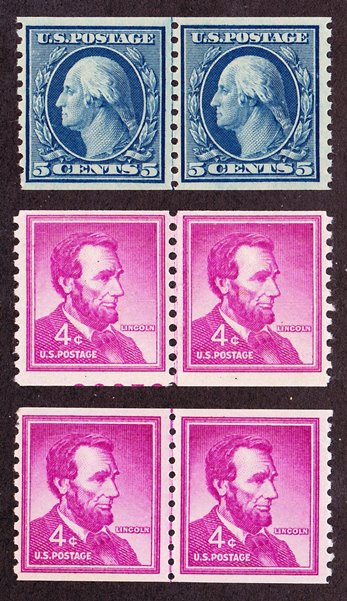
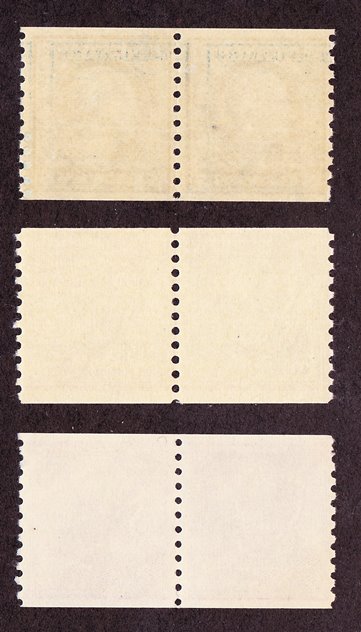
| Author |
 Replies: 34 / Views: 12,863 Replies: 34 / Views: 12,863 |
|
Pillar Of The Community
United States
1117 Posts |
|
|
I believe I have a line pair of the Small Hole variety of the 5c Rotary coil, Scott 496. Before I get too excited, I am posting pics here to get other eyes on it. What do you think? 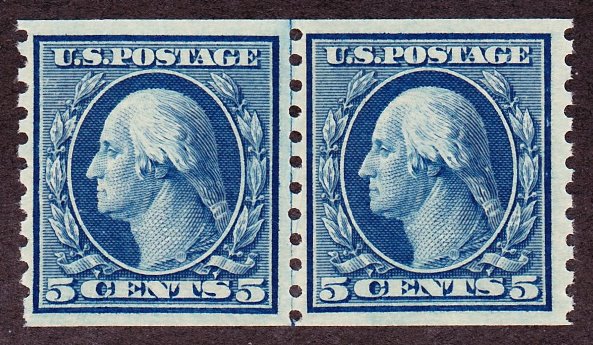 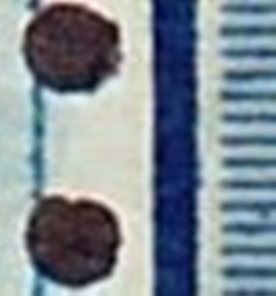 |
|
Send note to Staff
|
|
|
|
|
Pillar Of The Community
1849 Posts |
|
|
orstampman......easiest way to identify is compare to a
Liberty Series coil....most of these are small hole variety |
Send note to Staff 
|
|
|
Pillar Of The Community
United States
1117 Posts |
|
|
Pillar Of The Community
United States
1117 Posts |
|
|
Bedrock Of The Community
United States
12128 Posts |
|
|
Unfortunately, I don't think the example in the original post is the small hole variety (Scott 496a). The best way is to compare it against a known example of a 496a. I found this certified pair (not a line pair, though) on an auction site that is confirmed to be a 496a. Note the smaller holes that are readily seen in this example: 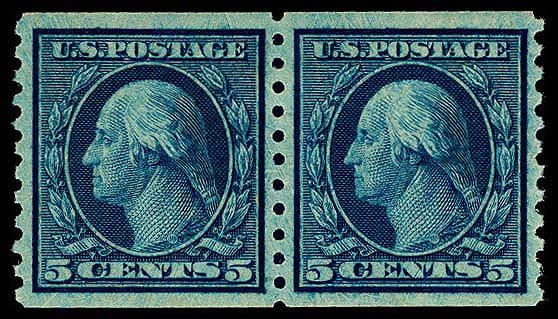 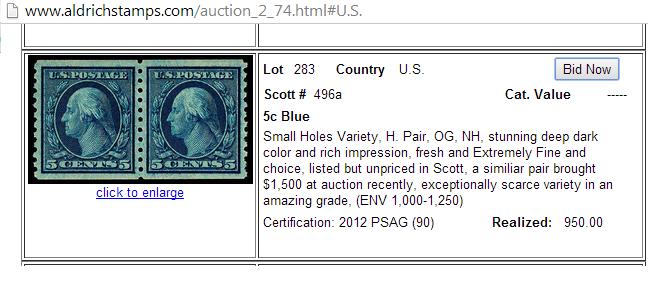 If it helps, I tried to make this comparison of the two examples (top is the originally posted example; bottom is the auction listing shown above): 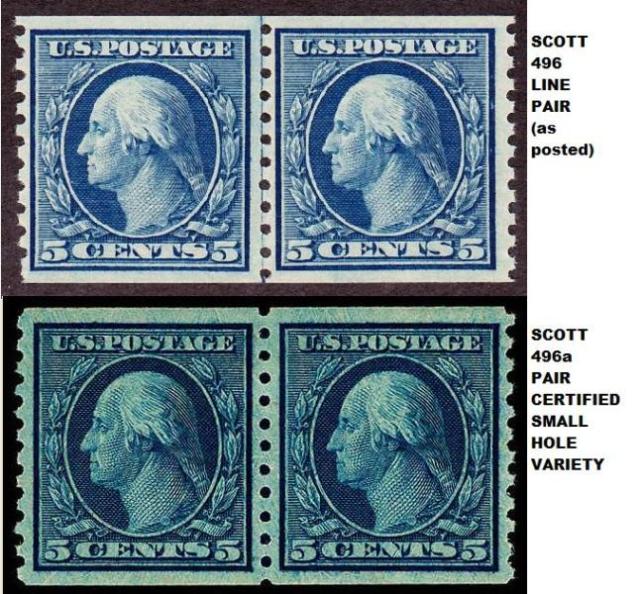 |
|
Send note to Staff
|
| Edited by wt1 - 12/22/2014 11:27 pm |
|
|
Pillar Of The Community
United States
1117 Posts |
|
|
Thanks, WT1, for the reference. I took your item scan and overlaid my cropped left stamp over yours, and they look the same to me. The top pair is mine, the bottom left (mine), bottom right (yours). What do you think? 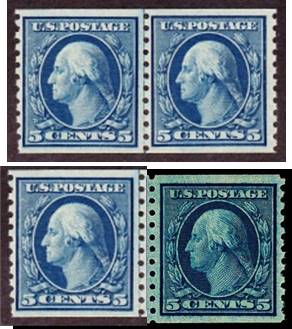 |
|
Send note to Staff
|
|
|
Rest in Peace
United States
7097 Posts |
|
|
I really hat to be the "nay-sayer" here, but look at the pair of 5¢ blue Washington's perforations down the center and sides...They are all over the place! Well at least to me they look suspect. I'm currently away from my stamp references but could one of these be manufactured from a possible imperforated pair? |
|
Send note to Staff
|
|
|
Pillar Of The Community
United States
1117 Posts |
|
|
I_Love_Stamps - Thanks for your observation. I noticed a few wilder perforations as well (bottom left hole, center hole 5 up from the bottom). I also observed that the perforation holes on the three vertical edges are aligned horizontally (as you would expect for the rotary coil). On the certified stamp, if you align the perforation hole edged against a straight line, you will see a little perforation jogging as well, but not as varied as these holes on my pair.
Here's my analysis:
1. Was it possibly manufactured from an imperforate pair or sheet multiple? No. This is because there is only one 5c imperforate Washington imperforate issue, Scott 347 which is flat plate. This stamp when compared to the flat plate imperforate stamp is much wider, and also when compared to other rotary coil issues (495, 496) is the same dimensions. So my coil pair is rotary and cannot be manufactured from the imperforate 347.
2. Was this pair reperforated to manufacture the small holes? As for most of the holes, no, since the regular perforation holes are larger. For the lower left corner perforation hole, maybe, since there may have been a flaw for which this one perforation was re-done. But there is also the possibility that these are just wilder perforation pin strikes.
3. General observation about the perforation holes is that they are not nice and round or cleanly cut. They have the appearance of genuinely struck perforation holes with some irregularity in shape and roughness.
I am of the opinion that these perforations are genuine, and I need more convincing that they are not the small hole variety, Scott 496a.
-dave |
|
Send note to Staff
|
|
|
Pillar Of The Community
United States
2555 Posts |
|
|
Not my area of expertise but I think you have exactly what you think you have, orstampman... So long as the other pair is certed correctly. I am not a fan of PSAG. |
|
Send note to Staff
|
|
|
Pillar Of The Community
1849 Posts |
|
|
Dave.....when I suggested to compare to the Liberty Series small holes.....
You did just that. Even compared a large hole.
Clearly you have a small hole LINE PAIR!
GREAT FIND! |
|
Send note to Staff
|
|
|
Pillar Of The Community
United States
1946 Posts |
|
|
I agree that this appears to be the small hole variety. I too saw the "wandering" perfs down the center, but noticed that they are in close parallel to the "wandering" perfs at the sides. Then I saw that the perfs on the certified example also have a bit of that characteristic, so dismissed it as a feature of this alternative style of perforation (about which I know absolutely nothing).
Congratulations! Good eye! I'd say it's time to get excited - and get a cert to put the skeptics at bay. (Too bad Scott only gives it a dash in the pricing. That means they don't have enough of a sales track record to assign a value standard. Getting it certified will help to establish the variety so it gets noted in auctions.) |
|
Send note to Staff
|
| Edited by essayk - 12/23/2014 09:46 am |
|
|
Bedrock Of The Community
United States
12128 Posts |
|
|
I'm still not convinced it's a 496a (small hole variety) but as others have suggested, certification will prove it right or wrong and will be needed anyway if the item is put on the market for sale.
Nevertheless, I do have a question:
It seems that my 2011 Scott Specialized does not list the 496a variety, whereas my 2013 Scott Specialized does. This suggests the variety was only added to the Scott Specialized catalog in either 2012 or 2013.
Does anyone know what prompted the addition of the 496a variety without any value and when it occurred? Was it based solely on a single find? Or is there documented evidence that many of these varieties exist but just have not been brought to market and therefore a catalog value cannot be established? |
|
Send note to Staff
|
| Edited by wt1 - 12/23/2014 10:40 am |
|
|
Pillar Of The Community
United States
1946 Posts |
|
|
Quote:
Does anyone know what prompted the addition of the 496a variety without any value and when it occurred?
I'm sure you want a published reference, and I know I cannot give you one. But the pattern for new listings is not foreign to me. The 2012 Specialized first includes the listing of 496a without pricing info. It also has the cross reference to the footnote to #1053 on large and small hole coils. You could contact Jim Kloezel or Chad Snee for an explanation for the new listing, but the usual pattern is that 2011 was when the variety was first reported, most often by one of the advisory dealers or auction houses who handled one. Since the Aldrich description of the item they sold specifies it had PSAG certification from 2012, presumably PSAG knew about the variety by then. You might check with them to find out what they knew, how they came to know it, and when. But if it's not yet in print, they might not wish to say. How rare are they? Too soon to say. Who's been looking? |
|
Send note to Staff
|
|
|
Pillar Of The Community
United States
1117 Posts |
|
|
Thank you for your inputs everyone - I think I will pass this line pair by one more set of eyes, and depending upon that opinion may submit for a certificate.  |
|
Send note to Staff
|
|
|
Rest in Peace
United States
763 Posts |
|
|
I've certified several of these in the last year. I suspect (but can't prove) they are more common than one would think based on the Scott pricing "dash". I too use one of the Liberty Series small hole variety that can not be large holes as my reference/benchmark copy. |
|
Send note to Staff
|
|
|
Pillar Of The Community
3865 Posts |
|
|
Were the older small hole perforations on earlier coil stamps made by a different perforator than those newer small hole perforations on later coil stamps? |
|
Send note to Staff
|
| Edited by jogil - 12/23/2014 4:20 pm |
|
|
Replies: 34 / Views: 12,863 |
|




 Posted 12/22/2014 9:14 pm