| Author |
 Replies: 34 / Views: 12,862 Replies: 34 / Views: 12,862 |
|
|
|
Pillar Of The Community
United States
1414 Posts |
|
|
Quote:
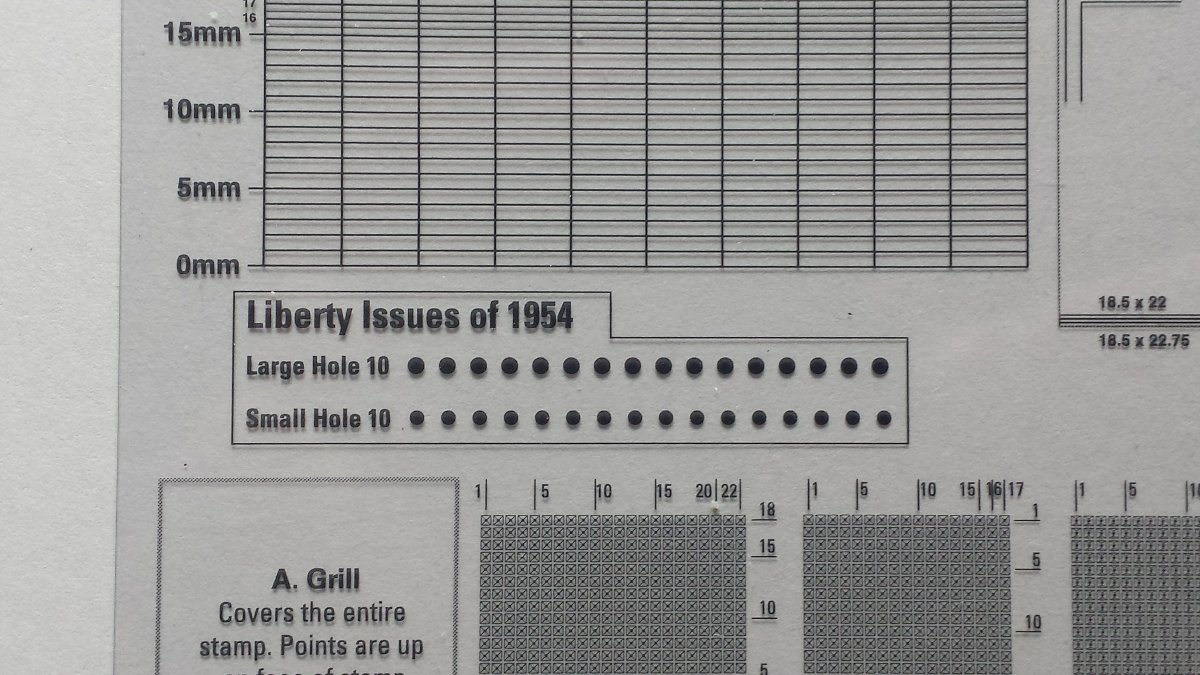
Were the older small hole perforations on earlier coil stamps made by a different perforator than those newer small hole perforations on later coil stamps? Yes, for sure, because the Liberty Series small hole coils were made on new perforators associated with the phase out of Stickney press production and the introduction of the Cottrell press. Large hole dry printed coils were produced from special Cottrell press plates with fewer subjects to fit the requirements of the older Stickney era perforators. When a few 3¢ wet printed Liberty small hole coil strips were discovered, one theory was that some wet printed coil rolls were used to test the new perforators. Finding the 1917 small hole coils and subsequent finds in other issues dashed that theory. It is believed that another perforator existed, built originally to be an integral part of the Stickney press, which remained available for use. Why was it not used more? One answer may be that the 25% smaller pin area resulted in some feeding problems and rough looking perforations. At this time, this is pure speculation. A well-known USSS author says that he can write a more definitive article, maybe someday. I don't have time to go into more detail now. I suppose I could be blamed for moving to get the listings added. At the time, I believed that a never hinged pair would fetch about $500 and a nice line pair $1,000 to $1,500. However, a number of pairs have come to light suggesting that a F-VF never hinged pair could be priced at about $200. Now that PSAG and PSE will certify small hole coils in addition to the APS, the variety has reached the mainstream. I believe that PF would also be able to certify them. I believe that a well-known Stamp dealer, originally from the Northwest had a partial roll of the small hole variety which he sold strips off of two local dealers and collectors. For those with Photoshop and a good scanner, hold size (top to bottom) should be in the range 0.043" (> 1 mm) for large holes, 0.037" < 1 mm) for dry printed small holes and 0.038" to maybe 0.039" for wet printed small holes. In addition to consistent top to bottom measurements, the round part of the hole, not stretched by the stroke perforator, should reasonably match a round 0.038" target or overlay. It the hole is badly shaped and the round part matches a 0.043" target, then it would be considered to be large. To check quickly, note whether the hole or the paper between the holes is larger. If the paper distance is consistently greater than top to bottom hole diameters, it is likely a small hole example. The discovery copy of 496a was written up in the Scott Stamp Monthly Journal a few years ago. 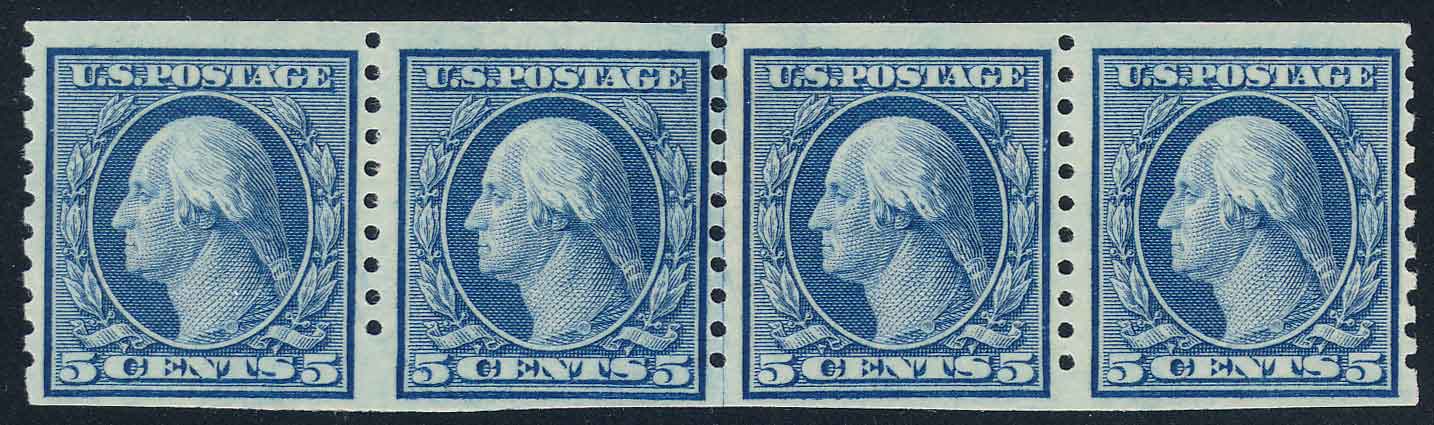 Clark |
Send note to Staff 
|
| Edited by cfrphoto - 12/23/2014 8:00 pm |
|
|
Pillar Of The Community
United States
937 Posts |
|
|
Clark, thank you for the great information. Someday I hope to attend one of your expertisation classes.
As for what type of scan is required, my math indicates that a 1200 dpi scan of the perfs should be a high enough resolution to obtain accurate measurements to make the distinction.
Also, Adobe Photoshop is not required. There are many programs such as Paint.net and GIMP that will display position information that you can manually subtract two cursor positions from to make an accurate measurement.
I'm not trying to dispute you Clark. I just want to point out there are many options that are accessible to all. |
|
Send note to Staff
|
Ryan = HDNAC = DNA = HDC = Hysterical DNA Collector = Historical DNA Collector = me who just loves stamps :) |
| Edited by Historical DNA Collector - 12/23/2014 8:37 pm |
|
|
Bedrock Of The Community
United States
12128 Posts |
|
|
On that strip of 4 stamps posted by cfrphoto, what's with the bottom coil where the straight edge is not at all straight? And how do you explain the missing perforation holes? |
|
Send note to Staff
|
|
|
Pillar Of The Community
United States
1414 Posts |
|
|
Quote:
what's with the bottom coil where the straight edge is not at all straight? And how do you explain the missing perforation holes? My guess is that the paper wandered in the press resulting in printing too close to the edge of the roll. Normally, the perforating pins do not extend much past the expected boundary of the printed designs. I have seen a couple of other examples with an uneven margin likely caused by the paper edge not quite reaching the knives on one side of the coiling machine. This strip would have had be from the outer edge of the roll where the roll had an uneven edge. Clark |
|
Send note to Staff
|
|
|
Rest in Peace
United States
7097 Posts |
|
|
That's not to say, though that a perforation pin on the comb, harrow, guillotine or whatever these were done on was bent or slightly out of skew...so, I wasn't saying definitively that is wasn't but in MY opinion was highly suspect. Hope you "nail it down" brother! (or Sister!) |
|
Send note to Staff
|
| Edited by I_Love_Stamps - 12/24/2014 07:49 am |
|
|
Pillar Of The Community
3865 Posts |
|
|
Do you know if the small hole variety gauges Kiusalas 10-80 and/or 10-81? Someone that has this coil stamp told me that his is Kiusalas 10-81 gauge. |
|
Send note to Staff
|
|
|
Pillar Of The Community
United States
1414 Posts |
|
|
Quote:
Do you know if the small hole variety gauges Kiusalas 10-80 and/or 10-81? Someone that has this coil stamp told me that his is Kiusalas 10-81 gauge. 10-80 |
|
Send note to Staff
|
|
|
Pillar Of The Community
United States
568 Posts |
|
|
While reading and enjoying this interesting thread, this essayk quote got my attention. Quote:
"How rare are they? Too soon to say. Who's been looking?"
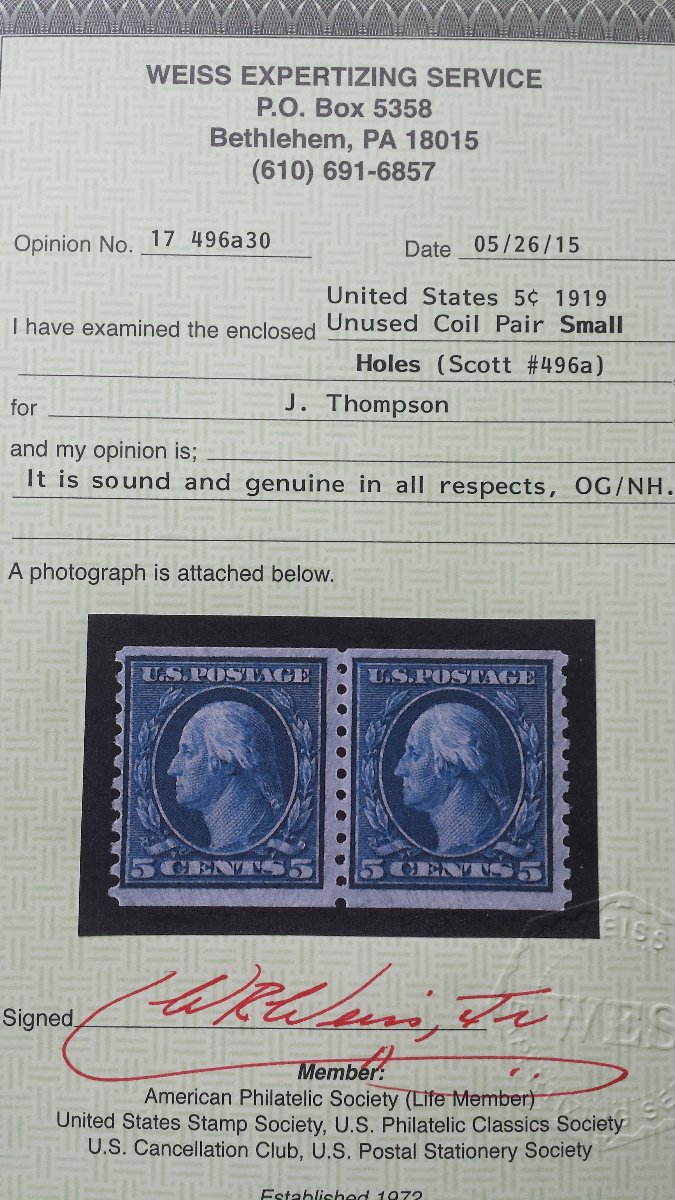
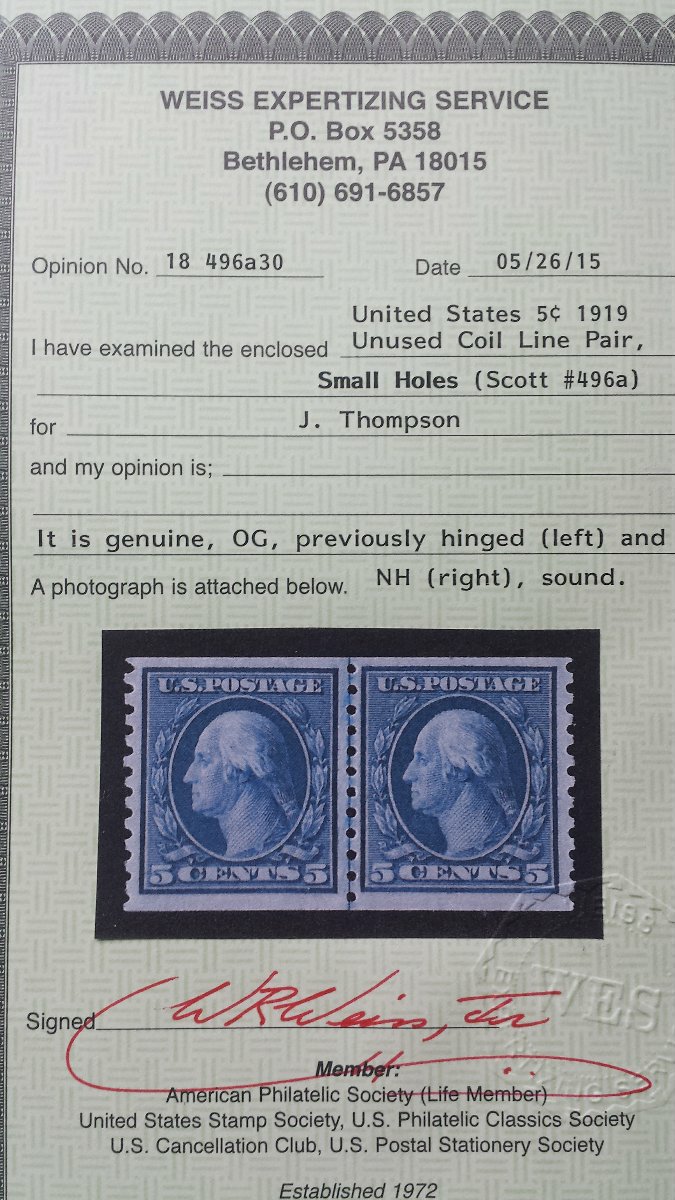
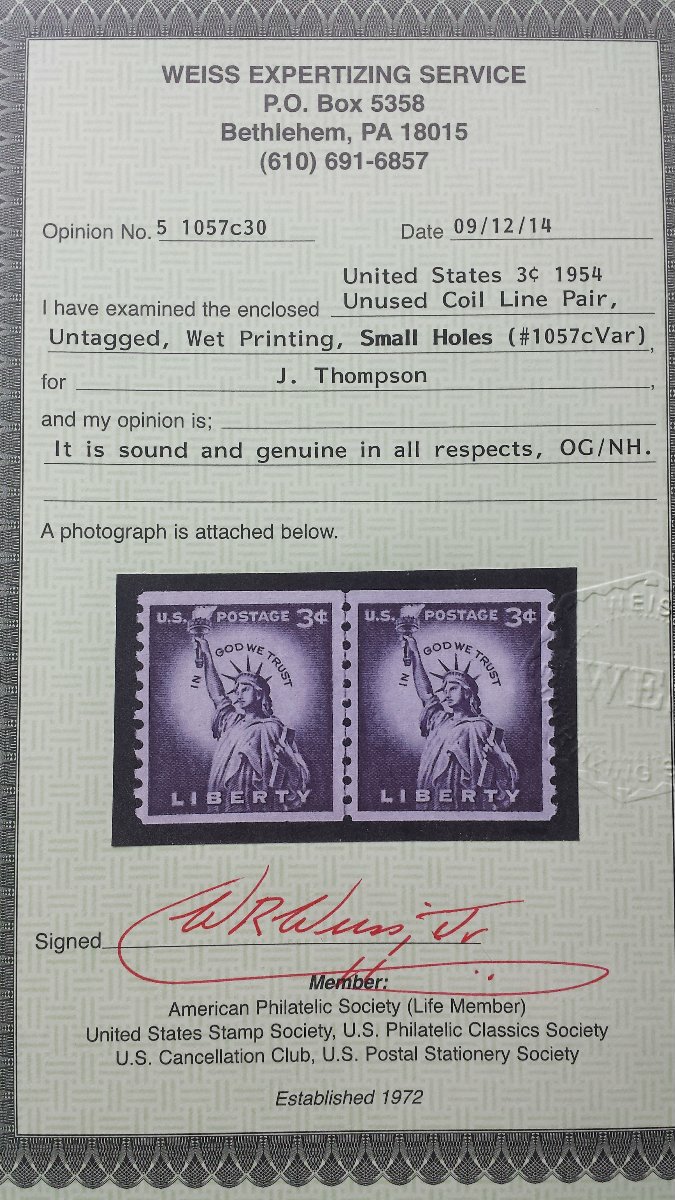
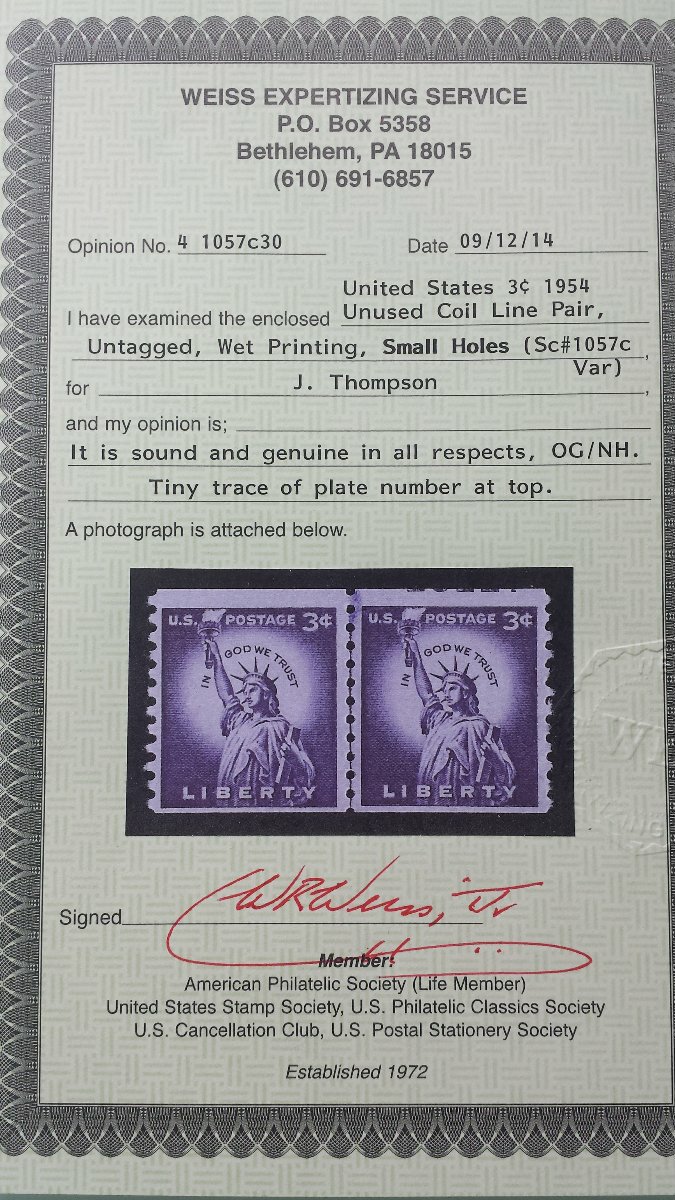
Over the last year or so, I have looked at, and bought a group of 496's. Most of the ones that I bought online that looked like the small hole variety were not. The PF has now issued their first three certificates of this variety to me. I did buy one of Bill Wieses certified 496a's, spoken of on this thread, that I saw on ebay. I am still ticked that as bidding on a second of Bill's 496a certed stamps, just minutes after buying the first, at the final moment of bidding, ebay or pay pal made me sign back in and I missed the item. These are two of the PF certs and stamps. The first, was first certed by Bill Weiss. I am waiting for a correction from the PF on the third. 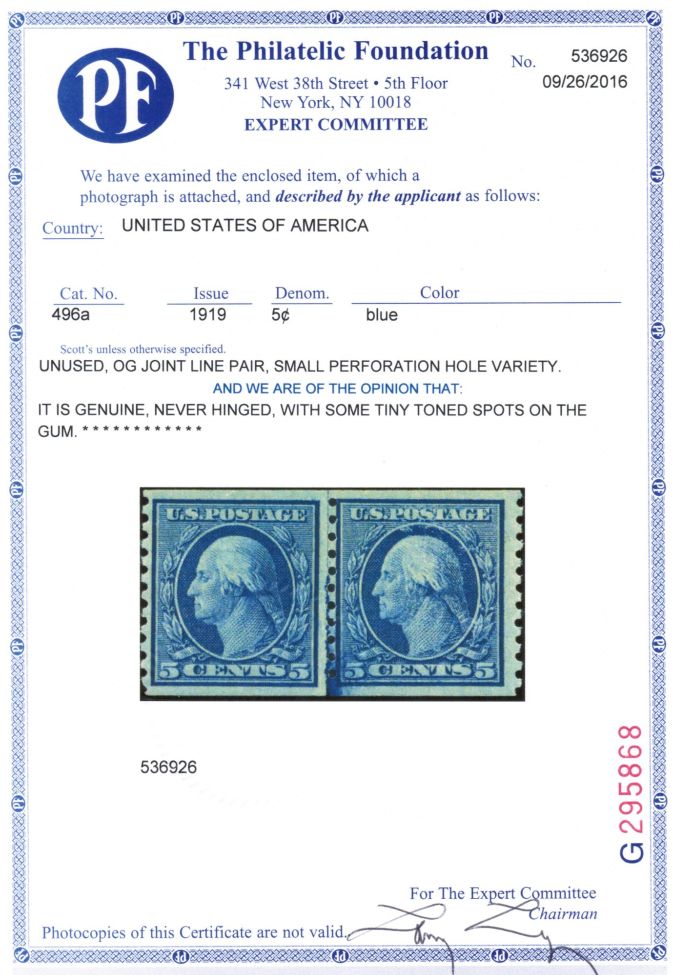 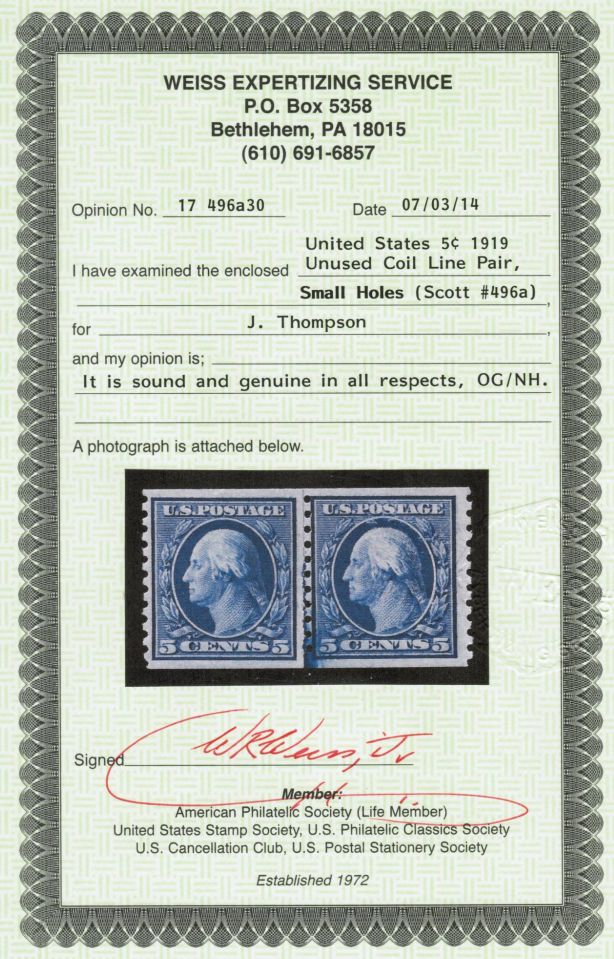 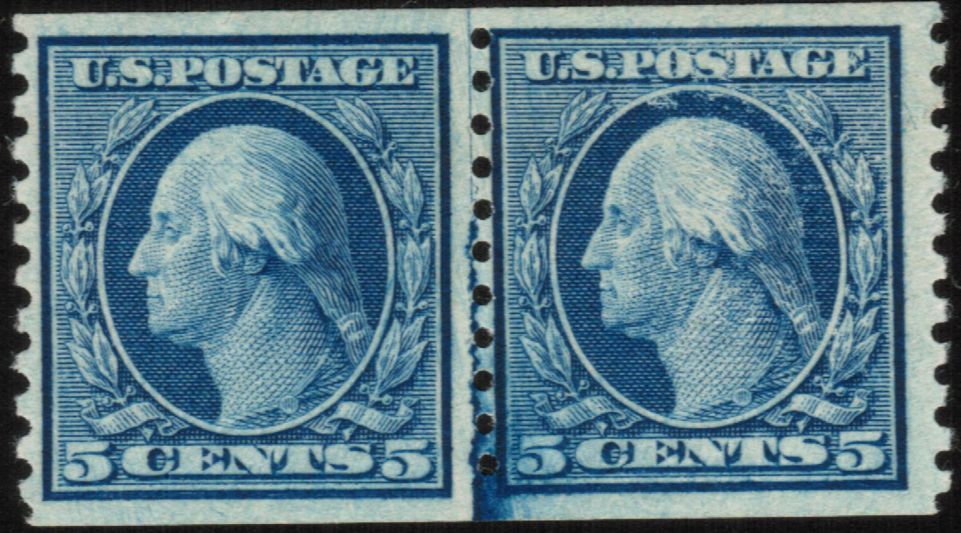 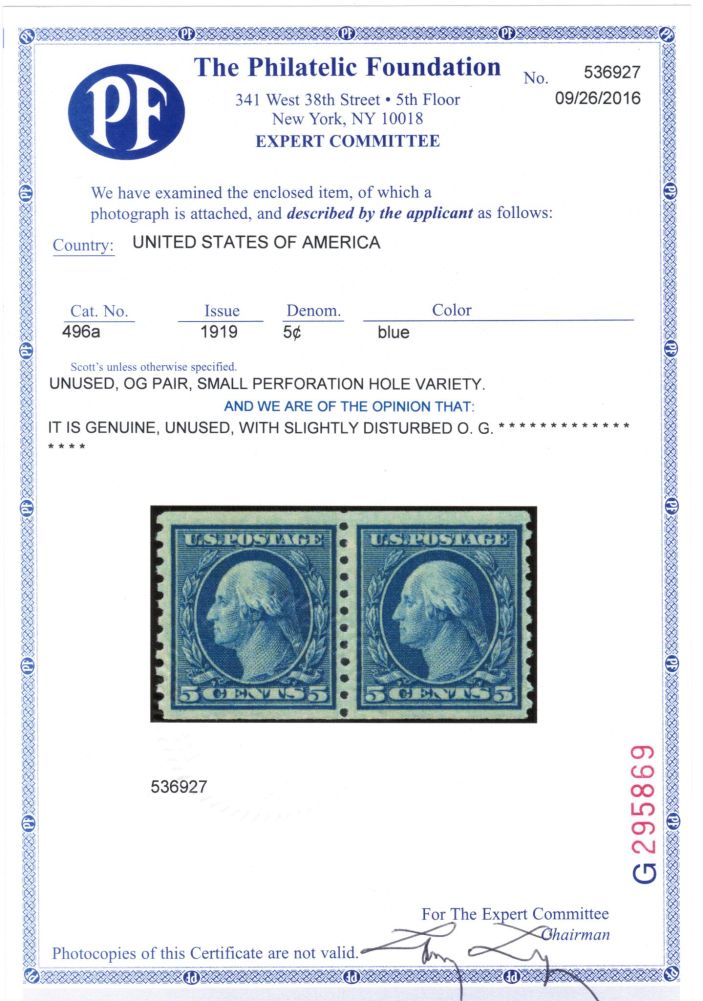 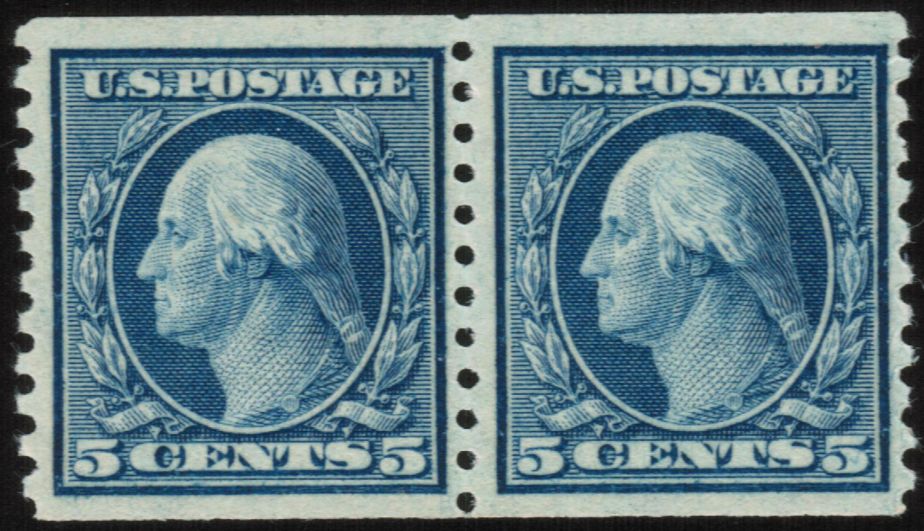 |
|
Send note to Staff
|
|
|
Pillar Of The Community
3865 Posts |
|
|
Would these small perforation holes be around 0.042" in diameter which makes them slightly bigger than the regular small perforation holes of 0.040" diameter? |
|
Send note to Staff
|
| Edited by jogil - 11/19/2016 09:52 am |
|
|
Pillar Of The Community
United States
568 Posts |
|
|
jogil, I read your post today regarding perforation questions. Your last post on this thread was a question. I was also hoping for some specifics answers. I am not sure why, but admit to buying and expertising a group of 496a's. When you asked about the hole size, I did not have an answer to your question.. When looking, as suggested earlier in this thread. If you take the image and magnify it, if the measurement between the perfs is less than that on the stamp, you may have a winner! I am still not sure why I bought all of these stamps. I guess I like them!  |
|
Send note to Staff
|
|
|
Pillar Of The Community
United States
1414 Posts |
|
|
Quote:
Would these small perforation holes be around 0.042" in diameter which makes them slightly bigger than the regular small perforation holes of 0.040" diameter? Liberty Series dry printing small hole stamps are about 0.037" measured top to bottom while large hole examples measure about 0.043' top to bottom. The perforations will be a bit wider horizontally (in the direction of the coil roll). Wet printing small holes range from 0.038" to 0.039' while large hole are 0.043" with a more pronounced stretching of perforation holes in the direction of the coil roll. I have measured holes on Scott 723 that were 0.040" but I would consider them to be large hole. Coils rolls perforated with sharp pins will have cleaner and closer to round holes. A simple test is to check the hole side with a 10x or 15x loupe with a reticule. If the perforation hole is less than one millimeter and the distance between the holes is larger than the hole height, the holes are small. If the perforation holes are larger than the paper between the holes, the holes are large. I am not sure what criteria the Philatelic Foundation is using to determine hole size. It may be less strict than the criteria used by APEX, PSE or PSAG. The recent addition of small hole listings for all of the Presidential series coils raises a potential red flag because it may not be backed up in the literature. It should also be noted that the 5 cent 496a is the only "a" variety small hole listing. I would advocate keeping the listing that way because 496a may be easier to find because a partial roll was broken up and sold to dealers and collectors by a well known dealer about 20 years ago in the Northwest. |
|
Send note to Staff
|
| Edited by cfrphoto - 06/05/2017 12:44 am |
|
|
Valued Member
157 Posts |
|
|
Valued Member
157 Posts |
|
|
Pillar Of The Community
United States
1414 Posts |
|
|
Quote:
Does anyone know what prompted the addition of the 496a variety without any value and when it occurred? There was an article in Scott's Monthly a year or two before the listing was added with an image of the discovery strip. By chance, a dealer in the Northwest was selling from a part roll of the small hole variety before the variety had been recognized. As a result, a number of pairs are in dealer stocks and stamp collections. |
|
Send note to Staff
|
| Edited by cfrphoto - 06/22/2018 9:03 pm |
|
|
Pillar Of The Community
United States
1414 Posts |
|
|
Quote:
Were the older small hole perforations on earlier coil stamps made by a different perforator than those newer small hole perforations on later coil stamps? Perforators associated with the Stickney rotary press were used for wet printings and some early dry printed coils. Almost all of the coils had "large" hole3s 0.43" io diameter. Once the new perforators were ready, Liberty Series dry printings were perforated and were referred to be as the "small hole" varieties. |
|
Send note to Staff
|
| Edited by cfrphoto - 06/22/2018 9:04 pm |
|
|
Replies: 34 / Views: 12,862 |
|




 Posted 12/23/2014 7:51 pm