| Author |
 Replies: 34 / Views: 7,636 Replies: 34 / Views: 7,636 |
|
Pillar Of The Community
1545 Posts |
|
|
I need to get a firm grip in my mind on the "rules" of tolerances on rotary press vs. flat plate stamps. The problem is that the world just doesn't operate in exact numbers. Things just don't measure either exactly 22 mm or 22.5 mm. Let us use for example the stamp height...A flat plate stamp height of a Washington coil is said to be 22 mm high. A rotary press stamp height (same design) is said to be 22.5 mm high. A very small difference. But how do you interpret measurements between 22 and 22.5 mm? Is it absolutely flat plate if it measures less than 22.5 mm? This could be the only way of telling the difference between two stamps. ( for e.g. US Scott Nos. 441 & 448).  -IBFS |
|
Send note to Staff
|
All science is either Physics or Stamp Collecting. -- Ernest Rutherford |
|
|
|
|
Pillar Of The Community
United States
1414 Posts |
|
|
As I mentioned in other posts, attempts to measure height or width to determine whether the stamp was from a flat plate or rotary press printing is inefficient and will inevitably lead to confusion. Measurements to the nearest 1/2 millimeter are simply not accurate enough. Why measure when a much simpler way exists?
An overlay test using an engraved stamp from the same series will quickly reveal whether the stamp is tall enough or wide enough to be a rotary press stamp. For example, the dimensions of a Fourth Bureau rotary press 2 cent coil will be about a frame line wider than the flat plate stamp. Similarly, a 634 perf 11 x 10½ rotary sheet stamp will be at least a frame line taller than the corresponding flat plate stamp. It should be noted that flat plate booklet pane singles are slightly wider by a fraction of a frame line that the corresponding sheet stamp and also a bit shorter because the paper grain is horizontal instead of vertical.
Throw away the ruler and regain your freedom. Save measurements for things like Kans. and Nebr. overprints. A 10 power loupe with a reticle can measure to within the nearest 0.1 millimeter. Unfortunately, the field of view is not wide enough to measure the height or width of a stamp. Most rulers are not accurate enough to measure to accuracy less than about 1/2 millimeter. Unfortunately, close enough is not good enough.
Clark |
Send note to Staff 
|
|
|
Pillar Of The Community
3860 Posts |
|
|
For W/F coils, the best way to separate rotary press coils from flat plate coils of perforation 10 is through perforation measurement. Rotary press perforations measure around 9.85 (Kiusalas 10-80) and flat plate perforations measure around 9.95 (Kiusalas 10-79). Most W/F rotary press printed stamps are coils (Scott 448-458, Scott 486-497) perforated Kiusalas 10-80 while W/F flat plate press coils are perforated Kiusalas 10-79. Also, one can check the gum since rotary press gum is usually streaked vertically from the press gumming roller and later also has horizontal gum breaker lines from the perforator. There's the rotary press coil waste (Scott 538-541) Kiusalas 11-72 x 10-80. There's the rotary press sheet Scott 542 Kiusalas 10-80 x 11-73 (11-72.5) and Scott 543 10-80 x 10-80. There's the rotary press sheet waste Scott 544 Kiusalas 11-72 x 11-72. There's the rotary press coil waste (Scott 545, Scott 546) Kiusalas 11-72 x 11-72. The hardest ones are Scott 544, 545, 546 to find. |
|
Send note to Staff
|
| Edited by jogil - 01/17/2015 09:06 am |
|
|
Pillar Of The Community

United States
1273 Posts |
|
|
Clark, I believe you have stated in other posts that #499f can be distinguished from #499. Can you give us something further on that--how to tell them apart in single stamps format.  |
|
Send note to Staff
|
|
|
Pillar Of The Community
1545 Posts |
|
|
Quote:
An overlay test using an engraved stamp from the same series will quickly reveal whether the stamp is tall enough or wide enough to be a rotary press stamp. This will work as long as you have a known vertical and horizontal template for each. But to get the templates in the first place you need some way of verifying that the template is rotary press or flat plate. It's the old catch-22 problem. Quote:
Rotary press perforations measure around 9.85 (Kiusalas) What the heck are Kiusalas? -IBFS |
|
Send note to Staff
|
All science is either Physics or Stamp Collecting. -- Ernest Rutherford |
|
|
Pillar Of The Community
United States
1756 Posts |
|
|
Quote:
An overlay test using an engraved stamp from the same series will quickly reveal whether the stamp is tall enough or wide enough to be a rotary press stamp. Good point... as the saying goes... "the proof is in the pudding"... Here's an overlay I did for Dave (Gator) on his 544 vs 498... 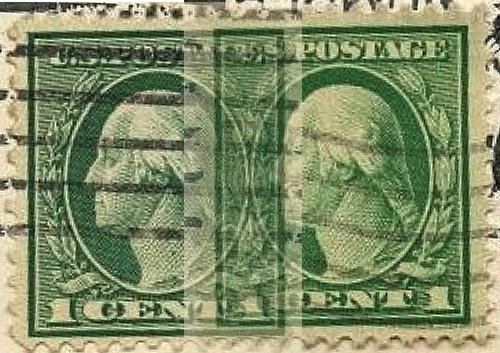 |
|
Send note to Staff
|
|
|
Pillar Of The Community
3860 Posts |
|
|
Kiusalas came up with a U.S. specialist perforation gauge and a Canadian specialist perforation gauge. Rotary press coils were perforated by a bar perforator which gives a 9.85 measurement and the perforation holes are parallel to each other across from each other. Flat plate coils were perforated in one direction by a rotary wheel perforator which gives a 9.95 measurement and the perforation holes are not parallel to each other across from each other. |
|
Send note to Staff
|
| Edited by jogil - 01/17/2015 6:47 pm |
|
|
Pillar Of The Community
1545 Posts |
|
|
Quote:
Kiusalas came up with a U.S. specialist perforation gauge and a Canadian specialist perforation gauge. Rotary press coils were perforated by a bar perforator which gives a 9.85 measurement and the perforation holes are parallel to each other across from each other. Flat plate coils were perforated in one direction by a rotary wheel perforator which gives a 9.95 measurement and the perforation holes are not parallel to each other across from each other. ......Fffascinating. You can scan a perforation gage, I did mine once. Would you show me a scan of this Kis...Kiuala... Perforation gage? -IBFS |
|
Send note to Staff
|
All science is either Physics or Stamp Collecting. -- Ernest Rutherford |
|
|
Valued Member
72 Posts |
|
|
Pillar Of The Community
3860 Posts |
|
|
The Kiusalas U.S. Specialist Gauge is recommended for Washington-Franklin stamps. It is also found on the Sonic Imagery Labs US Specialty Precision Multi-Gauge which also has several different measurement templates for flat vs rotary stamps. Unfortunately, perforations which are an important identification tool between flat plate and rotary press stamps are sometimes overlooked.
There have been a few very well written and researched articles on Canadian stamps recently that mostly focus on very small stamp frame measurements between flat plate and rotary press stamps while totally ignoring perforation measurements altogether when the fact that different perforators were used to perforate flat plate stamps than were used to perforate rotary press stamps which give different perforation measurements. |
|
Send note to Staff
|
| Edited by jogil - 01/18/2015 8:07 pm |
|
|
Pillar Of The Community
United States
2546 Posts |
|
|
This little gauge works well for me. It is clear plastic, cheap, and indestructible. 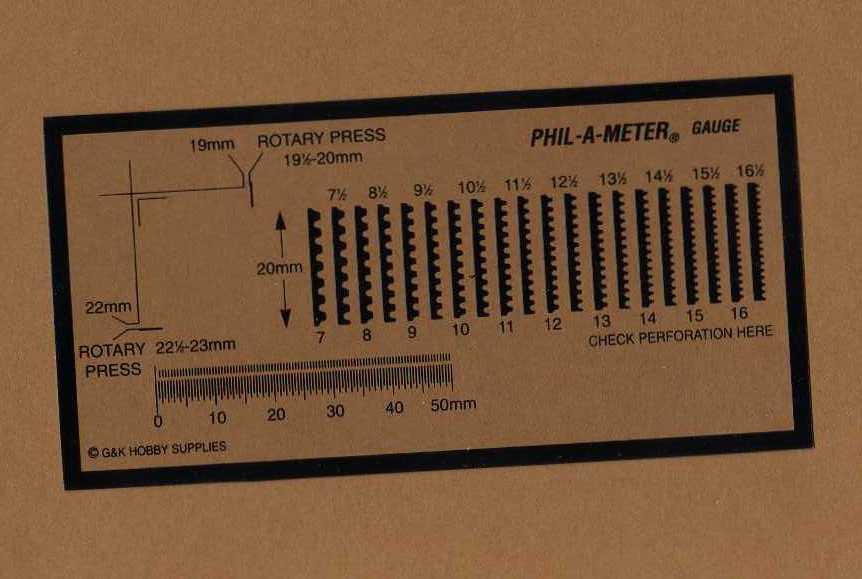 |
|
Send note to Staff
|
|
|
Rest in Peace
United States
7097 Posts |
|
|
Can one even purchase the Kiusalas U.S. specialist perforation gauge anymore though? I haven't seen one in decades! |
|
Send note to Staff
|
|
|
Pillar Of The Community
3860 Posts |
|
|
There's someone on ebay currently selling them. Without a Kiusalas U.S. Specialist perforation gauge, I would find it harder to separate perforation 10 U.S. flat plate coils (K 10-79) from perforation 10 U.S. rotary press coils (K 10-80). |
|
Send note to Staff
|
| Edited by jogil - 01/19/2015 5:25 pm |
|
|
Pillar Of The Community
United States
1756 Posts |
|
|
Pillar Of The Community
United States
1273 Posts |
|
|
The Sonic Imaging Gauge is a better buy for the money-IMO. It has multiple uses along with the Kiusalas gauge. |
|
Send note to Staff
|
|
|
Pillar Of The Community
United States
1414 Posts |
|
|
Quote:
I believe you have stated in other posts that #499f can be distinguished from #499. Can you give us something further on that--how to tell them apart in single stamps format. The image below shows a booklet pane single on the left, a normal sheet stamp in the center and a booklet pane single on the right, trimmed to resemble a coil stamp. Generally, watermarked booklet pane singles will have vertical (letter read vertically) watermark instead of the normal horizontal watermark (letters read horizontally). The size difference is the end result of paper shrinkage across the grain of the paper. The design of the stamps on the printing plates is the same. The size difference is enough to allow an overlay test to work. Sometimes, inexperienced collectors confuse booklet pane singles with wide rotary stamps. The relative size differences attributed to paper shrinkage are small relative to size differences attributable to bending printing plates to fit the rotary press. The way to most quickly separate flat plate and rotary press stamps is to take careful mental notes regarding aspect ratio, shade or quality of the printing. Most rotary press stamps of the era look substantially different than flat plate stamps. Color, size and printing quality should make the decision easy. Eventually, aspect ratio will be apparent just looking at the stamp. Start with First Bureau (1894-1901) stamps from 200 subject plates and compare them with ones from 400 subject plates. Once the size difference becomes visually apparent, separating rotary press and flat plate stamps should be simple in comparison. Clark 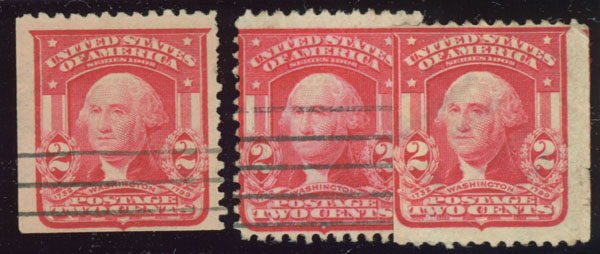 |
|
Send note to Staff
|
| Edited by cfrphoto - 01/22/2015 12:11 am |
|
|
Replies: 34 / Views: 7,636 |
|




 Posted 01/16/2015 9:55 pm


