| Author |
 Replies: 34 / Views: 7,634 Replies: 34 / Views: 7,634 |
|
|
|
Pillar Of The Community

United States
1273 Posts |
|
|
Thank you Clark. One further question along this line, can a mint or used single, off cover, #499f be distinguished from #499e, or, since they are both booklet panes, as such are they essentially the same?  |
Send note to Staff 
|
|
|
Pillar Of The Community
3860 Posts |
|
|
U.S. rotary press stamps were first issued in 1914 with Scott # 459 |
|
Send note to Staff
|
| Edited by jogil - 01/22/2015 7:59 pm |
|
|
Pillar Of The Community
United States
1756 Posts |
|
|
jogil... that's correct... however, it is worthy to note the first *perforated* rotary press coil was issued in 1915, beginning with
the one cent # 448... |
|
Send note to Staff
|
|
|
Pillar Of The Community
3860 Posts |
|
|
Pillar Of The Community
United States
1756 Posts |
|
|
jogil... you are correct... 448 was the first perf 10 horizontal, while 453 was the first perf 10 vertical... which, by the way has an EDU earlier than the 459 by 5 months... |
|
Send note to Staff
|
|
|
Pillar Of The Community
United States
1414 Posts |
|
|
Quote:
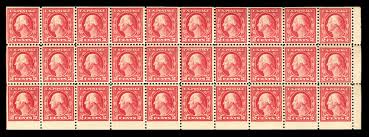
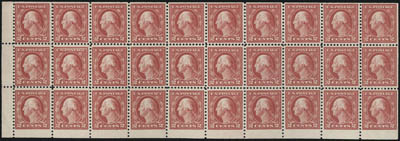
One further question along this line, can a mint or used single, off cover, #499f be distinguished from #499e, or, since they are both booklet panes, as such are they essentially the same? Six subject 498e 1¢ or 499e 2¢ booklet pane stamps are imperforate on the left side, right side or exist as bottom left or right corner copies. Thirty subject 498f 1¢ or 499f 2¢ booklet pane stamps can be imperforate on the top, bottom, right side, top right corner, bottom right corner or fully perforated. Even singles on AEF covers must be checked for size because normal sheet stamps were also in use. Quite often top or bottom copies are have large enough margins to be instantly recognizable because a normal sheet stamp straight edge would show the center line in a sufficiently wide imperforate margin. Clark |
|
Send note to Staff
|
|
|
Pillar Of The Community
United States
542 Posts |
|
|
Clark, you say above: "Thirty subject 498f 1¢ or 499f 2¢ booklet pane stamps can be imperforate on the top, bottom, right side, top right corner, bottom right corner or fully perforated." I am having trouble understanding this; please explain why an AEF booklet single could not be imperforate on the left side or be a top or bottom left corner stamp. |
|
Send note to Staff
|
|
|
Bedrock Of The Community
United States
10824 Posts |
|
|
I fail to understand why learning flat vs rotary is a problem. Any perf 12 W/F stamp is flat plate. Use a used 332 or 375, when something is noticeably larger then it's rotary. And since the 332/375 is the A139 design, it's very easy to find. |
|
Send note to Staff
|
|
|
Pillar Of The Community
United States
542 Posts |
|
|
revcollector, I am not asking how to determine flat vs. rotary. I am asking why an AEF booklet single cannot be imperforate at left or be a top or bottom left corner stamp. |
|
Send note to Staff
|
|
|
Pillar Of The Community
United States
1414 Posts |
|
|
The plate layout diagram for AEF booklet panes is in the 2018 Scott US Specialized catalog on page 463. Booklet singles from bottom left or right corners and left or right side AEF examples cannot be distinguished from booklet pane of 6 examples. I omitted "top right corner" from the list above. I am glad that someone was alert, but guessing is no substitute for checking the catalog, even if a trip to a public library is required. |
|
Send note to Staff
|
|
|
Pillar Of The Community
United States
542 Posts |
|
|
Clark, since you referenced all 30 positions on the AEF panes, I didn't realize you were describing only the AEF pane positions that can be distinguished from the booklet pane of 6 positions. But in that case, aren't the only AEF positions that are distinguishable from the booklet pane of 6 positions just the following types: imperf only at top, imperf only at bottom, imperf only at top and right, imperf only at top and left, and fully perforated? I may be wrong about this (which is why I asked), but I wasn't guessing and I did read the catalog. |
|
Send note to Staff
|
|
|
Pillar Of The Community
United States
811 Posts |
|
|
Another tip: flat plate mint stamps often have some ink on the back that transfered when the sheets were stacked. Rotary press almost never have ink on the back. . . Ink on the back = almost surely flat plate. No ink on the back = could be either. |
|
Send note to Staff
|
|
|
Pillar Of The Community
United States
542 Posts |
|
|
Once again, I am NOT trying to differentiate flat plate from rotary press printings. I am wanting to determine which positions on an AEF booklet pane of 30 (498f,499f) can be differentiated from positions on the standard booklet pane of 6 (498e,499e). Both the AEF panes and the standard panes are flat plate printings. |
|
Send note to Staff
|
|
|
Valued Member
United States
283 Posts |
|
|
Valued Member
United States
16 Posts |
|
|
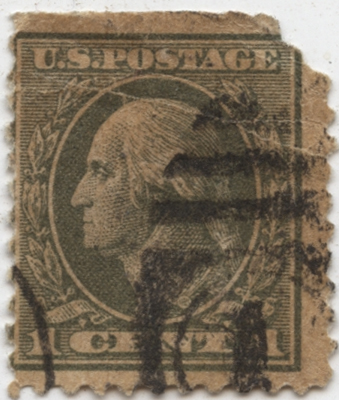 This poor old thing is perf 11x11 with an image measurement of 18.74 x 21.14 when measured with a digital Vernier caliper using a magnifier to make sure the caliper is positioned correctly with respect to the stamp. I expected the width to be fluky given the lousy centering, but the vertical features are all intact. Could this be a single stamp from the top row of a 498f pane? If so I'll keep it; if not will put it out of its misery. |
|
Send note to Staff
|
|
|
Replies: 34 / Views: 7,634 |
|



 Posted 01/22/2015 2:22 pm