| Author |
 Replies: 14 / Views: 2,448 Replies: 14 / Views: 2,448 |
|
|
Valued Member
United States
257 Posts |
|
|
If I misinterpreted the sub-title 'postal history' for this thread I apologize in advance. I'm not even sure what, exactly, this is. It appears to be a bill or receipt for P.O. Box rental. It's dated 1836. Any thoughts/info is appreciated.  The back:  |
|
Send note to Staff
|
| Edited by JessEm - 02/02/2015 02:56 am |
|
|
|
|
Pillar Of The Community
United States
692 Posts |
|
|
It appears to me to be a receipt for postage charged to his box for the last quarter of 1836, a common practice in the early 1800s. |
Send note to Staff 
|
|
|
Valued Member
United States
257 Posts |
|
|
WOW that IS neat. Thanks jarnick. I can't believe someone would keep something like this for that long. I assume such was the practice before the advent of postage stamps? That's pretty cool. |
|
Send note to Staff
|
|
|
Moderator
1589 Posts |
|
|
There are two sums added to get the total, and given their position, seems to me they could be for Newspaper ($58) and Box rent ($75, $25 per month?). Perhaps the date were just written on the first line, and not repeated. $133 would have bought a lot of postage at the time, wouldn't it have? |
|
Send note to Staff
|
| Edited by blcjr - 02/02/2015 12:28 pm |
|
|
Pillar Of The Community
United States
5894 Posts |
|
|
I read the total as $13.31, a more managable if still expensive service. |
|
Send note to Staff
|
|
|
Valued Member
United States
257 Posts |
|
|
Quote:
There are two sums added to get the total, and given their position, seems to me they could be for Newspaper ($58) and Box rent ($75, $25 per month?). Perhaps the date were just written on the first line, and not repeated. $133 would have bought a lot of postage at the time, wouldn't it have? I would think $133. at that time would dang near buy the post office! haha. I wonder if it wasn't just a given at that time that they were dealing with cents and not dollars, and the entries are basically shorthand for cents? Would seem to make more sense that way. Edit: smauggie posted while I was typing. I see it now and that does seem logical. |
|
Send note to Staff
|
| Edited by JessEm - 02/02/2015 12:43 pm |
|
|
Pillar Of The Community
United States
925 Posts |
|
|
I think it is $1.33½ - note the small "2" after the 58 - that was a shorthand way of writing 1/2. These would be the postal rates of 1825 (by distance and number of sheets), so there were 1/2 cent rates. Assuming single-rate letters, 58½ cents could be 4 letters at 10 cents, 1 letter at 6 cent and one letter at 12½ cents. The 75 could be 6 letters at 12½ cents or 3 letters at 25 cents. |
|
Send note to Staff
|
| Edited by SPQR - 02/02/2015 12:53 pm |
|
|
Pillar Of The Community
United States
5894 Posts |
|
|
Ah, that makes even more sense. Thanks SPQR. The US minted it's first half cent in 1794 I think so half cents were a common part of the currency in 1836. |
|
Send note to Staff
|
|
|
Valued Member
United States
257 Posts |
|
|
Quote:
I think it is $1.33½ - note the small "2" after the 58 - that was a shorthand way of writing 1/2. These would be the postal rates of 1825 (by distance and number of sheets), so there were 1/2 cent rates. Assuming single-rate letters, 58½ cents could be 4 letters at 10 cents, 1 letter at 6 cent and one letter at 12½ cents. The 75 could be 6 letters at 12½ cents or 3 letters at 25 cents. Some major league knowledge and deductive reasoning went into that conclusion. At least from a newbies perspective! Bravo! |
|
Send note to Staff
|
|
|
Pillar Of The Community
6364 Posts |
|
|
A very nice item. I will agree with SPQR that the amount on the first line is fractional at 58 ½, giving a total of 1.33 ½. From there I will differ with SPQR. Printed matter rates (newspapers, magazines, periodicals and pamphlets) were quite low, typically a penny or two each, so several combinations are possible, but they would not involve the standard (and much higher) 1825 letter rates which SPQR quotes. Also the 75 cents is the flat-rate box rent of 25 cents per month for 3 months. It has nothing to do with the amount due on any letters passing through it, so the calculation exercise is off-track. Here are 2 additional examples. The first from Terre Haute Indiana dated 1869 with amounts for box rent and newspaper postage. And a second from Indianapolis Indiana dated 2000 solely for box rent. Some forms never go away entirely! 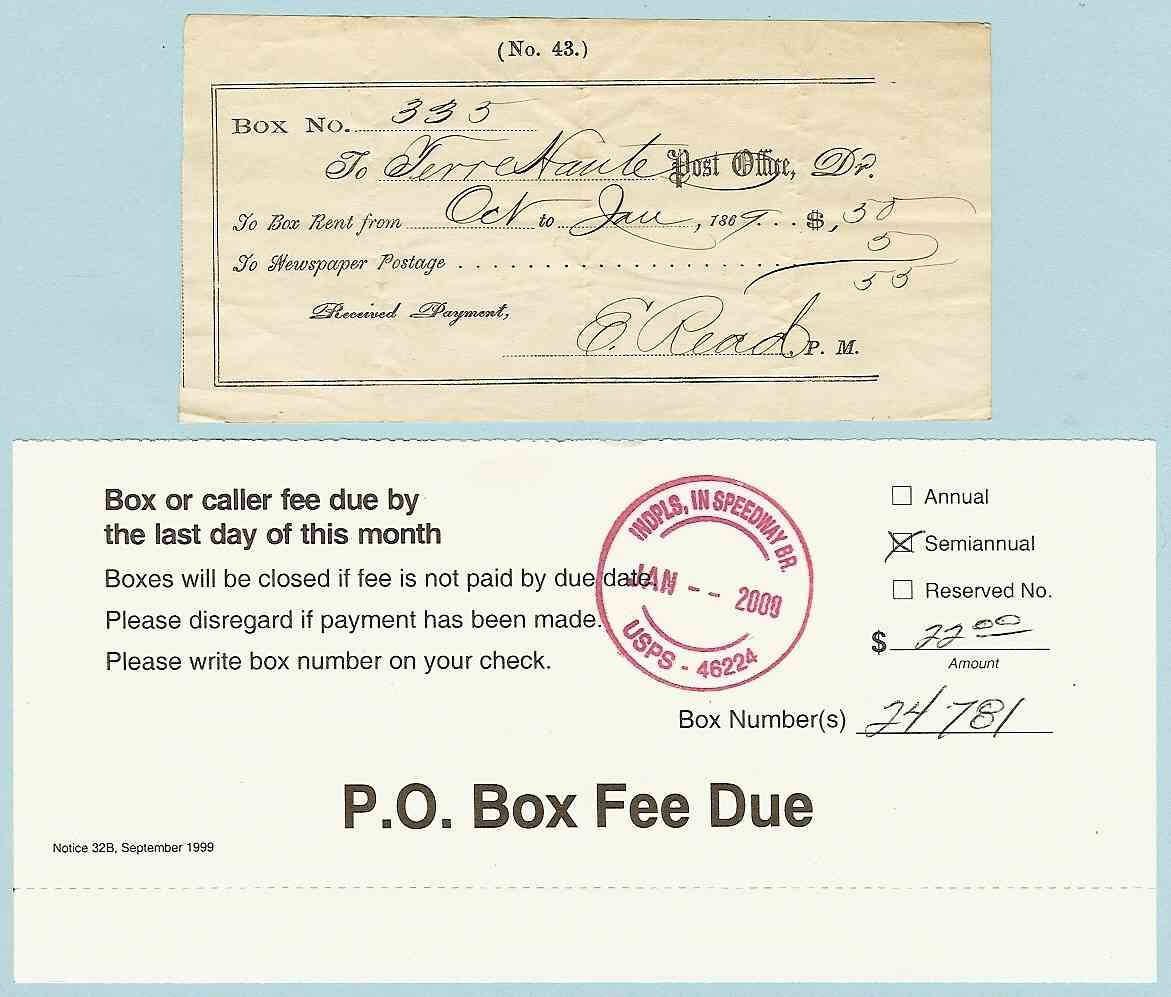 |
|
Send note to Staff
|
|
|
Valued Member
United States
225 Posts |
|
|
Quote:
The US minted it's first half cent in 1794 I think so half cents were a common part of the currency in 1836. Yes, half cents were in use and in circulation at that time. I also happen to be a coin collector  -MV |
|
Send note to Staff
|
|
|
Moderator
1589 Posts |
|
|
Thanks for all the corrections. I knew the sums were large for the period, but didn't know how else to read them. The replies have been educational. |
|
Send note to Staff
|
|
|
Valued Member
United States
257 Posts |
|
|
Google search of "J.J.Jacob" returned this. (Most definitely a notable person of his time) John Jermiah Jacob (1778-1852) http://en.wikipedia.org/wiki/John_J...b_(Kentucky)"Jacob organized and was the first president of the Louisville branch of the Bank of the United States and its successor, the Bank of Kentucky.[1] He organized and was a member of the board of directors for the Galt House.[4] He was president of the Lexington and Ohio Railroad and a member of the board of directors of the Louisville and Frankfort Railroad. He was also treasurer of the Louisville and Portland Canal[5] and involved in the Ohio Bridge Commission in 1827.[1] He was among the founders of the Louisville Gas and Water Company in 1838." |
|
Send note to Staff
|
|
|
Pillar Of The Community
United States
925 Posts |
|
|
Quote:
Printed matter rates (newspapers, magazines, periodicals and pamphlets) were quite low, typically a penny or two each, so several combinations are possible, but they would not involve the standard (and much higher) 1825 letter rates Agree completely, and there were fractional rates for printed matter during the period. I'm not sure that it is possible to read the receipt as stating that the 58½ due was entirely for newspapers - but you may be correct. I was simply trying to show that there were fractional cent rates that could explain a reading of 58½. Quote:
half cents were a common part of the currency in 1836 actually, many of the coins in circulation were Spanish. The postage rates of 12½ cents and 18¾ cents were equal to 1 bit (1/8th of a Spanish dollar) and 1½ bits. The 6 cent rate was often paid with 1/2 bit Spanish coin equal to 6 1/4 cents, known as a "picayune." |
|
Send note to Staff
|
|
|
Valued Member
United States
257 Posts |
|
|
SPQR, I think I speak for everyone on this: You should post more.  So let me ask everyone a question. What would be the best approach to selling this? How much should expect it to sell for? Any thoughts on the notable persons signature? Any suggestions are appreciated. |
|
Send note to Staff
|
| Edited by JessEm - 02/02/2015 8:43 pm |
|
| |
Replies: 14 / Views: 2,448 |
|




 Posted 02/02/2015 02:54 am


