| Author |
 Replies: 36 / Views: 7,400 Replies: 36 / Views: 7,400 |
|
|
|
Pillar Of The Community
3860 Posts |
|
|
There may be a possibility that some Centennial stamps may also be affected such as early (1967) Canadian Bank Note (CBN) line perf. 12 booklet stamps, tagged stamps and miniature sheet stamps. However, this would relate to the old line perf. 12 (11.95) being rarer rather than the new line perf. 12 (11.85) since the CBN Centennial line perforated stamps are in new line perf. 12 (11.85) territory. |
Send note to Staff 
|
| Edited by jogil - 06/29/2015 10:21 pm |
|
|
Valued Member
Canada
382 Posts |
|
|
jogil, congratulations on having your article on the 1952 Canada Goose stamp published in the latest issue of THE CANADIAN PHILATELIST.
It is good work and deserves recognition and a request for more such work.
GJP |
|
Send note to Staff
|
|
|
Pillar Of The Community
3860 Posts |
|
|
gportch, thank you very much for your compliments, recognition and support of my philatelic work, it is very much appreciated. There are also several more related articles in the works for THE CANADIAN PHILATELIST. |
|
Send note to Staff
|
| Edited by jogil - 07/04/2015 12:59 pm |
|
|
Rest in Peace
720 Posts |
|
|
Pillar Of The Community
3860 Posts |
|
|
Yes since Scott 320 was current from November 3, 1952 until March 11, 1964 when it was replaced by Scott 414 |
|
Send note to Staff
|
|
|
Pillar Of The Community
923 Posts |
|
|
On page 148 of the 2015 Unitrade there is an inset mentioning the new CBN Perforating. The editor states, however, that "This perforation difference is likely outside the scope of most general collectors."
I would argue that a lot of the varieties listed in the Unitrade catalogue are "outside the scope of most general collectors." How many general collectors are trying to make sense of the small queen varieties? Not many, I bet, can tell a Montreal printing from an Ottawa one. How many general collectors are trying to find all 6 tiny scratches on the RMC centenary (1976) or the 5 dots on the CAPEX '78 (1978)?
Why are they listed? Because there are enough NON-general collectors interested to warrant inclusion.
Since the perforation is a true (albeit difficult) variety, Unitrade should at least refer to it in the listing for every stamp that has the variety. I further believe each deserves a variety number.
This will happen as specialists increasingly become aware of the situation. Ironically, specialists will not become aware unless Unitrade alerts them to the many varieties found (unless they read the StampCommunity Blog, of course.)
|
|
Send note to Staff
|
| Edited by sak - 07/12/2015 12:01 pm |
|
|
Pillar Of The Community
Canada
1401 Posts |
|
|
Pillar Of The Community
Canada
1416 Posts |
|
|
I agree too. Those kind of specialist fields and the associated improved knowledge of a particular variety is what draws many of us into this advanced philately. Given the importance and the highly respected status of the Unitrade catalogue, I would support assigning a variety to it. As a minimum, may be a table listing all the known varieties initially would be welcome. |
|
Send note to Staff
|
| Edited by Gilles le timbre - 07/12/2015 12:29 pm |
|
|
Moderator

United States
12330 Posts |
|
|
Ideally the stamp hobby would settle on a specification of a variety that all catalogs and hobbyists could follow. Historically it was usually a stamp that contained a repeatable attribute (i.e plate flaw). But the 'significance' of the attribute was never really defined. If the person was very vocal, developed memorable presentations, knew the right people to talk to, or applied a catchy marketing term to the attribute; they seemed to get inclusion in many catalogs. In general the most sought after were those attributes which could be easily seen with an unaided eye, under normal lighting, at arm's length.
There were also some older varieties which really demanded an aided eye (i.e magnifying glass). But now, in this day and age, we have high resolution scanners, images, and USB microscopes for the masses. New varieties seem to be coming out of the wood work at times. We are now down to the pixel level on many of these varieties. Nothing wrong with that (for those that are fly speccers) but the market place seems to not be rewarding a lot of these varieties. Add to this the habit of many online sellers to use marketing 'puffery' in their titles and descriptions (Heck, I just saw one listing where the listing declares a color omitted variety with cert but the cert clearly says 'no opinion on missing color'.) and I wonder where we will all end up with these more recent varieties?
Don
|
|
Send note to Staff
|
|
|
Pillar Of The Community
Canada
1416 Posts |
|
|
Pillar Of The Community
Canada
1416 Posts |
|
|
This one is from a different stamp, seen on ebay confirming the somewhat "constant" variety. I wonder if others have noticed/seen similar one. 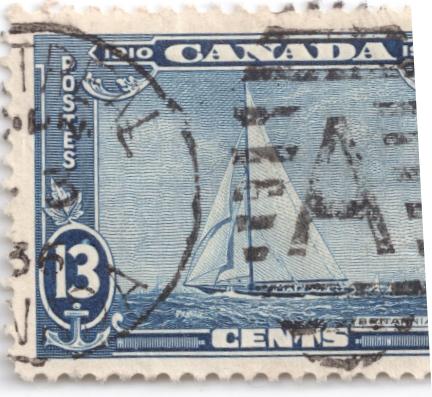 |
|
Send note to Staff
|
| Edited by Gilles le timbre - 07/12/2015 2:04 pm |
|
|
Pillar Of The Community
923 Posts |
|
|
So, rarity is not the single determiner of value. It's demand, too. What is the best way to encourage demand? List on ebay, proclaim the variety loudly in the title, charge a relatively high price, and give bold references to the Unitrade's citation. |
|
Send note to Staff
|
|
|
Pillar Of The Community
3860 Posts |
|
|
A chart listing all of these perforation differences was published recently in BNAPS Elizabethan II Study Group Newsletter, The Corgi Times, March-April 2015, Volume XXIII (23), Number 5, Whole Number 137, page 76. |
|
Send note to Staff
|
| Edited by jogil - 07/12/2015 5:19 pm |
|
|
Pillar Of The Community
Canada
1416 Posts |
|
|
Thanks Jogil. I must have missed that one. I just downloaded and printed my copy now. |
|
Send note to Staff
|
|
|
Pillar Of The Community
3860 Posts |
|
|
It is very much appreciated that the perforation chart was made with the suggestion and help of Robin Harris who is the editor of The Corgi Times and The Unitrade Specialized Catalogue of Canadian Stamps. |
|
Send note to Staff
|
| Edited by jogil - 07/12/2015 8:47 pm |
|
|
Replies: 36 / Views: 7,400 |
|




 Posted 06/29/2015 08:53 am