| Author |
 Replies: 9 / Views: 1,444 Replies: 9 / Views: 1,444 |
|
|
Pillar Of The Community
United States
1510 Posts |
|
|
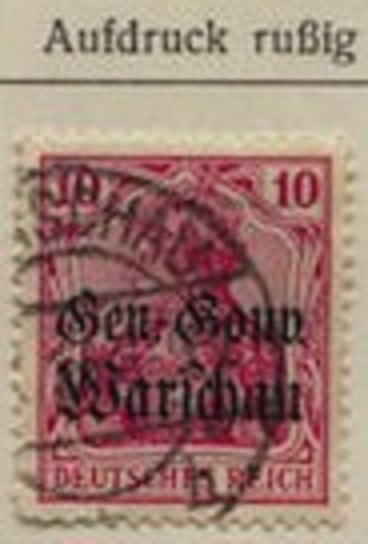 I am unable to find "ruBig" in any of my philatelic dictionaries |
|
Send note to Staff
|
| Edited by Timm - 06/11/2015 10:27 am |
|
|
|
|
Pillar Of The Community
United States
526 Posts |
|
|
That's because it's not a "B" but an sz, roughly ss
russig = sooty
overprint is sooty |
Send note to Staff 
|
|
|
Valued Member
United States
183 Posts |
|
|
I agree. "sooty" (ruBig) would probably indicate "a shade of black"... not black (schwartz) or grey (grau), but somewhere in between.
|
|
Send note to Staff
|
| Edited by barhata - 06/11/2015 10:49 am |
|
|
Pillar Of The Community
United States
1510 Posts |
|
|
Valued Member
United States
297 Posts |
|
|
Pillar Of The Community
United States
7239 Posts |
|
|
Actually, the overprint is a dull (sooty), or matte black. The other overprint type for this series of 11 stamps is "glaenzend" or shiny black. The Michel Deutschland-Spezial catalog doesn't differentiate the 2 overprint types for the 10 Pf value, so I am assuming they are all sooty black for this stamp. The catalog lists three color types; carmine red, lilac red, and rose. |
|
Send note to Staff
|
|
|
Pillar Of The Community
United States
8956 Posts |
|
|
Back when I was in school in Holland and had German, I was taught that the sign that looks like an upside down 'b' is a "Gothic s" or a double s. "sz" is not used in Germanic languages, just in Slavic languages. The sound is nothing unusual, just a longer "S".
Peter
|
|
Send note to Staff
|
|
|
Pillar Of The Community
United States
526 Posts |
|
|
Well, actually, it's called an esss zet when the character is named in German. It is derived from the ligature of s and z. It's form comes from a need for a terminal s distinct from a beginning or mid-word s (the latter, in the old script, looked more like an f and was also used in English typesetting and writing). It's form comes from that ligature of s and z but it does not represent an s and a z rather, a "sharp s" or "round s".
To Timm's question: if you can achieve the "B" like character (similarities to a Greek Beta) on your keyboard, you use that. That's the proper way to "spell" it. If you don't have that special character available, as Petert4522 says, you substitute double s, not sz. You are substituting for the sound/letter, not for the typesetting ligature that customarily represents that sound/letter.
Since more than one "s" sound exists in German (as also in English and other languages), one needs to specify that it is an extended "s" of a specific type: Not the "zzz" like s-sound of sehen or the sh s-sound of stehen but the (terminal) ess-sound of das, something like the s in "last" in English.
|
|
Send note to Staff
|
|
|
Pillar Of The Community
United States
1106 Posts |
|
|
Quote:
if you can achieve the "B" like character (similarities to a Greek Beta) on your keyboard, you use that. The ASCII code is Alt+225. "ß" "Rußig." Dan  |
|
Send note to Staff
|
Experienced stamps need a home too. I'd rather have an example that is imperfect than no example.
I collect for enjoyment, not investment.
APS Member #223433
Postmark Collectors Club Member #6333
Meter Stamp Society Member #1409 |
|
|
Pillar Of The Community
United States
526 Posts |
|
| |
Replies: 9 / Views: 1,444 |
|



 Posted 06/11/2015 10:27 am


