| Author |
 Replies: 19 / Views: 13,272 Replies: 19 / Views: 13,272 |
|
Valued Member
5 Posts |
|
|
|
My (old) Scott Classic catalog has a footnote regarding Japanese #'s 55-84, differentiating postal from telegraph cancellations. I have a few of these with two distinct types of cancels: 1) big black killer cancels in various patterns, and 2) more "typical" circular cancellations in varying sizes with characters within the circles (hmmm, looks like Japanese....) Am I correct in assuming that the killer cancels are the work of telegraph/telephone offices, & the others are postal? Thanks!
|
|
Send note to Staff
|
|
|
|
|
Valued Member
United States
145 Posts |
|
|
bobdob, here is a Japanese telegraph to illustrate it's cancel.  I'm not an expert so another opinion would be good but it looks like the killer would be postal use. |
Send note to Staff 
|
|
|
Pillar Of The Community
USA
1881 Posts |
|
|
Hi Bobdob..... Welcome to the club. Japan Sc #93 issued from 1899-1907.....The "Chrysanthemum" series issued for use in Korea. The first three show one type of postal cancel...the lines above and below the center bar are called combs....vertical combs show that the stamp was used in Japan.....horizontal combs show that the third stamp was used in Korea. One of the projects I'm planning is a beginners guide to reading the dates on this type of cancel. 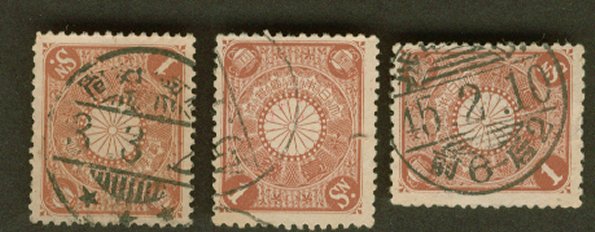 You're right about the killers being telegraph cancels....and the circular cancels with Japanese characters are another type of postal cancel. These also have a purple/violet roller cancel, most commonly found on parcel post packets. 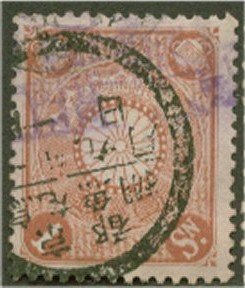 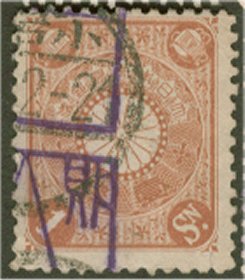 This nice orange one is a revenue cancel. 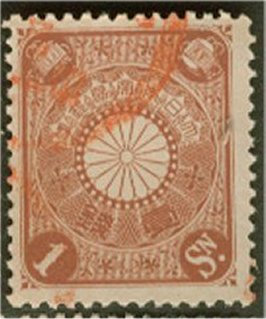 |
|
Send note to Staff
|
|
|
Pillar Of The Community
USA
1881 Posts |
|
|
Pillar Of The Community
United States
2758 Posts |
|
|
Great information on the the cancelations, the difference between used in Japan or Korea. I did not know!
Just like to clarify that the 'Chrysanthemum' series were issued for use in Japan only, until 1905 when the two postal systems were merged using excisting issues of Japan and old Korean issues were withdrawn. These stamps were overprinted and used in Japanese PO's in Korea, those were withdrawn at the same time. |
|
Send note to Staff
|
|
|
Valued Member
Netherlands
333 Posts |
|
|
I have to write this from memory but can check later today: Scott 55-84 are the socalled Koban stamps and the cancels you mention as big black killer cancellations are usually called Bota. These are oval daub cancels on the stamp that used to be in combination with a small round cancel with the postofficename on the letter itself. Among Koban-collectors these are very popular. As far as I know these were normal postoffice cancels, not telegraph cancels.
Then there are the _real_ telegraph cancels: double circle with a small inner circle, like the one pictured by oldgum. These get lower prices. Also very wanted are the cancels from the international post offices, with romanji writing (in other words latin script: Kobe, Yokohama etc.) Most of the time these came in combination with daub killer cancels in exotic forms: stars, crossroads etc.
It is a very complex topic, especially because you should be able to read Japanese to differentiate between all the different cancels. Unfortunately I can't read it. |
|
Send note to Staff
|
| Edited by Jan-Simon - 04/01/2009 07:25 am |
|
|
Pillar Of The Community
USA
1881 Posts |
|
|
These stamps were not withdrawn....
The date on #3 shows that it was used in Korea in 1912.....and I have others used in 1910 & 1911 both in Japan and in Korea....I also have one used in 1906 in Japan.
The overprints were Military Franchise Issues issued in 1900. These also had another Military overprint issed from 1900-07 for use in China.
The Old Koban issues were issued from 1876-79 with Military Franchise overprints issued in 1876.....UPU Koban were issued in 1883....and the New Koban were issued from 1888-92. |
|
Send note to Staff
|
| Edited by nr-notrare - 04/01/2009 10:51 am |
|
|
Pillar Of The Community
USA
9748 Posts |
|
|
Hello Bobdob, what do you think of the information so far ? When people start studying cancels like this they are truly philatelists and not just stamp collectors ! |
|
Send note to Staff
|
APS 070059 Life Member International Society of Guatemala Collectors I.S.G.C. #853 |
|
|
Pillar Of The Community
United States
2758 Posts |
|
|
nr-notrare, I'm sorry you've misunderstood what I was saying.
I did not say that the Japan #93, 'Chrysanthemum' series was withdrawn from use.
What I was saying is that in 1905 all "Korean issued" stamps and overprinted issues of the 'Chrysanthemum' series that are listed in Scott
as Japanese Offices in Korea were withdrawn, when Japan merged the two postal systems together.
As far as the Military issues go, Yes, there is a M1 listing in Scott issued in 1910 on the 'Chrysanthemum' series and used in China, I was not refering to this issue. Sakura may have better detail for earlier military issues omitted by Scott.
Again, I sorry for any confusion!
Take Care!
Mike |
|
Send note to Staff
|
|
|
Valued Member
5 Posts |
|
|
Thanks for all the responses! I'll try to post some pics a bit later today as nr-notrare asked.
And there's probably worse things than being a cancellation geek.... |
|
Send note to Staff
|
|
|
Valued Member
5 Posts |
|
|
So, if I understand things correctly: Post office cancellations: 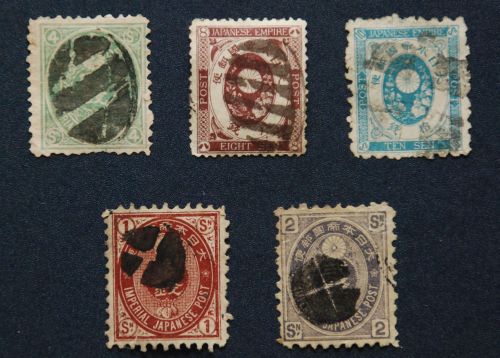 and 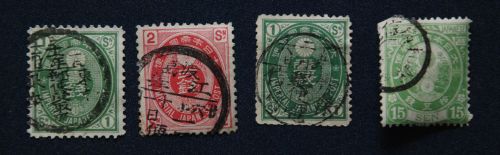 Telegraph cancellations: 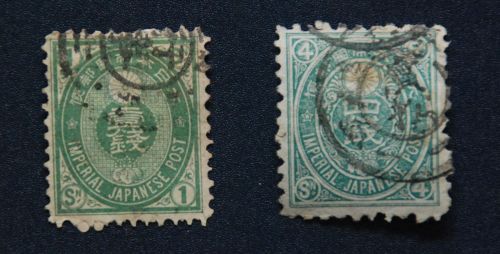 |
|
Send note to Staff
|
|
|
Pillar Of The Community
USA
9748 Posts |
|
|
i would say at least the first card..i dont know about the second one..collecting Japan for us occidentals is a tough nut ! |
|
Send note to Staff
|
APS 070059 Life Member International Society of Guatemala Collectors I.S.G.C. #853 |
|
|
Valued Member
Netherlands
333 Posts |
|
|
bobdob: I would say you're spot on. the second scan are the later standard postal cancels. The fourth stamp though is a strange one. Not sure how to classify that one.
The double circle cancels on the third scan seem to be slightly different as well, must check if that is something different than telegraph cancels.
Jan-Simon |
|
Send note to Staff
|
| Edited by Jan-Simon - 04/02/2009 02:41 am |
|
|
Valued Member
Netherlands
333 Posts |
|
|
it looks like the first stamp on the first scan was cancelled in Kumamoto. The second is Tokyo and the third might be from an international postoffice (have not been able to find info on it yet and there are many that used a crossroads cancel)
the small round Bota cancels (first scan, second row) are from Takasaki and Nagoya. These predate the large oval Bota cancels
update: the double circle cancels in the third scan are postal. The telegraph cancels have a much smaller inner circle. The cancel on the fourth stamp of scan 2 might be telegraph. Compare it with the image of a telegraph stamp earlier in this thread. |
|
Send note to Staff
|
| Edited by Jan-Simon - 04/02/2009 05:51 am |
|
|
Valued Member
5 Posts |
|
|
Valued Member
United States
9 Posts |
|
|
I've been a collector of Japan for 30 years, or 3 days. Learn something new every day. Occidentals interpreting Japanese when they cannot read Kanji can be frustrating and amusing at the same time. 1.  2.  3.  Image 1. The horizontal comb is usually Taiwan. Can be other occupied China, eg. Hong Kong. Image 2. The single-tooth comb is usually Korea. Image 3. Purple markings are often fiscal, or documentary, or bank cancel. When applied to small packets, it is often a receiving mark. 4.  5.  6.  Image 4. Telegraph cancels are often shaped like this Lifesaver candy. Image 5. Also a telegraph, or money order, or telephone cancel. If you cannot read Japanese, notice the cramped stack of central characters. Image 6.Could be a revenue cancel, but more likely part of a VCD. See "The Variant Color Datestamps of Japan 1904-1936" (Swenson, 2008). 7.  8.  9.  Image 7, 8, 9. Overprints on Koban issues are not military. There exist specimen overprints, either Sumiten (single black dot) or Mihon (2 or 3 characters). MOST IMPORTANT!All the early Japanese stamps (from the Dragon stamps of 1871 through the Koban stamps of 1879) have been extensively forged. Philatelic award winner Lois M. Evans estimates close to 80% of the classic Japanese stamps found in general collections will be forgeries. Her Japan website is at http://japan-stamp-forgeries.org/expert/index.htmlKoban forgeries http://japan-stamp-forgeries.org/ex...n/koban.html1-4 sen http://japan-stamp-forgeries.org/ex...n/one_4.html5-9 sen http://japan-stamp-forgeries.org/ex.../five_9.html15-45 sen http://japan-stamp-forgeries.org/ex...n/15_45.html50 sen http://japan-stamp-forgeries.org/ex...n/fifty.htmlOne of the world's most referenced Koban collections is now online. The great Horst Mueller collects: http://www.japhila.cz/hof/0015/index0015_01.htm (2004) http://www.sanrizuka.com/koban/index.html (2009) I recommend joining The International Society for Japanese Philately http://www.isjp.org/join(ISJP) offers a free expertizing service. ISJP members can e-mail digital images of their stamps to an expert that will separate the images into two categories: 1. images of forgeries 2. images of stamps that need to be seen to be expertized. |
|
Send note to Staff
|
| Edited by burneggroll - 11/09/2015 8:32 pm |
|
|
Replies: 19 / Views: 13,272 |
|



 Posted 03/31/2009 6:33 pm


