| Author |
 Replies: 9 / Views: 1,991 Replies: 9 / Views: 1,991 |
|
|
Pillar Of The Community
United States
1047 Posts |
|
|
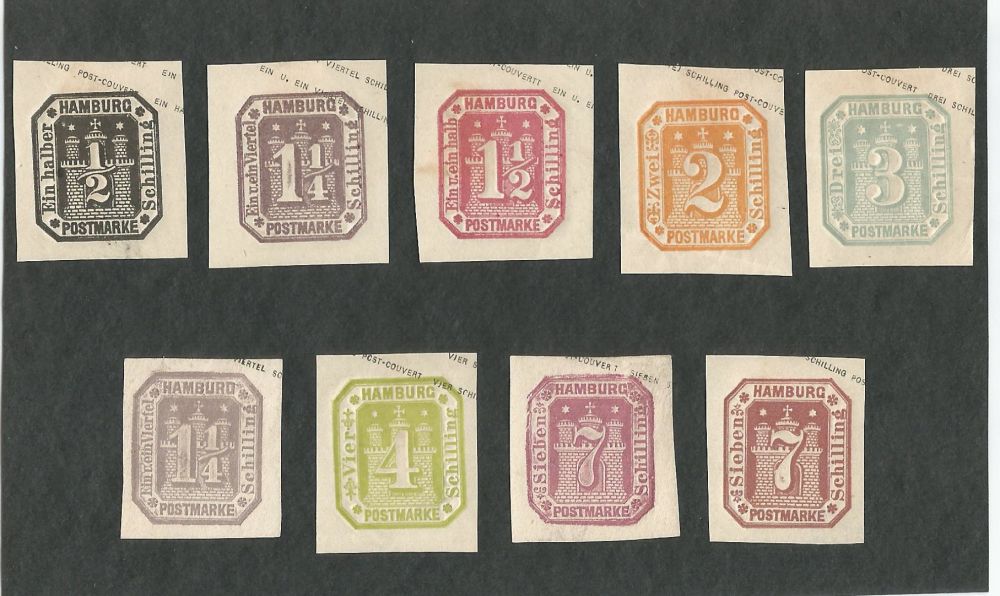 Several years ago I found the above items in a lot of Germany. They have resurfaced in "my things to deal with" box, but I would like to find out more about them before putting them in an album. Can anyone provide the history or background to these items? Who produced them and when? Is the set complete or should there be a 9 shilling value too? Were they sold or given away? It appears they are reproductions of Hamburg Sc. design A5, but for values and colors are more akin to Sc. designs A1, A2 and A3. Thanks. Don |
|
Send note to Staff
|
| Edited by DonSellos - 08/25/2015 2:46 pm |
|
|
|
|
Pillar Of The Community
United States
2423 Posts |
|
|
Pillar Of The Community
Israel
6191 Posts |
|
|
A lot more colours are posted somewhere in the Cinderella section but I have not found them in a search.
I can scan them tomorrow if they don't appear before then.
Since I posted them some years ago, other types of reproductions have surfaced, similar designs, but I do not have any. |
Send note to Staff 
|
|
|
Pillar Of The Community
United States
7239 Posts |
|
|
Actually, these are postal stationery cut outs, or cut squares. The diagonal printing on the upper right of each of each piece is the giveaway. When you see "rare" imperforates of German States offered on ebay or at a stamp show, and they have the diagonal printing, they are simply stationery cut outs. In Germany, cut squares are not collected because they cannot be precisely identified. The reason? Postal stationery of the same value and design come in different envelope formats. The envelopes can be of different sizes, and also different die cuts of the flaps. There are genuine postal stationeries and there are reprints. The Michel Gansachen-Katalog Deutschland explains that there are 3 different ways to distinguish the genuine envelopes. Firstly, the genuine stamp image is printed in a bright color, whereas the reprints are pale. Secondly, the die cutting of the genuine stationeries and reprints are different, but that won't help here because we have only the cut squares. Thirdly, in the genuine diagonal text printing, the "R" has diagonal leg, and the "G" is open. In the reprints, the "R" has a vertical leg, and the "G" is closed. Hope this helps. |
|
Send note to Staff
|
| Edited by bookbndrbob - 08/25/2015 5:21 pm |
|
|
Pillar Of The Community
United States
1047 Posts |
|
|
Quote:
A lot more colours are posted somewhere in the Cinderella section Quote:
Actually, these are postal stationery cut outs, or cut squares I'm not sure there is a consensus yet as to what these are, cinderellas or cut squares. If cut squares, what is the time period for the entires? If cut squares, are these originals or reprints? It's my understanding that a reprint (by a governmental or official entity) is not a cinderella. If cinderellas who would reproduce them if they are not collected in this format? Interesting, and thanks for the info Londonbus and Bookbndrbob! I would like to hear more. Don |
|
Send note to Staff
|
|
|
Pillar Of The Community
United States
7239 Posts |
|
|
Don, the original postal stationeries were issued in 1866 and 1867. The 1866 stationeries were unwatermarked, and the 1867 stationeries had a large watermark in the design of the building on the stamp design, including the 2 stars.
About the reprints, Michel says "Private Nachdrucke (private reprints) were made some time around 1871 using the correct dies and original paper. Reprints are always made with flap die cut #3, which does not occur on the originals".
Interestingly, on the page listing these postal stationeries, the 1871 printings are referred to as "Nachdrucke", which translates as reprints. On the following page, which illustrates the flap die cuts, the wording under illustration for type III is "Faelschung", which means forgery. I have wondered about this with other Hamburg material.
In the Deutchland-Spezial Katalog, after Hamburg #s 20 and 21, there is a reference to the "private Nachdrucke" of 1978-85. I have some of these and they are clearly not government reprints. The next entry in the catalog refers to the "Mophila-gedenkblock (Dezember 1931)" which is a "Faksimile-Druck (kein Nachdrucke)." The Mophila memorial sheet is a facsimile printing and not a reprint. If both of these items are printed by private entities, it is unclear to me what the distinction is between a reprint and a facsimile...in German philately. |
|
Send note to Staff
|
| Edited by bookbndrbob - 08/25/2015 9:52 pm |
|
|
Pillar Of The Community
Israel
6191 Posts |
|
|
I have 32 different types and all are Cinderellas. They have dry gum and are underprinted 'Faux'. If the original poster can tell us if his are underprinted or not it may help. I also have a sheetlet of 4 in Black which is on ungummed paper and with no underprint, margins all round. But to my dismay I cannot find it !  |
|
Send note to Staff
|
|
|
Pillar Of The Community
United States
1047 Posts |
|
|
Quote:
If the original poster can tell us if his are underprinted or not it may help. Londonbus1: I'd be glad to say, but I don't recognize the term underprinted. Would you explain that for me? I don't see a "faux" on any of them, front or back Thanks. Don |
|
Send note to Staff
|
|
|
Pillar Of The Community
United States
1047 Posts |
|
|
Quote:
Don, the original postal stationeries were issued in 1866 and 1867. The 1866 stationeries were unwatermarked, and the 1867 stationeries had a large watermark in the design of the building on the stamp design, including the 2 stars.
About the reprints, Michel says "Private Nachdrucke (private reprints) were made some time around 1871 using the correct dies and original paper. Reprints are always made with flap die cut #3, which does not occur on the originals".
Bookbndrbob: Many thanks for your reply. There still does not seem to be consensus as to what these are, cinderellas or cut squares - original printings or reprints. Don |
|
Send note to Staff
|
|
|
Pillar Of The Community
United States
7239 Posts |
|
|
Londonbus1, I feel pretty confident in saying that your stamps with the small "faux" imprinting on the bottom are modern forgeries/reproductions. The sheetlet of black prints is also a forgery. A different one is shown below. 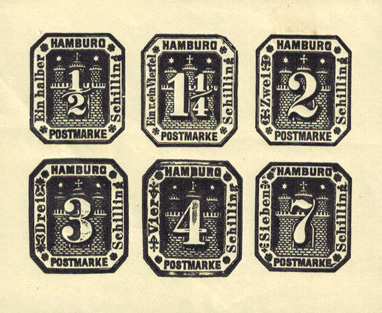 |
|
Send note to Staff
|
| Edited by bookbndrbob - 08/26/2015 10:56 am |
|
| |
Replies: 9 / Views: 1,991 |
|




 Posted 08/25/2015 2:45 pm


