It appears that the silver finish was applied over the entire stamp as the last phase of the printing process.
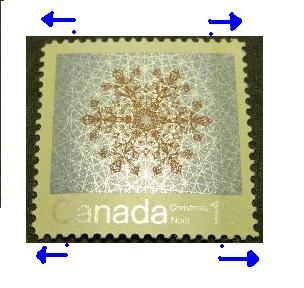
I'm basing this on the mint 15 cent stamp pictured below, which does not have the silver properly applied over the entire stamp. The photo created a non-squared image as it had to be taken at an angle to capture the silver application.
The silver was missed on both the left and right sides of this stamp, leaving 4mm on the left and 5mm on the right as plain paper. The silver does cover the balance of the stamp from the top through to the bottom of the margins. The characters "C" and "5" are the only parts of "Canada" and "15" not silvered.
This is neither the untagged ribbed horizontal [SC 557i], tagged [SC 557p] nor tagged and ribbed horizontal [SC 557pi] versions of this issue. It is the untagged non-ribbed SC 557.
The non-silvered areas, indicated by the blue dots and arrows, appeared to me at first to be darkened chemically, or by sunlight, etc., until I determined that it was simply the hue of the natural paper prior to the silver being applied.
The blue background and the red snowflake are both well centred on the stamp.
The left and right non-silvered portions are rough to the touch, whereas the silvered section is extremely smooth to the touch.
On a normal stamp, the entire surface is smooth to the touch.
Knowing nothing of the printing industry, I can't figure out how the silver application was restricted to only the centre portion of the stamp. In my thinking, the applicator would normally cover at least one complete stamp, if not more stamps on a pane at the same time.
This is the first I've seen or am aware of and wonder if there are more.





 Posted 09/13/2015 8:52 pm


