| Author |
 Replies: 14 / Views: 2,062 Replies: 14 / Views: 2,062 |
|
|
Valued Member
Canada
7 Posts |
|
|
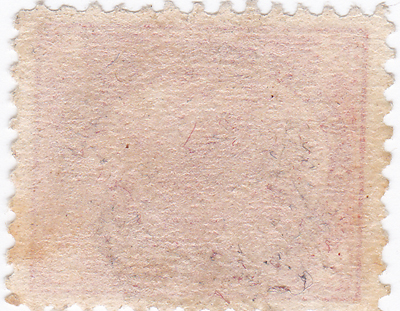
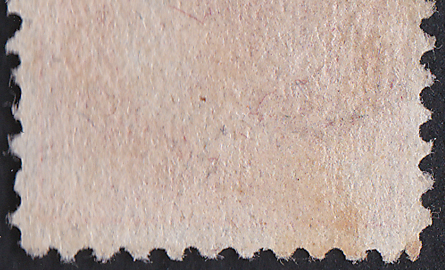
I recently came into possession of a Canadian Queen Victoria stamp. I have examined the gumming only to discover that it has fibres throughout that side of the stamp embedded into the adhesive. I would like to know if this is normal for a stamp of that period or if this is something to be concerned about? Any thoughts will be appreciated. Thank you. 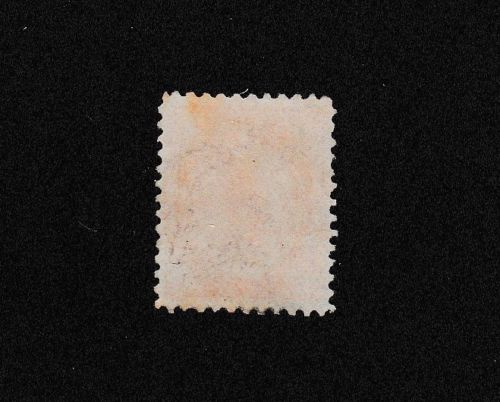 |
|
Send note to Staff
|
|
|
|
|
Pillar Of The Community
United States
2423 Posts |
|
|
persius, I think we'll need a better scan to help you with any confidence.
(It sounds, to me, like the stamp was re-gummed.) |
Send note to Staff 
|
|
|
Valued Member
Canada
7 Posts |
|
|
Pillar Of The Community
United States
2423 Posts |
|
|
Another possibility is that the stamp was a bit damp from humidity and picked up debris this way.
I hope one of our experts will chime in.
P.S. Some of our members will appreciate seeing the front of the stamp, if you don't mind. Also, you might edit your topic to identify the stamp as a Canadian Queen Victoria. We have some very good Canadian experts here who will be drawn by this. |
|
Send note to Staff
|
|
|
Pillar Of The Community
United States
2830 Posts |
|
|
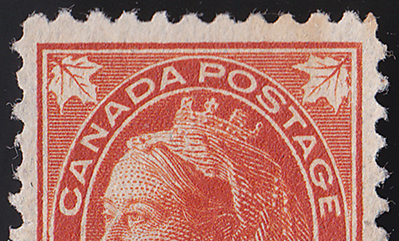
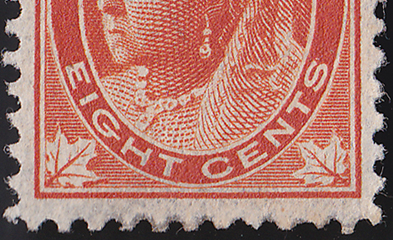
Persius, two additional things that might be helpful would be to put something matte black behind the stamp before scanning. Something like black construction paper. With a white background it's almost impossible to see what might be going on with the perf tips.
Second, try scanning just 1/4 of the stamp, for example just the lower left of the image above. Make sure all perfs are visible. That will make the stamp appear 4 times larger. If you wish, consider scanning each quarter of the stamp and upload as separate files so we can help examine each quadrant. |
|
Send note to Staff
|
|
|
Valued Member
Canada
7 Posts |
|
|
Pillar Of The Community
United States
2830 Posts |
|
|
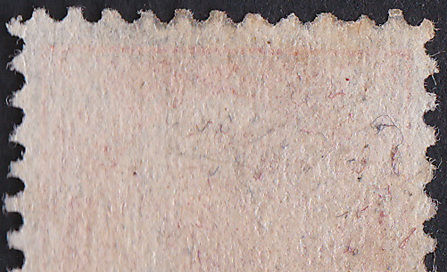
Based on what I can see, the fibers you see are normal and are caused when the stamps are separated from one another. However, I am suspicious of the bottom margin which appears to have surplus gum in between some of the perforations, a sign of regumming. At the same time, the bottom perfs seem to have very few paper fibers visible on the perf tips, another sign of regumming. I cannot be sure the bottom edge (or the entire stamp) has been regummed, but I would be suspicious.
Also, the left edge of the stamp shows possible signs of reperfing- the pin holes are quite asymmetrical indicating possible tampering. Same for the bottom- some of the perfs look odd. Just my opinions... |
|
Send note to Staff
|
| Edited by shermae - 11/14/2015 9:09 pm |
|
|
Pillar Of The Community
United States
7239 Posts |
|
|
I would be concerned about several things here. My primary concern would be about the staining along the top edge. The mottled light brown areas have the look of the beginnings of mold damage.
Also, the bottom edge looks "sweated" from moisture or humidity. The gum looks as though it has gone through the paper. This could also be a sign of repair, but it is hard to tell from the scan. I think I see small dark streaks on the middle of the 4th and 6th perforation holes from the right...looking at the scan of the back of the bottom edge. If you put the stamp in watermark fluid, it will indicate if the paper is different in this area. Also, check it out with your UV lamp.
The perforation tips look fairly normal on the top and sides. If you look at them under 10x magnification, you'll be able to see if there are wet, hard tips that would indicate regumming.
Just my opinion. Hope this helps. |
|
Send note to Staff
|
|
|
Valued Member
Canada
7 Posts |
|
|
Hello
I appreciate your thoughts, after all, the more people who have the chance to examine and share their opinions the better.
Thanks again for your help. |
|
Send note to Staff
|
|
|
Valued Member
Canada
382 Posts |
|
|
The black fibres are likely adhesions from an old stockbook with black pages. Quite common with stamps that have been stored without moving for a lengthy period of time. Just leave them as they are as the stamp will likely be damages if an attempt is made to scrape them off.
GJP |
|
Send note to Staff
|
|
|
Valued Member
Canada
7 Posts |
|
|
Hi all.
So based on what you see in these scans, would this be a stamp you would place into your collection or not?
|
|
Send note to Staff
|
|
|
Pillar Of The Community
United States
2423 Posts |
|
|
Pillar Of The Community
United States
7239 Posts |
|
|
For me, maybe not. I am overly cautious...it is the brown staining that would most likely keep me from putting this one in an album. |
|
Send note to Staff
|
| Edited by bookbndrbob - 11/15/2015 6:34 pm |
|
|
Pillar Of The Community
United States
692 Posts |
|
|
Based strictly on nthe scans, it looks regummed to me. The staining might be from an old hinge that regumming was meant to hide. |
|
Send note to Staff
|
|
|
Pillar Of The Community
United States
2830 Posts |
|
|
Most likely, this stamp would not make it into my collection. I'm a "fresh gum freak." I've seen dealers go through a modest portion of a collection and find a couple of stamps with gum flaws, and they very quickly move to the impression that the entire collection is full of "weeds." I've witnessed the same issue with perf problems. For me, it's impossible to separate my hobby from the financial implications. I know I'll lose money when selling, but I'd like to mitigate the losses to some degree. |
|
Send note to Staff
|
|
| |
Replies: 14 / Views: 2,062 |
|




 Posted 11/14/2015 7:19 pm