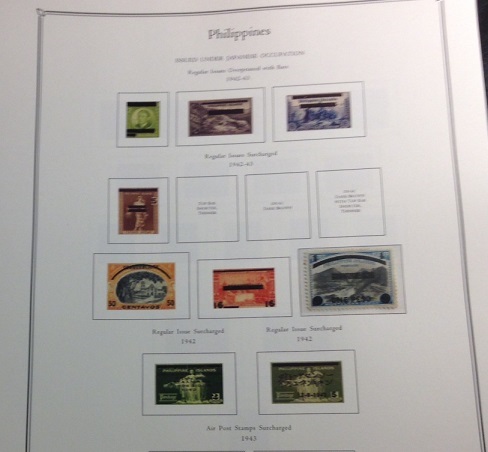
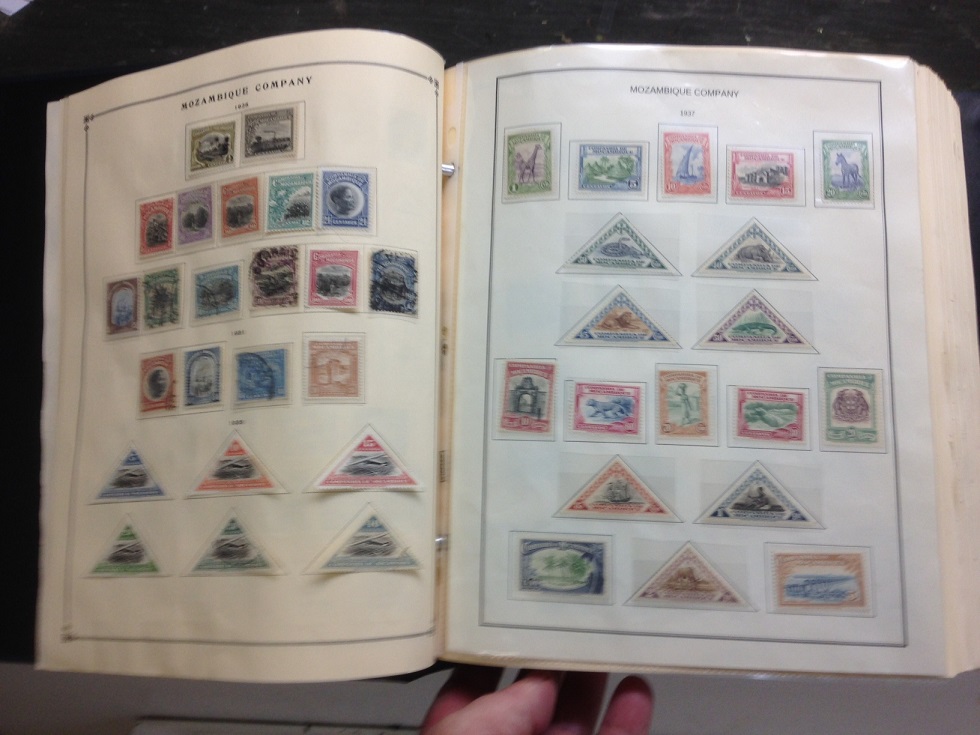
I think the Browns are a good choice for classical era WW collectors.

Be aware, though, that the stamp descriptions are fossilized (old Scott catalogue descriptions) compared to the Steiner (modern Scott catalogue descriptions).

From my "Big Blue, the "Browns", and Steiner: A three album shootout"that compares coverage of the 1867-1906 "Sphinx and Pyramid"issues of Egypt.....
http://bigblue1840-1940.blogspot.co...e-album.htmlThe "Browns"
http://www.subwaystamp.com/My International Postage Stamp Nineteenth Century Album states:
"Contains spaces for every principal variety of Postage Stamp issued by any Government in the World during the Nineteenth Century"
And yes, the album cover is "brown", hence the affectionate name these volumes are known by. The complete set by Scott came in five volumes, the last for the years 1934-1938 +/-. Sometime after Scott sold the rights to these albums, a sixth volume was produced bringing the coverage up to 1940. Presently, they can be purchased on good paper printed on one side at Subway Stamp Shop Inc.
A complete set of the "Browns" will take up some shelf space, specifically 12-19 binders. Big Blue clearly wins that argument. Nevertheless, linking oneself to the great collectors of the past who used the "Browns" is hard to resist. :-)
The first issue: 1867 "Sphinx and Pyramid"The first issue, with the Sphinx placed directly in front of the Pyramid, was issued as a 5pa orange ($10+), 10pa lilac($10+), 20pa yellow green($10+), 1pi rose red($1+), 2pi blue($10+), and 5pi brown($200+).
The first five denominations are modestly priced for classics.
The "Browns"Naturally, the "Browns" offer a space for the entire series. So far, so good. But the description for the 20pa yellow green is "green" in the "Browns". This again highlights a problem. Based on the copyright of the Album (1919 for the Nineteenth Century album, 1939 for the Fifth volume), the Scott descriptions are
fossilized.
Yes reading the descriptions means you are reading a Scott 1919 catalogue! Naturally descriptions change. My 1947 catalogue describes the 20pa stamp (major number) as "blue green" with the minor number "a" given to "yellow green". Notice that the descriptions had already changed by 1947. Today (2011), the catalogue describes the major number as "yellow green", while the minor number "a" has "blue-green". So descriptions change, stamps drop out (Colombian States-City of Cucuta anyone?), and stamps drop in ( Five blank page coverage by the 19th Century "Brown" for the Indian Native Feudatory States, while Steiner has 131 page coverage in total). Big Blue has a similar, albeit not as severe of a problem, as their descriptions were fossilized in the 1940s-1960s.
So for the "Browns", one will need to interpret the 2011 catalogue through a 1919 catalogue lens. Not impossible, but a challenge nevertheless.





 Posted 12/10/2015 3:46 pm