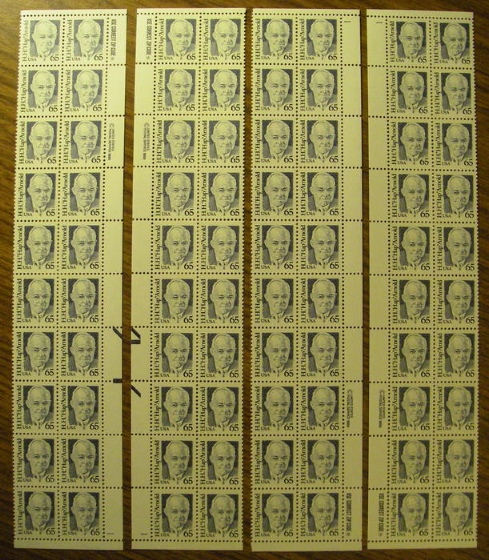
I'm curious about sheets produced on the BEP A Press, like the one in this image:
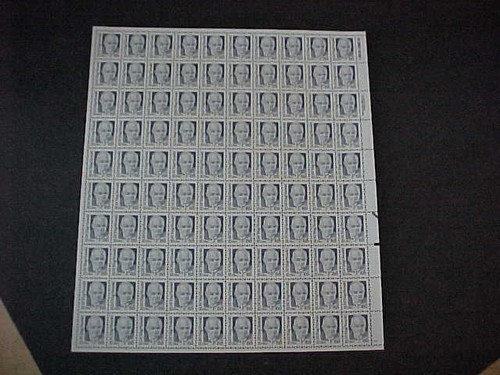
I don't have a sheet of my own to copy and this was the best I could find to grab off
ebay. I think it sufficient for the questions I have.
The plate number '1' is in the lower right corner. This stamp has four plate blocks described in Durland as "UL UR LL LR". Does that also mean that before cutting into sheets, that there would have been four 100 stamp panes, of which the one shown was the pane from the lower right quadrant of the four? Or would this pane actually be from the
lower left quadrant, with the plate numbers and selvage markings actually passing through the middle of the four panes? I'm presuming -- please correct me if I am wrong -- that the markings along the fourth row from the bottom are for aligning the sheets for perforation.
Linn's 1988 Yearbook for this stamp describes the format further as "Printing sleeve of 800 subjects (20 across, 40 around)." I think I understand that, in which case there would be 2 sets of "UL UR LL LR" blocks per sleeve. Does that sound right?
Is "sleeve" here comparable to what today is called a "press sheet?" Were such sleeves ever sold to collectors as such, the way modern press sheets are now sometimes sold?
Finally, a sleeve would consist of 8 panes. This is a common definitive, and I assume others were produced in similar fashion. Would anyone know of a source that would depict, either by photograph, or a sketch, of what a sleeve/sheet of these 8 panes would look like?
TIA for helping me out with this. Any standard references for further reading about this would also be appreciated.





 Posted 02/08/2016 08:45 am